Discussion
Loading...

#Tag

Log in
  • About
  • Code of conduct
  • Privacy
  • Users
  • Instances
  • About Bonfire
hypebot boosted
Wikipedia
Wikipedia
@wikipedia@wikis.world  ·  activity timestamp 3 weeks ago

#OnThisDay in #1612 #Galileo Galilei became the first person to observe the #planet #Neptune, although he mistakenly catalogued it as a fixed star.

🪐 https://en.wikipedia.org/wiki/Neptune

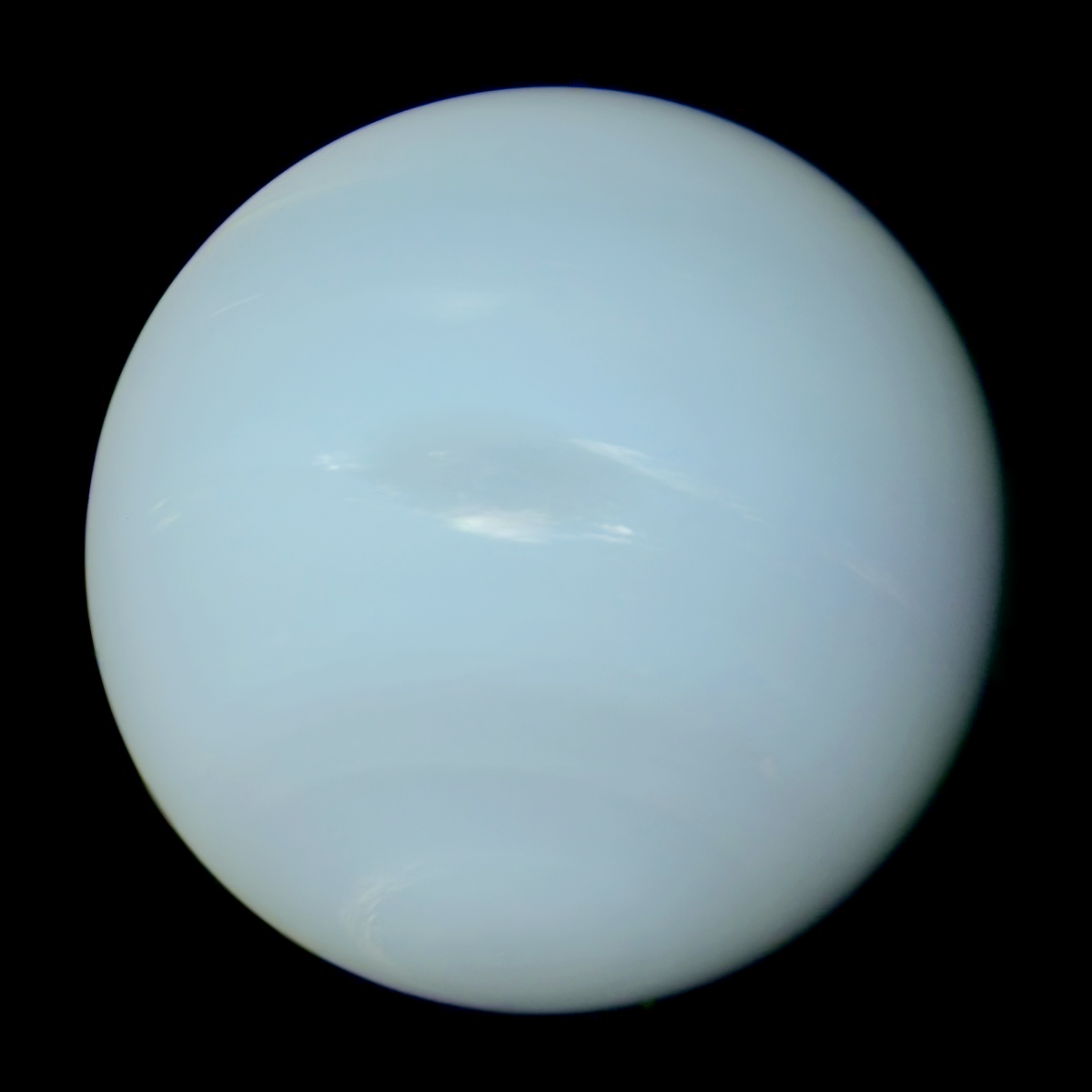
Neptune on 1989-08-17, taken by NASA's Voyager 2 probe. This color image was composed of three frames, orange, green, and blue, taken by Voyager 2's imaging system. This color image has been calibrated to best represent Neptune's true color and appearance (Source: NASA / Voyager 2 / PDS / OPUS / Ardenau4)

Neptune - Wikipedia

  • Copy link
  • Flag this post
  • Block
Wikipedia
Wikipedia
@wikipedia@wikis.world  ·  activity timestamp 3 weeks ago

#OnThisDay in #1612 #Galileo Galilei became the first person to observe the #planet #Neptune, although he mistakenly catalogued it as a fixed star.

🪐 https://en.wikipedia.org/wiki/Neptune

Neptune on 1989-08-17, taken by NASA's Voyager 2 probe. This color image was composed of three frames, orange, green, and blue, taken by Voyager 2's imaging system. This color image has been calibrated to best represent Neptune's true color and appearance (Source: NASA / Voyager 2 / PDS / OPUS / Ardenau4)

Neptune - Wikipedia

  • Copy link
  • Flag this post
  • Block
Prof. Sam Lawler boosted
Andrea Luck
Andrea Luck
@andrealuck@fosstodon.org  ·  activity timestamp last month

2/2 🧵

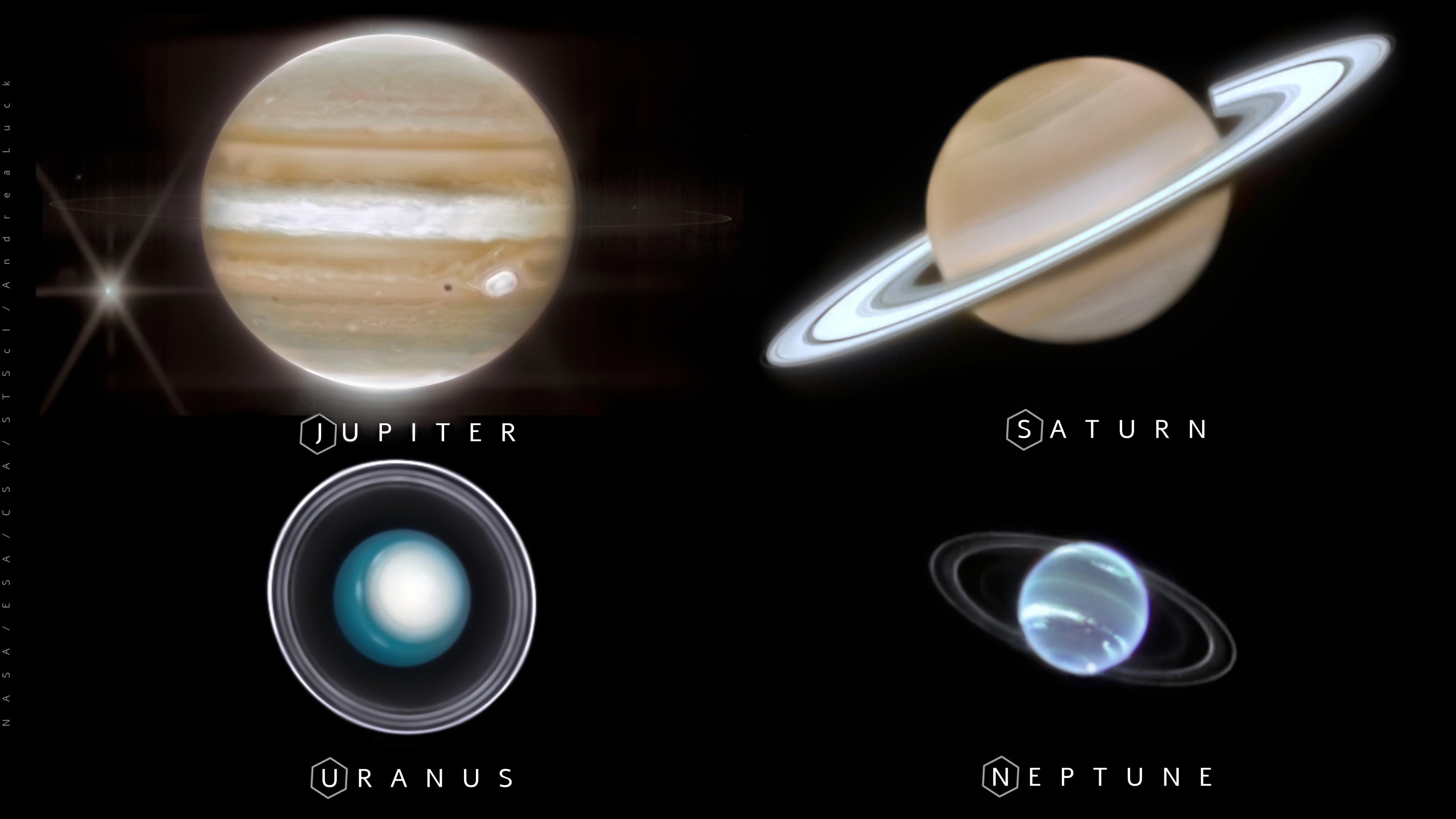
The Outer Giant Planets by JWST - My final version

Full size image & all info: https://flic.kr/p/2oUkYSY 🧪🔭
Credit: NASA/ESA/CSA/STScI/AndreaLuck

#Space #Astronomy #JWST #Jupiter #ESA #NASA #Astrodon #Solarocks #Neptune #Uranus #Saturn

The image is divided into four sections, each showing one of the gas giants against a black background as seen by JWST. Filters are near infrared and have been colorised.

Top left: Jupiter. It appears as a large, round sphere with horizontal bands in shades of light brown, tan, and white. A bright white oval storm sits on the lower right side. A faint ring is visible alongside Europa, one of its satellites, which appears very bright with a star-shaped artifact.

Top right: Saturn. It has a pale beige surface with soft horizontal shading. Surrounding it is a wide, bright ring system tilted diagonally. The rings look thin and sharply defined, with multiple subtle bands of light and dark.

Bottom left: Uranus. It appears as a smooth blue-green sphere with some whitish circular clouds around the pole that is facing the observer. Surrounding it is a bright circular ring system made up of thin white lines. The rings form a bright, symmetrical halo around the planet.

Bottom right: Neptune. It is a blue sphere with slightly brighter and darker circular features on its atmosphere. It also has a thin ring system, dimmer and less defined than Uranus’s in this image, appearing as a faint double oval around the planet.

Each planet has its name printed below it in white capital letters.
The image is divided into four sections, each showing one of the gas giants against a black background as seen by JWST. Filters are near infrared and have been colorised. Top left: Jupiter. It appears as a large, round sphere with horizontal bands in shades of light brown, tan, and white. A bright white oval storm sits on the lower right side. A faint ring is visible alongside Europa, one of its satellites, which appears very bright with a star-shaped artifact. Top right: Saturn. It has a pale beige surface with soft horizontal shading. Surrounding it is a wide, bright ring system tilted diagonally. The rings look thin and sharply defined, with multiple subtle bands of light and dark. Bottom left: Uranus. It appears as a smooth blue-green sphere with some whitish circular clouds around the pole that is facing the observer. Surrounding it is a bright circular ring system made up of thin white lines. The rings form a bright, symmetrical halo around the planet. Bottom right: Neptune. It is a blue sphere with slightly brighter and darker circular features on its atmosphere. It also has a thin ring system, dimmer and less defined than Uranus’s in this image, appearing as a faint double oval around the planet. Each planet has its name printed below it in white capital letters.

  • Copy link
  • Flag this post
  • Block
Andrea Luck
Andrea Luck
@andrealuck@fosstodon.org  ·  activity timestamp last month

2/2 🧵

The Outer Giant Planets by JWST - My final version

Full size image & all info: https://flic.kr/p/2oUkYSY 🧪🔭
Credit: NASA/ESA/CSA/STScI/AndreaLuck

#Space #Astronomy #JWST #Jupiter #ESA #NASA #Astrodon #Solarocks #Neptune #Uranus #Saturn

The image is divided into four sections, each showing one of the gas giants against a black background as seen by JWST. Filters are near infrared and have been colorised.

Top left: Jupiter. It appears as a large, round sphere with horizontal bands in shades of light brown, tan, and white. A bright white oval storm sits on the lower right side. A faint ring is visible alongside Europa, one of its satellites, which appears very bright with a star-shaped artifact.

Top right: Saturn. It has a pale beige surface with soft horizontal shading. Surrounding it is a wide, bright ring system tilted diagonally. The rings look thin and sharply defined, with multiple subtle bands of light and dark.

Bottom left: Uranus. It appears as a smooth blue-green sphere with some whitish circular clouds around the pole that is facing the observer. Surrounding it is a bright circular ring system made up of thin white lines. The rings form a bright, symmetrical halo around the planet.

Bottom right: Neptune. It is a blue sphere with slightly brighter and darker circular features on its atmosphere. It also has a thin ring system, dimmer and less defined than Uranus’s in this image, appearing as a faint double oval around the planet.

Each planet has its name printed below it in white capital letters.
The image is divided into four sections, each showing one of the gas giants against a black background as seen by JWST. Filters are near infrared and have been colorised. Top left: Jupiter. It appears as a large, round sphere with horizontal bands in shades of light brown, tan, and white. A bright white oval storm sits on the lower right side. A faint ring is visible alongside Europa, one of its satellites, which appears very bright with a star-shaped artifact. Top right: Saturn. It has a pale beige surface with soft horizontal shading. Surrounding it is a wide, bright ring system tilted diagonally. The rings look thin and sharply defined, with multiple subtle bands of light and dark. Bottom left: Uranus. It appears as a smooth blue-green sphere with some whitish circular clouds around the pole that is facing the observer. Surrounding it is a bright circular ring system made up of thin white lines. The rings form a bright, symmetrical halo around the planet. Bottom right: Neptune. It is a blue sphere with slightly brighter and darker circular features on its atmosphere. It also has a thin ring system, dimmer and less defined than Uranus’s in this image, appearing as a faint double oval around the planet. Each planet has its name printed below it in white capital letters.

  • Copy link
  • Flag this post
  • Block
Daniel Appelquist boosted
Natasha 🇪🇺
Natasha 🇪🇺
@Natasha_Jay@tech.lgbt  ·  activity timestamp 3 months ago

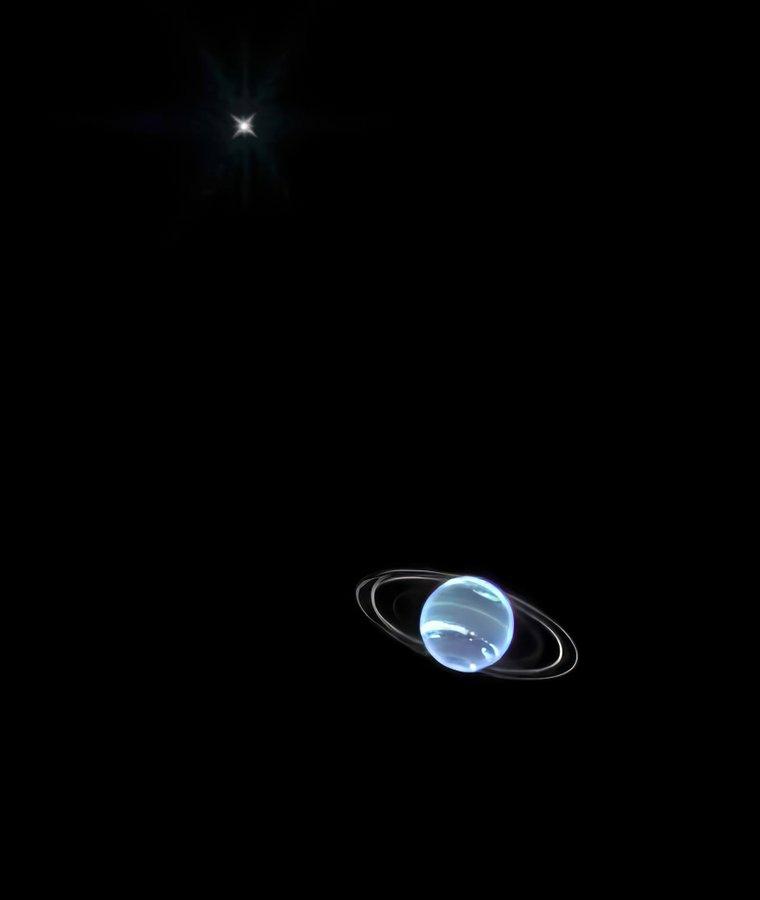
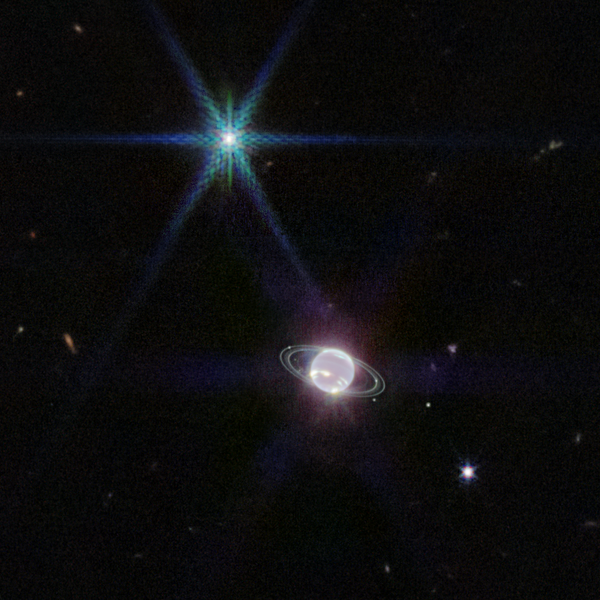
Neptune, its ring system, and its moon Triton in a frame from the James Webb telescope 🔭

2.68 billion miles from Earth

https://science.nasa.gov/missions/webb/new-webb-image-captures-clearest-view-of-neptunes-rings-in-decades/

Credit: NASA/ESA/CSA/STScI/reprocessed Andrea Luck

#Astronomy #NASA #neptune #Space

A processed view of the planet Neptune shining brightly in pale blue with two clear rings and it's moon Triton in a dark black sky
NASA Science

New Webb Image Captures Clearest View of Neptune’s Rings in Decades

NASA’s James Webb Space Telescope shows off its capabilities closer to home with its first image of Neptune. Not only has Webb captured the clearest view of
  • Copy link
  • Flag this post
  • Block
Natasha 🇪🇺
Natasha 🇪🇺
@Natasha_Jay@tech.lgbt  ·  activity timestamp 3 months ago

Neptune, its ring system, and its moon Triton in a frame from the James Webb telescope 🔭

2.68 billion miles from Earth

https://science.nasa.gov/missions/webb/new-webb-image-captures-clearest-view-of-neptunes-rings-in-decades/

Credit: NASA/ESA/CSA/STScI/reprocessed Andrea Luck

#Astronomy #NASA #neptune #Space

A processed view of the planet Neptune shining brightly in pale blue with two clear rings and it's moon Triton in a dark black sky
NASA Science

New Webb Image Captures Clearest View of Neptune’s Rings in Decades

NASA’s James Webb Space Telescope shows off its capabilities closer to home with its first image of Neptune. Not only has Webb captured the clearest view of
  • Copy link
  • Flag this post
  • Block
jbz
jbz
@jbz@indieweb.social  ·  activity timestamp 6 months ago

🔭 Astronomers Discover Rare Distant Object in Sync with Neptune • Harvard & Smithsonian

「 The tilt of 2020 VN40's orbit means that the objects are not actually close, because 2020 VN40 is actually far below the solar system- they only appear close when flattened onto a map. All other known resonant trans-Neptunian objects orbit such that they avoid this alignment at their closest approach to the sun, even in the flattened view 」

https://pweb.cfa.harvard.edu/news/astronomers-discover-rare-distant-object-sync-neptune

#neptune #astronomy #science

  • Copy link
  • Flag this post
  • Block

bonfire.cafe

A space for Bonfire maintainers and contributors to communicate

bonfire.cafe: About · Code of conduct · Privacy · Users · Instances
Bonfire social · 1.0.1-beta.35 no JS en
Automatic federation enabled
Log in
  • Explore
  • About
  • Members
  • Code of Conduct