Discussion
Loading...

Post

Log in
  • About
  • Code of conduct
  • Privacy
  • Users
  • Instances
  • About Bonfire
Andrea Luck
Andrea Luck
@andrealuck@fosstodon.org  路  activity timestamp last month

2/2 馃У

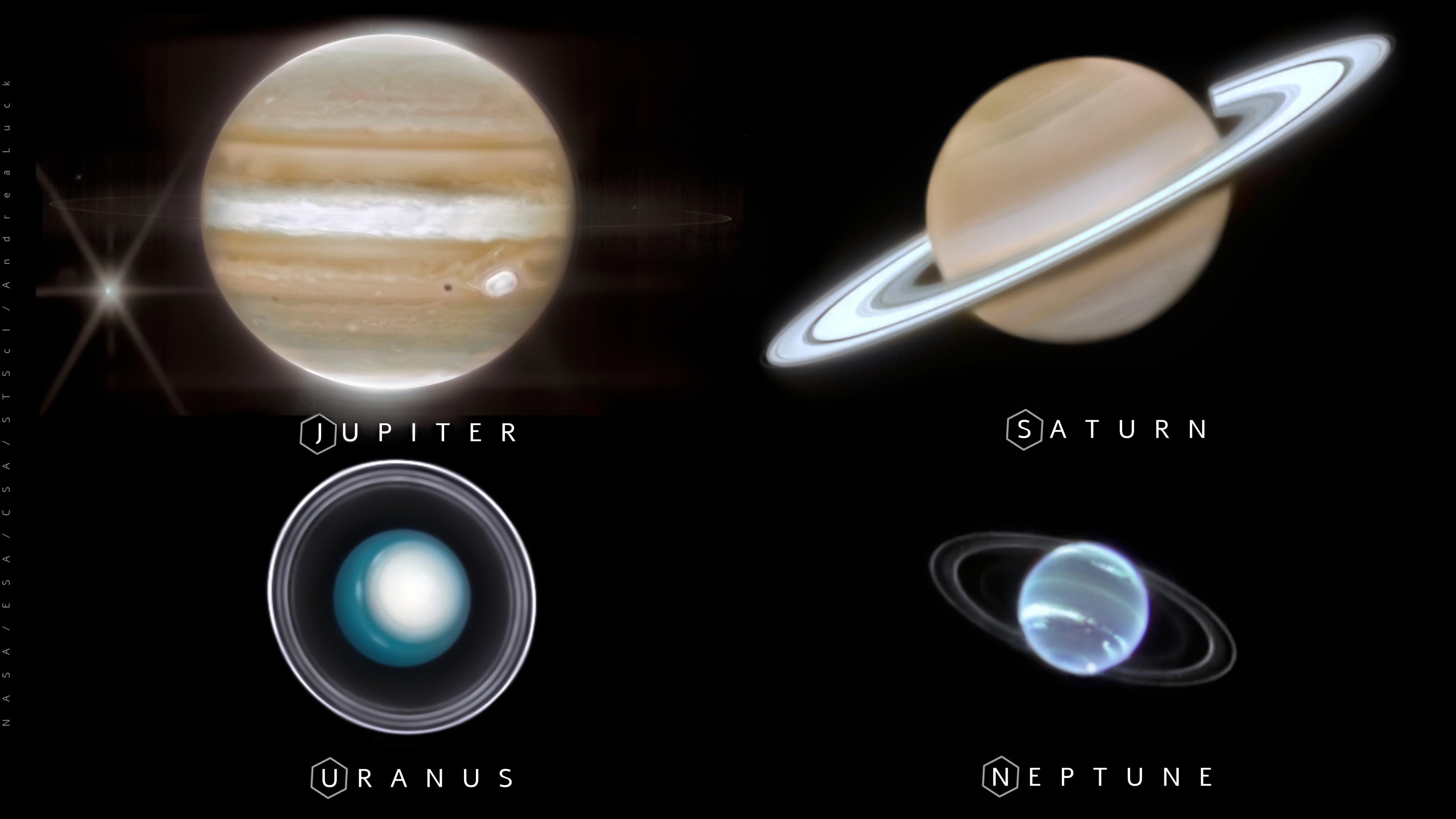
The Outer Giant Planets by JWST - My final version

Full size image & all info: https://flic.kr/p/2oUkYSY 馃И馃敪
Credit: NASA/ESA/CSA/STScI/AndreaLuck

#Space #Astronomy #JWST #Jupiter #ESA #NASA #Astrodon #Solarocks #Neptune #Uranus #Saturn

The image is divided into four sections, each showing one of the gas giants against a black background as seen by JWST. Filters are near infrared and have been colorised.

Top left: Jupiter. It appears as a large, round sphere with horizontal bands in shades of light brown, tan, and white. A bright white oval storm sits on the lower right side. A faint ring is visible alongside Europa, one of its satellites, which appears very bright with a star-shaped artifact.

Top right: Saturn. It has a pale beige surface with soft horizontal shading. Surrounding it is a wide, bright ring system tilted diagonally. The rings look thin and sharply defined, with multiple subtle bands of light and dark.

Bottom left: Uranus. It appears as a smooth blue-green sphere with some whitish circular clouds around the pole that is facing the observer. Surrounding it is a bright circular ring system made up of thin white lines. The rings form a bright, symmetrical halo around the planet.

Bottom right: Neptune. It is a blue sphere with slightly brighter and darker circular features on its atmosphere. It also has a thin ring system, dimmer and less defined than Uranus鈥檚 in this image, appearing as a faint double oval around the planet.

Each planet has its name printed below it in white capital letters.

The image is divided into four sections, each showing one of the gas giants against a black background as seen by JWST. Filters are near infrared and have been colorised. Top left: Jupiter. It appears as a large, round sphere with horizontal bands in shades of light brown, tan, and white. A bright white oval storm sits on the lower right side. A faint ring is visible alongside Europa, one of its satellites, which appears very bright with a star-shaped artifact. Top right: Saturn. It has a pale beige surface with soft horizontal shading. Surrounding it is a wide, bright ring system tilted diagonally. The rings look thin and sharply defined, with multiple subtle bands of light and dark. Bottom left: Uranus. It appears as a smooth blue-green sphere with some whitish circular clouds around the pole that is facing the observer. Surrounding it is a bright circular ring system made up of thin white lines. The rings form a bright, symmetrical halo around the planet. Bottom right: Neptune. It is a blue sphere with slightly brighter and darker circular features on its atmosphere. It also has a thin ring system, dimmer and less defined than Uranus鈥檚 in this image, appearing as a faint double oval around the planet. Each planet has its name printed below it in white capital letters.
  • Copy link
  • Flag this post
  • Block

bonfire.cafe

A space for Bonfire maintainers and contributors to communicate

bonfire.cafe: About 路 Code of conduct 路 Privacy 路 Users 路 Instances
Bonfire social 路 1.0.1-beta.35 no JS en
Automatic federation enabled
Log in
  • Explore
  • About
  • Members
  • Code of Conduct