

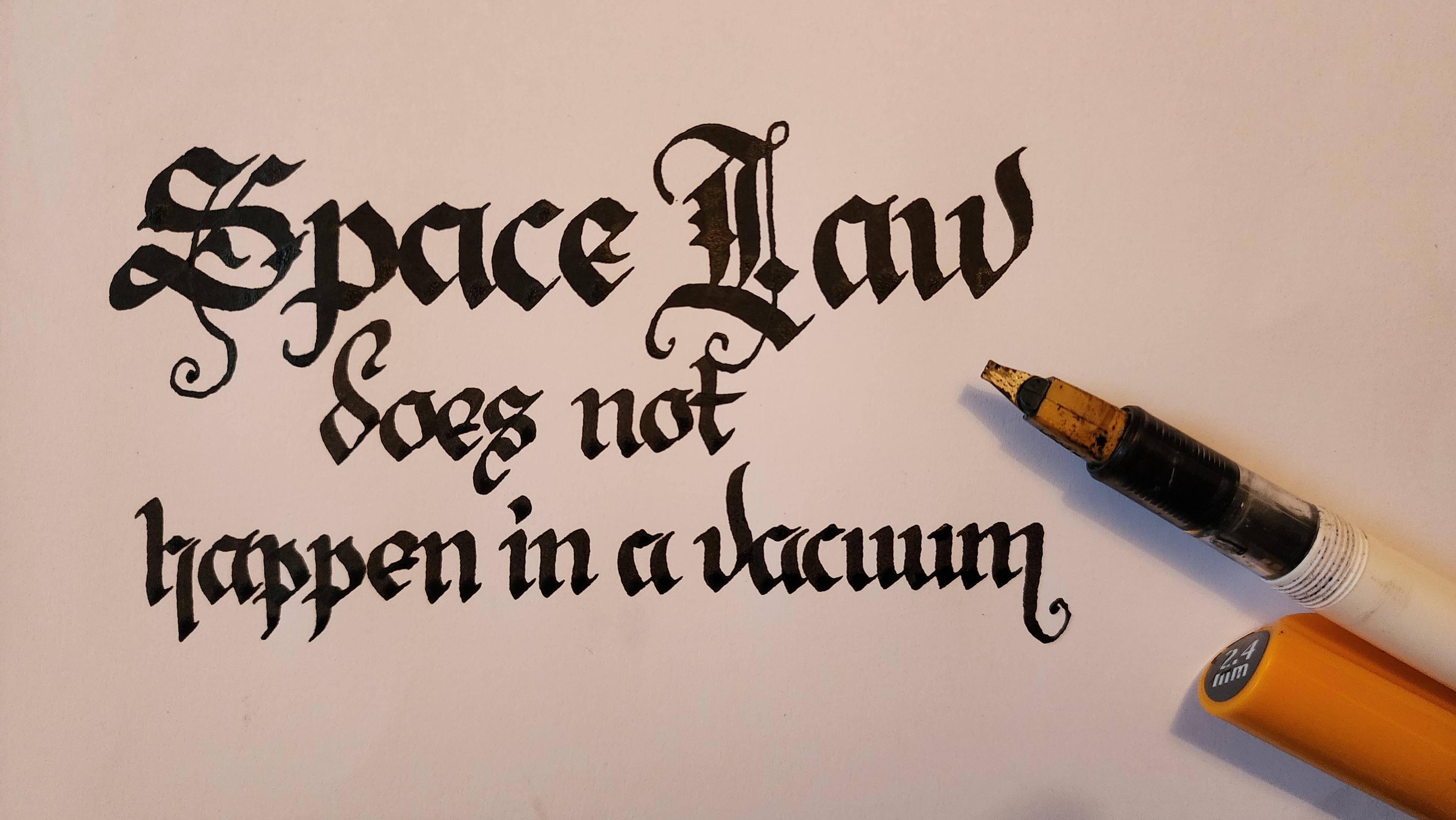
Funny out of context quote from a meeting earlier today: "Space law does not happen in a vacuum"
@Federation_Bot

Is it a day that ends in Y again? New perfect 10s just dropped 
CVE-2026-50242 - https://www.cve.org/CVERecord?id=CVE-2026-50242

AI puts up a glass ceiling for women. AI is actively holding you back as a woman. (And possibly as a Black person too.)
https://youtu.be/PhJxbbhSU-Y
#AI #sexism #misogyny #work #jobsearch #resume

Quando installo una distribuzione Linux amo costruire un ambiente grafico su misura, dando vita a quello che mi piace definire Desktop From Scratch.
Come e perché, nel nuovo articolo, che punto a trasformare in una rubrica; online ora su DajeLinux.
https://dajelinux.it/archivio/zero-desktop/
@linux @opensource @linux@diggita.com @gnulinuxitalia
#linux #unolinux #gnulinux #opensource #foss #desktop #FromScratch #hyprland #niri #server #archlinux #CachyOS #ricing

Concerned About Data Centers in Your Area? Erin Brockovich Just Built a Free Tracker
https://www.yahoo.com/news/us/articles/concerned-data-centers-area-erin-120028033.html?utm_source=flipboard&utm_medium=activitypub
Posted into NEWS "THE WORLD" @news-the-world-ARTJose


So. For the past few days I've been deep in a fun and very rewarding, but also extremely scary debugging saga. To cut a long git-bisecting story short:
Since Linux 6.9 (May 2024), the tool that locks the laptop's drive on suspend had been silently failing.
Like many of my friends, I use full-disk encryption (LUKS) to protect my data if my laptop is lost, seized or stolen. Highly recommended to everyone; in combination with tested and automated backups, it contributes greatly to peace of mind. (Under Windows, the canonical software to do that is VeraCrypt.)
Except that, for more than two years, the encryption key remained resident in memory across suspend, leaving it there for the taking by anyone who seized the still-powered laptop. (It still worked on a full shutdown, but a full shutdown is rare these days.)
There is something uniquely unsettling about trusting a security mechanism for years and learning it was never doing the thing. "A technical argument by a trusted author, which is hard to check and looks similar to arguments known to be correct, is hardly ever checked in detail." The same, it seems, is true for computer code.
The culprit was a sensible and useful refactoring, https://git.kernel.org/pub/scm/linux/kernel/git/torvalds/linux.git/commit/?id=a28d893eb3270cf62c10dd8777af0d8452cdc072. But it had an unexpected long-range interaction with the encryption code. The fix is exactly one line long: https://lore.kernel.org/all/ajKwRtP8izwRsMmv@quasitopos/ And no, without formal proofs I cannot say whether my patch is correct and free of its own long-range interactions... At the very least, we now have an automated test to detect future regressions (https://github.com/NixOS/nixpkgs/pull/532499) and a patch to emit a warning instead of failing silently (https://gitlab.com/cryptsetup/cryptsetup/-/merge_requests/936).

And here is an indigenous viewpoint from the Arctic:
https://policylabs.frontiersin.org/content/policy-outlook-geoengineering-inuit-homelands
https://fediscience.org/@Ruth_Mottram/116769466126905589
Ruth_Mottram - Flurry of articles, including in the Guardian on the very well funded but seriously misguided efforts to geoengineer the Arctic by growing sea ice, reminds me that it is probably time to report our critical article on the subject..
https://www.frontiersin.org/journals/science/articles/10.3389/fsci.2025.1527393/full
Vom Fleischfresser zur Blütenfreundin: die Bienen-Evolution
Das Onlinemagazin RiffReporter, zu dem AstroGeo gehört, braucht eure Hilfe: Hier gehts zum laufenden Crowdfunding.
Manchmal landeten Insekten auf dem frisch ausgeflossenen Harz eines Baumes, klebten fest und wurden schließlich von dem Harz eingeschlossen. Dieses Harz wurde später Teil des Bodens und des Sediments und schließlich zu einem durchscheinenden Stein – dem Bernstein. Mit viel Glück findet viele Tausend oder Millionen Jahre später ein Mensch den Bernstein mit dem Insekt […]
 Karl UrbanAutor


 Franziska KonitzerModeratorin
Das Onlinemagazin RiffReporter, zu dem AstroGeo gehört, braucht eure Hilfe: Hier gehts zum laufenden Crowdfunding.
Manchmal landeten Insekten auf dem frisch ausgeflossenen Harz eines Baumes, klebten fest und wurden schließlich von dem Harz eingeschlossen. Dieses Harz wurde später Teil des Bodens und des Sediments und schließlich zu einem durchscheinenden Stein – dem Bernstein. Mit viel Glück findet viele Tausend oder Millionen Jahre später ein Mensch den Bernstein mit dem Insekt darin.
Was nach dem Stoff für eine bekannte Science Fiction-Filmserie klingt, ist zumindest im Ansatz Realität: Karl erzählt in dieser Folge nicht etwa von eingeschlossen Stechmücken mit Dinosaurier-DNA, sondern von Insekten, die uns deutlich sympathischer sind. Es geht um die Bienen: wer ihre Vorfahren waren, wann in der Erdgeschichte sie sich entwickelten und wieso sie zu dem wurden, was sie heute sind. Wir schätzen sie als wichtige Bestäuber von Blütenpflanzen, züchten die europäische Honigbiene, lassen uns ihren Honig schmecken. Dabei sind Bienen eine extrem diverse Tiergruppe, die als Einzelgänger oder in riesigen sozialen Völkern lebt.
Insektenforscher sind froh über fossilisierte Insekten, ob in Bernstein oder eingebettet in Tonstein. Dank ihnen wissen sie: Bienen entstanden aus fleischfressenden Vierflüglern, die eher den heutigen Grabwespen ähnelten. Zu Beginn der Kreidezeit tauchten dann die ersten Blütenpflanzen auf, die sich quasi zeitgleich mit den ersten Bienenarten über die Welt ausbreiteten. Bienchen und Blümchen beeinflussten sich dabei gegenseitig. Schon am Ende der Kreidezeit vor 66 Millionen Jahren hatten Blütenpflanzen die Kontinente erobert – und mit ihnen die Bienen.
Es geht in dieser Folge um wild lebende Bienen, um Solitärbienen und um Hummeln. Auch die europäische Honigbiene gehört dazu: Sie ist zwar heute ein weitgehend domestiziertes Tier, das von Imkern gehalten, versorgt oder gegen Krankheiten oder Parasiten behandelt wird. Wild lebend kommt es in unseren Breiten kaum noch vor. Uns Menschen ist sie nah und nützlich. Wir verwenden die Honighbiene als Covergirl für Naturschutzbroschüren oder Wahlplakate, was nicht immer gerechtfertigt ist. Zurecht geschätzt wird sie als wichtige Bestäuberin in der Kulturlandschaft.
Mehr bei AstroGeo
- Folge 119: Erstarrte Momente: Tödliche Spuren, Wassergeburt und Dinopipi
- Folge 104: Riffsterben und Klimachaos im Devon: Sind die Bäume schuld?
- Folge 89: Ninjas der Nacht: Die Entwicklung der Säugetiere
- Folge 86: Das Ende der Dinosaurier: Massensterben im Frühling
- Folge 64: Massensterben im Treibhaus
Weiterführende Links
- WP: Entomologie
- WP: Randecker Maar
- WP: Miozän
- WP: Bernstein
- WP: Europäische Honigbiene
- WP: Eusozialität
- WP: Echte Bienen
- WP: Hautflügler
- WP: Stechimmen
- WP: Grabwespen
- WP: Metamorphose (Zoologie)
- WP: Koevolution
- WP: Stachellose Bienen
- WP: Nektar
- WP: Pollenhöschen
- Museum of the Earth: Evolution & Fossil Record of Bees
- BUND: Wildbienen-Arten in Deutschland
- Crowdfunding der RiffReporter
Quellen
- Fachartikel: C. Jouault: The radiation of Hymenoptera illuminated by Bayesian inferences from the fossil record, Current Biology (2025)
- Fachartikel: F. Berendse & M. Scheffer: The angiosperm radiation revisited, an ecological explanation for Darwin’s abominable mystery (2009)
Episodenbild: Biene Anthidiellum perplexum aus Nordamerika public domain, Sara Guerrieri, USGS
2 media

22 more link(s)
Brasileira de 21 anos é campeã do mundial de Candy Crush
https://www.adrenaline.com.br/games/e-sport/brasileira-de-21-anos-e-campea-do-mundial-de-candy-crush/?utm_source=flipboard&utm_medium=activitypub
Posted into Adrenaline @adrenaline-Adrenalinebr



Hi everyone I was wondering if someone could explain SMTP to me? Thanks!!!!
@cwebber first you connect to your server and say HELO, it's very important to politely greet it. then you say who you are, and who you want to talk to, then you deposit your message, then you finish with a cr/lf then a period, then another cr/lf.
The best Apple deals you can already get ahead of Prime Day
https://www.theverge.com/gadgets/949350/amazon-prime-day-sale-best-apple-deals-2026?utm_source=flipboard&utm_medium=activitypub
Posted into Tech News @tech-news-theverge

LinkedIn will tell others how you really use Adobe’s apps
https://www.theverge.com/tech/951291/linkedin-connected-apps-ai-summary-verification?utm_source=flipboard&utm_medium=activitypub
Posted into Tech News @tech-news-theverge
Dendrites are what machine learning is missing. (And inhibitory neurons, but hey, one at a time.)
"What can a neuron compute", by Ido Aizenbud, David Beniaguev, Noam Pnueli, Idan Segev, Michael London, 2026
https://www.biorxiv.org/content/10.64898/2026.06.08.730984v1
All about dendrites. Extending prior work by Beniaguev et al. 2021 and Jones and Kording 2021.
Topping 1930: Victoria breaks daily heat records 2 days running
https://saanichnews.com/2026/06/16/topping-1930-victoria-breaks-daily-heat-records-2-days-running/?utm_source=flipboard&utm_medium=activitypub
Posted into Saanich @saanich-BlackPressMedia

Comcast Xfinity adds same-day delivery to get you online immediately
https://www.theverge.com/tech/950537/comcast-xfinity-same-day-router-delivery-availability-launch?utm_source=flipboard&utm_medium=activitypub
Posted into Tech News @tech-news-theverge

Today I actually feel some hope for the world for the first time in a long time: from the office of the UN Special Rapporteur on extreme poverty and human rights comes The Roadmap for Eradicating Poverty Beyond Growth - and it's ... really good.
Is it perfect? No, but the authors stress that it is a living document that continues to be researched, and we all know at this point that letting perfect be the enemy of the good is a sure-fire strategy for nothing to ever change.
It is by necessity complex, because the challenges are complex, but it is clear, and it is coherent, and it presents actual concrete solutions, and concrete steps to achieving them.
It understands structural systems, and intersectionality, and it recognises lived experiences as opposed to think-tank suppositions, and deftly translates them into actionable policy responses.
It is kind, and it has been developed by people who clearly genuinely give a shit.
And, unusually, it is ambitious at a scale commensurate to the problem - it doesn't pick at the edges of one or two of the challenges we're confronted with, it goes at all of them wholesale, in all their tangled interconnectedness, recognising that systems-level change is imperative, and also frames that change as achievable. Which it is.
It is also long, at 139 dense pages, but honestly worth reading in its entirety.
I'm feeling a profound sense of possibility and relief at having an actual articulated thing to be able to point to and say, "oh excellent, let's try doing that".
Our Topics editors have created Flipboard topics for every #WorldCup team, from Algeria to Uzbekistan, plus topics for host cities and the whole tournament. Search the app or flipboard.com to find the country or countries you're rooting for.


New Drystone Diary: Whose History Is Worth Knowing? From Great Zimbabwe to Sacsayhuamán to the famine walls of the Scottish Highlands. Who gets recognised and who gets erased was, and still is, a story told by the same people about the same people.
https://kristiedegaris.substack.com/p/drystone-diary-history-worth-knowing
#DrystoneDiary #History #Nature #World #Scotland #Writing #Craft
@kristiedegaris So much important (and fascinating) history lost or hidden this way.
The Beinn Dearg wall runs above my family's old farm at Auchindrean, and I suspect the famine in question was what drove them to leave for the US. They had already been forced off the farm at that point, and much of the family had fled to Nova Scotia years previous. I've read their letters, complaining of predatory ship captains demanding to strip them of all their remaining assets in exchange for (un)safe passage to a chance of a life, and can't help but think of folk who may be in comparable straits across the channel today.
On the erasure of African history, another branch of my family had lived in Nigeria for a time and I encountered what seemed a particularly egregious example in studying the history of that place. The remarkable 15th century head sculptures found at Ife were initially claimed as evidence of the discovery of Atlantis by the first Westerner to excavate one in the 20th century. This despite the neighbouring Kingdom of Benin having had a tradition of making impressive sculptures using comparable techniques stretching back hundreds of years, and lasting right up to its destruction by the British less than 15 years prior to the first Ife find. The history being ignored here was virtually the present, and firmly in the photographic era. (There will be folk here much better versed in Nigerian history than I am - corrections welcome!)
I knew a little of Great Zimbabwe* and Sacsayhuamán (amazing places), but most of the other sites were new to me. Naletale is spectacular!
I wondered what Nigeria might have in the way of dry stone traditions, and found this notable example:
https://museum.ng/sukur-cultural-landscape/
* I found Henry Louis Gates Jr's series Africa's Great Civilisations really interesting on Great Zimbabwe and other such places often overlooked/ignored in Western histories
Thanks for another thought-provoking post, and hope you'll excuse the essay reply
Quando diachos o #mastodon vai ter formatação de texto en markdown? 
@fediverse @tecnologia @academicos @internet (pode seguir para acompanhar os assuntos ou marcar para amplificar a postagem até no #lemmy tb)

Meine Meinung: Gedenkreden, Trauerreden & Trauzeugenreden per KI zu generieren & als vermeintlicher Ausdruck eigener Gefühle vorzutragen ist einfach schlechter Stil. Das gehört sich nicht. Sich Zeit zu nehmen, um nachzudenken & eigene Worte zu finden, war hier schon immer zentraler Teil der Aufgabe.
