

Public Interest Social Networks
Bonfire is built by communities, for communities. Rooted in autonomy, mutual care, and collective power. Co-create your tools, reclaim your data, and resist manipulation by shaping your own federated digital spaces.
Previously at @bonfire@indieweb.social
- Joined
- Website
- bonfirenetworks.org


@Bonfire When I tried to run the default Bonfire executables on my device, it crashed with a segfault, and investigating further it seems to be caused because my device lacks AVX instructions. Maybe there's some flag I can use to manually build without AVX support? I was using the version shipped by YunoHost: github.com/YunoHost-Apps/bonfi…
@csolisr@hub.azkware.net ah yeah it probably would have to built for (ideally on) your machine in this case
Terrible moment to learn that #Bonfire, the up-and-coming #ActivityPub implementation, apparently has a hard dependency on #AVX instructions that my home server's chipset physically lacks. I'd have to spend upwards of $400 just to replace my server in order to test it, sigh... @Bonfire
@csolisr@hub.azkware.net Which dependency did you see on AVX? our markdown renderer for example uses it when available but has a fallback which should be enabled automatically when not available (otherwise you can force it with `MDEX_USE_LEGACY_ARTIFACTS=true`. In any case please provide more info or open a bug report.


watching the intro to @Bonfire Mosaic, its looking really good, and see they are making lots of progress with fediverse groups
https://videos.scanlines.xyz/w/hV9wzGzsXvNjgXtVg3uS2i
I really hope they don't introduce new handle semantics tho at I see from the demo they are using &groupname@instance.tld as opposed to !groupname@instance.tld that lemmy is already using and @groupname@instance.tld that most of the rest of the fediverse already supports to some extent
FediForum Demo: Bonfire Mosaic: co-designing federated groups and publisher tools with Jacobin DE & Totnes Pulse

@liaizon@social.wake.st those are just placeholders, our goal is maximum interoperability while also extending what is possible, and we're participating in the W3C groups task force to define how things should work, please weigh in there if you have any suggestions: github.com/swicg/groups/issues
Our @fediforum@mastodon.social demo is up! 🔥
We showed off Bonfire Mosaic and our ongoing work on federated groups and new publisher tools we’ve been co-designing with jacobin.de, including federated discussion threads that can be embedded on their existing website.
Built on our modular framework for community-governed digital spaces.
Watch 👉 spectra.video/w/hV9wzGzsXvNj...
FediForum Demo: Bonfire Mosaic: co-designing federated groups and publisher tools with Jacobin DE & Totnes Pulse
You can read more about our work on groups in this previous blog post: bonfirenetworks.org/posts/wh...
And if you're an #ActivityPub developer who's interested, please join the W3C task force discussions: github.com/swicg/groups/issues


@Bonfire @fediforum Hi there, any chance you will prohibit the use of #AI in code contributions?
Thanks for asking, it's something we're taking seriously. We're working on an AI policy for the project but want to do it thoughtfully and with care rather than rush something out, please bear with us.
Our @fediforum@mastodon.social demo is up! 🔥
We showed off Bonfire Mosaic and our ongoing work on federated groups and new publisher tools we’ve been co-designing with jacobin.de, including federated discussion threads that can be embedded on their existing website.
Built on our modular framework for community-governed digital spaces.
Watch 👉 spectra.video/w/hV9wzGzsXvNj...
FediForum Demo: Bonfire Mosaic: co-designing federated groups and publisher tools with Jacobin DE & Totnes Pulse
Bonfire
boosted

FediForum Demo: Bonfire Mosaic: co-designing federated groups and publisher tools with Jacobin DE & Totnes Pulse
Bonfire
boosted


👾 Ci siamo!
📯 Appuntamento a NINA Festival per il workshop
🔥 Attorno a Bonfire - framework open source federato
Creare spazi digitali federati, flessibili e orientati alla comunità
con @ivan, Zero81, Scift Lab, @reclaimthetech,
📍dove e quando
Sabato 9 maggio, alle 15.00
Millepiani - Via Nicolò Odero 13 - Roma
🔗 link per registrarsi (gratuito):
https://supporta.nina.watch/NINA/roma/19/
🧩 Aiutateci a diffondere coinvolgendo altri collettivi e comunità oltre Reclaim the Tech!



We are a little bit late to the party, but on the 1. May we celebrated #lauti's first anniversary 🥳.
This year was crazy, we got in touch with so many amazing people a long the way. We did our first talk at the #39c3 self organized session of @techfrombelow@chaos.social
We visited #fosdem with our friends from @Bonfire where they announced our collaboration working on #events in the #fediverse.
We are just getting started, SSO is around the corner and we are working on #activitypub at the moment.
For more updates take a look at our last blog post
lauti.org/blog/lauti-updates...
@lauti 🍻
Bonfire
boosted
We are a little bit late to the party, but on the 1. May we celebrated #lauti's first anniversary 🥳.
This year was crazy, we got in touch with so many amazing people a long the way. We did our first talk at the #39c3 self organized session of @techfrombelow@chaos.social
We visited #fosdem with our friends from @Bonfire where they announced our collaboration working on #events in the #fediverse.
We are just getting started, SSO is around the corner and we are working on #activitypub at the moment.
For more updates take a look at our last blog post
lauti.org/blog/lauti-updates...
Bonfire
boosted

The paper Governing Together: Toward Infrastructure for Community-Run Social Media by @s0hw@hci.social @andresmh@hci.social and colleagues at hci.princeton.edu (which we will discuss at #FediForum today) takes on a tension at the heart of decentralised social media. The fediverse promises to empower communities to govern themselves and set norms in their own context, on their own terms. But communities can't actually govern in isolation. Their members talk across boundaries, bad actors hop between servers, and the rules one community sets can directly undermine another's. The authors call these "governance frictions."
Their argument is that we've spent a lot of design effort looking inside communities, like improving moderation tools and onboarding, but almost none on what they call inter-community governance: the infrastructure that lets communities coordinate, share information, and manage their relationships with each other.
To explore what that infrastructure could look like, they ran four design workshops with 24 Fediverse admins, moderators, and developers. Participants imagined ideal tools, and the authors synthesized those ideas into six concrete challenges, like making governance decisions visible, sharing nuanced information about issues, controlling who you share what with, and minimizing barriers to adoption.
The synthesis lands on three design principles:
Modularity: communities need a shared vocabulary, like a "Governance Nutrition Facts" label, so they can read each other parsimoniously.
Polycentricity: communities should sit in overlapping "trust bubbles," not one global network, so they can have nuanced, evolving relationships.
And forkability: communities should be able to copy and adapt each other's governance structure and rules, preserving autonomy while reducing labor.
The big takeaway: decentralisation alone isn't enough. If we want community-run social media to actually work, we need to design the connective tissue between communities, and the design principles here may apply well beyond the Fediverse, to any platform where multiple communities coexist.
Bonfire
boosted
Today at #FediForum we'll have a discussion with some of the co-authors of the academic paper Governing Together: Toward Infrastructure for Community-Run Social Media. There's no better time to read this paper!
Bonfire
boosted
If you're attending #FediForum let's have a discussion tomorrow around this open access paper: Governing Together: Toward Infrastructure for Community-Run Social Media which argues that decentralized platforms like the Fediverse focus on governing within communities, but ignore the frictions between them. From workshops with 24 Fediverse community organisers, they identify six design challenges (visibility of governance decisions, collating issue information, controlling what's shared and with whom, enabling new inter-community relationships, customising governance, and minimizing adoption barriers) and propose three principles for "inter-community governance": modularity (shared vocabulary, like governance nutrition labels) and forkability (copy and adapt others' governance structure or rules), and polycentricity (overlapping trust bubbles instead of one global network, i.e. archipelagos).
Decentralisation and autonomy alone aren't enough, communities need connective tissues to interconnect them beyond just technical federation (a mycelium network if you like 😊)
If you're interested and are able to read or peruse it ahead of time that will help us have a more grounded and potentially productive discussion based on it...
Bonfire
boosted


Hi everyone 
We're a new tech co-op that aims to support people working for social good with compassionate and caring tech support. No more feeling alone, no more getting stuck. That thing that is a total showstopper for you, may be an easy fix for us. We’ll be there for you.
We're currently mostly one person @kawaiipunk who is a founder member of @autonomic (and friends) but we're looking to expand.
Bonfire
boosted


⁂ Fediverse meetup at #EGU26 🌍
Join us to exchange experiences and to talk about the potential fedi has to become a platform for scientific discussion and networking.
🗓️Thu, 07 May, 17:30–18:30
📍EGU networking zone – terrace G (Purple Level)

@Bonfire @reclaimthetech I've been watching this project for a while but I have no sense of your rate of progress. Your website still shows a 2025 copyright and your news posts have no date on them. I'd like to have a better sense of progress before committing to setting up an instance if possible?
I love the concept, I just don't want to head into a dead end.
@reflex@retrogaming.social ah blogposts have date at the end of the page, we'll move at the top for clarity, but we're alive and thriving... will share more of our ongoing work at the next @fediforum@mastodon.social if you are interested 😊
@elettrona@poliversity.it ouch! though today at 19.00 we will hold a workshop online for preparing the structure and priorities, we can share the link via DM if you can make it...
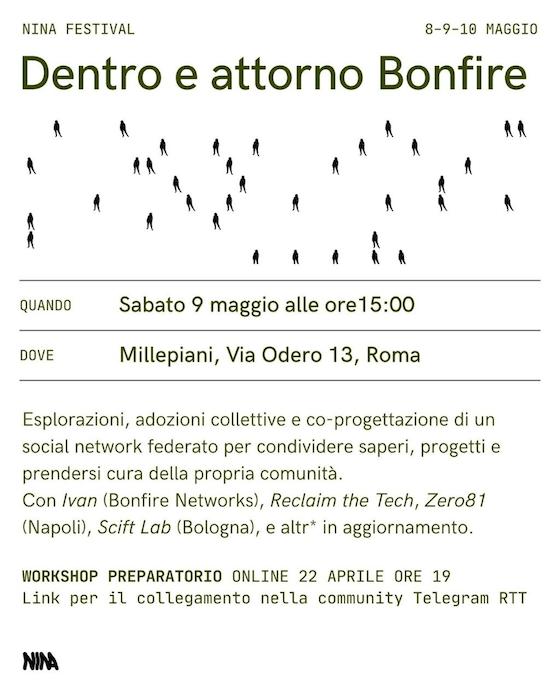
On Saturday May 9th in Rome, as part of the Nina Festival, we're hosting a workshop to think with Bonfire, exploring and co-designing federated digital spaces for caring for our communities.
Together with @reclaimthetech@mastodon.uno, Zero81, Scift Lab and more.
📍 Millepiani, Via Odero 13, 3pm
If you're in (or near) Rome, come join us!


@netvor@masto.nu @Bonfire@bonfire.cafe Yeap, zig had been on my short list to learn for a while now and that is one of the main reasons (along with comp time and solid cross compilation).
@mavnn@bonfire.mavnn.eu @netvor@masto.nu zig is also very easy to use within an elixir app (even mixing zig code inline within an elixir module: hexdocs.pm/zigler/Zig.html
