We are a little bit late to the party, but on the 1. May we celebrated #lauti's first anniversary 🥳.
This year was crazy, we got in touch with so many amazing people a long the way. We did our first talk at the #39c3 self organized session of @techfrombelow@chaos.social
We visited #fosdem with our friends from @Bonfire where they announced our collaboration working on #events in the #fediverse.
We are just getting started, SSO is around the corner and we are working on #activitypub at the moment.
For more updates take a look at our last blog post
lauti.org/blog/lauti-updates...
Public Interest Social Networks
Bonfire is built by communities, for communities. Rooted in autonomy, mutual care, and collective power. Co-create your tools, reclaim your data, and resist manipulation by shaping your own federated digital spaces.
Previously at @bonfire@indieweb.social
- Joined
- Website
- bonfirenetworks.org
The paper Governing Together: Toward Infrastructure for Community-Run Social Media by @s0hw@hci.social @andresmh@hci.social and colleagues at hci.princeton.edu (which we will discuss at #FediForum today) takes on a tension at the heart of decentralised social media. The fediverse promises to empower communities to govern themselves and set norms in their own context, on their own terms. But communities can't actually govern in isolation. Their members talk across boundaries, bad actors hop between servers, and the rules one community sets can directly undermine another's. The authors call these "governance frictions."
Their argument is that we've spent a lot of design effort looking inside communities, like improving moderation tools and onboarding, but almost none on what they call inter-community governance: the infrastructure that lets communities coordinate, share information, and manage their relationships with each other.
To explore what that infrastructure could look like, they ran four design workshops with 24 Fediverse admins, moderators, and developers. Participants imagined ideal tools, and the authors synthesized those ideas into six concrete challenges, like making governance decisions visible, sharing nuanced information about issues, controlling who you share what with, and minimizing barriers to adoption.
The synthesis lands on three design principles:
Modularity: communities need a shared vocabulary, like a "Governance Nutrition Facts" label, so they can read each other parsimoniously.
Polycentricity: communities should sit in overlapping "trust bubbles," not one global network, so they can have nuanced, evolving relationships.
And forkability: communities should be able to copy and adapt each other's governance structure and rules, preserving autonomy while reducing labor.
The big takeaway: decentralisation alone isn't enough. If we want community-run social media to actually work, we need to design the connective tissue between communities, and the design principles here may apply well beyond the Fediverse, to any platform where multiple communities coexist.
Today at #FediForum we'll have a discussion with some of the co-authors of the academic paper Governing Together: Toward Infrastructure for Community-Run Social Media. There's no better time to read this paper!
If you're attending #FediForum let's have a discussion tomorrow around this open access paper: Governing Together: Toward Infrastructure for Community-Run Social Media which argues that decentralized platforms like the Fediverse focus on governing within communities, but ignore the frictions between them. From workshops with 24 Fediverse community organisers, they identify six design challenges (visibility of governance decisions, collating issue information, controlling what's shared and with whom, enabling new inter-community relationships, customising governance, and minimizing adoption barriers) and propose three principles for "inter-community governance": modularity (shared vocabulary, like governance nutrition labels) and forkability (copy and adapt others' governance structure or rules), and polycentricity (overlapping trust bubbles instead of one global network, i.e. archipelagos).
Decentralisation and autonomy alone aren't enough, communities need connective tissues to interconnect them beyond just technical federation (a mycelium network if you like 😊)
If you're interested and are able to read or peruse it ahead of time that will help us have a more grounded and potentially productive discussion based on it...
Hi everyone
We're a new tech co-op that aims to support people working for social good with compassionate and caring tech support. No more feeling alone, no more getting stuck. That thing that is a total showstopper for you, may be an easy fix for us. We’ll be there for you.
We're currently mostly one person @kawaiipunk who is a founder member of @autonomic (and friends) but we're looking to expand.
⁂ Fediverse meetup at #EGU26 🌍
Join us to exchange experiences and to talk about the potential fedi has to become a platform for scientific discussion and networking.
🗓️Thu, 07 May, 17:30–18:30
📍EGU networking zone – terrace G (Purple Level)
@reflex@retrogaming.social ah blogposts have date at the end of the page, we'll move at the top for clarity, but we're alive and thriving... will share more of our ongoing work at the next @fediforum@mastodon.social if you are interested 😊
@elettrona@poliversity.it ouch! though today at 19.00 we will hold a workshop online for preparing the structure and priorities, we can share the link via DM if you can make it...
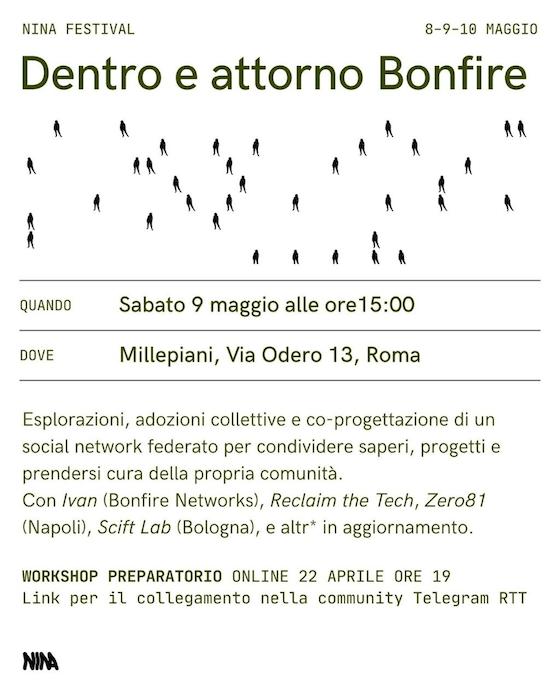
On Saturday May 9th in Rome, as part of the Nina Festival, we're hosting a workshop to think with Bonfire, exploring and co-designing federated digital spaces for caring for our communities.
Together with @reclaimthetech@mastodon.uno, Zero81, Scift Lab and more.
📍 Millepiani, Via Odero 13, 3pm
If you're in (or near) Rome, come join us!
@netvor@masto.nu @Bonfire@bonfire.cafe Yeap, zig had been on my short list to learn for a while now and that is one of the main reasons (along with comp time and solid cross compilation).
@mavnn@bonfire.mavnn.eu @netvor@masto.nu zig is also very easy to use within an elixir app (even mixing zig code inline within an elixir module: hexdocs.pm/zigler/Zig.html
There was a website that held a library of common elements of modern UI/web app design, assessed for their attentional harm or addictive qualities. I don't remember if it had these exact items, but you would find things like "infinite scroll" and "notification badges" on there, along with research and recommended best practices.
Does anyone know what it is I'm thinking of?
@spencer@motley.club There's this website, but it's the reverse, cataloguing patterns that they consider to be prosocial: prosocialdesign.org/
@strypey@mastodon.nzoss.nz @mavnn@bonfire.mavnn.eu we did some changes to improve feed performance, you can find the edit button in "advanced" - after opening the 3 vertical dots more menu
@orchun@hachyderm.io Oh, weird. I wonder what's causing that one? I don't know if @bonfire@indieweb.social might be interested in knowing that is happening.
Thanks for reporting! It looks like Mastodon picked up the hashtag link to preview, will look into it.
Once again, a truly astonishing amount of stuff has been happening with Co-op Cloud since our last blog post in October. Read about it here!
https://coopcloud.tech/blog/march-2026-equinox
– 3wordchant
Are there any plans for integration with RSS feeds? Besides of group support (in the works) and some sort of BlueSky integration (which could be skirted with RSS feeds), that's one of the few things I'd be missing to move from Friendica.
@csolisr@hub.azkware.net Bonfire provides RSS/Atom for feeds and users: docs.bonfirenetworks.org/rss... (we want to add the same for thread comments next)
And we've prototyped an extension for following RSS/Atom feeds just like you do ActivityPub actors within Bonfire, some feedback on the approach would be useful: github.com/bonfire-networks/...
Here's the announcement about MLS over AP: socialwebfoundation.org/2025...
The draft spec: swicg.github.io/activitypub-...
The discussion space: github.com/swicg/activitypub...
📢 A lot has happened in the past months for #LAUTI and @klasse_methode@chaos.social. Here is a short rundown:
🏁 We released LAUTI v1.2.0 yesterday along with a brand new blog and LAUTI documentation page on lauti.org. Some weeks ago we started working on Fediverse integration with the support of @nlnet@social.nlnet.nl @NGIZero@mastodon.xyz thanks to @linos@graz.social. Furthermore we collaborate with @Bonfire for a tight integration of events and got a couple of new contributors and public instances!
☀️ The future looks bright! Read all about it in first blog post: lauti.org/blog/lauti-updates...
We just released Bonfire 1.0.2, an update focused on giving you a more stable and reliable experience.
We're also heads-down working with several communities who are setting up their own Bonfire servers.
Plus updates on end to end encryption and federated groups.
More details: bonfirenetworks.org/posts/bo...
Finally, LAUTI has it's own fediverse account! 👋 Up until now, we used @klasse_methode@chaos.social to post about LAUTI, but we think it deserves it's own account. And we hope you think so too. 😀
We're glad that our friends from @Bonfire provided us with an account on their server. And it makes total sense, as we work closely with them on different projects, one of them being the tight integration of LAUTI events into Bonfire.
For all who don't know LAUTI yet: LAUTI - Open Source Community Calendar provides communities with a sovereign platform to share their events. Fediverse integration is in the making. For more check lauti.org
Help spread the word if you like. 🤝
Are there any activitypub implementations which encrypt the contents of messages and only allow federated instances a key to decrypt it or a similar privacy mechanism?
@capriciousday@mastodon.social we're working on it! see socialwebfoundation.org/2025...