

@smallcircles "grassroots social dynamics" may be actually digital NIMBY movement against targeted advertising and AI... :-)
@thisismissem
Post


Quoting from another toot I just posted:
> What I am talking about is architecture and design, and all the things that allow people to easily form a clear mental picture on how things fit together, wrap their head around the fediverse.
> Never defining this well, and having the documentation be scattered all across the fediverse in 1,001 random locations doesn't help. Meanwhile the dev talk that is going on for years remains very inefficient due to endless Babylonian speech confusion.
Another quote has steps that would then be involved with solution design, and expand fedi's interoperable apps & services:
https://social.coop/@smallcircles/116109322688804011
Without that, with app-centric protocol-decay-ensuring method we have:
0. Deteriorate your domain, reduce ambition
1. Hammer your design until it looks like a microblog, add warts for own features
2. Plug and pray that it works
3. Keep fixing based on daily fedi weather conditions
--
4. Discuss fixes in fire-and-forget fleety communication channels
To chain things together a bit on this fleety medium of ours, create a hyperweb 😜 I'll quote this toot to follow-up to
https://social.coop/@smallcircles/116110545919004233
I remember about 2018 or so, when I joined my first #SocialCG meetup. It was when the CG was still strongly tied to #SocialHub community.
There were mundane items on the agenda, interesting to any #ActivityPub dev, and also the call to action was "whether you are technical or not at all, join the meetup, we are open and inclusive to all fedizens". Very friendly, good vibes.
However during the session the talk was not only CS expert level, but dealing with subject matter nowhere near the spec. It was 'wire reality' slang, and to learn it the guidance was either nowhere, or everywhere, dispersed. And this is still as it is today. To expertised AP developers their domain language sounds all natural, but it likely seems Martian to a dev newcomer.
Stark contrast to the W3C specs that leave folks with refreshing "Let's implement this" vibe.
I recreated an old diagram in Excalidraw that I spread about a couple years ago, and made it a bit more informative. Explanation can be found in the #AltText
See also and for discussion: https://discuss.coding.social/t/diagram-interoperability-in-practice/828
Or join the Social experience design chatroom at: https://matrix.to/#/#socialcoding-foundations:matrix.org
Also posted to #SocialHub at: https://socialhub.activitypub.rocks/t/activitypub-versus-fediverse-interoperability-in-practice/8498
#SX #SocialCoding #SocialWeb #ActivityPub #SolidProject #fediverse
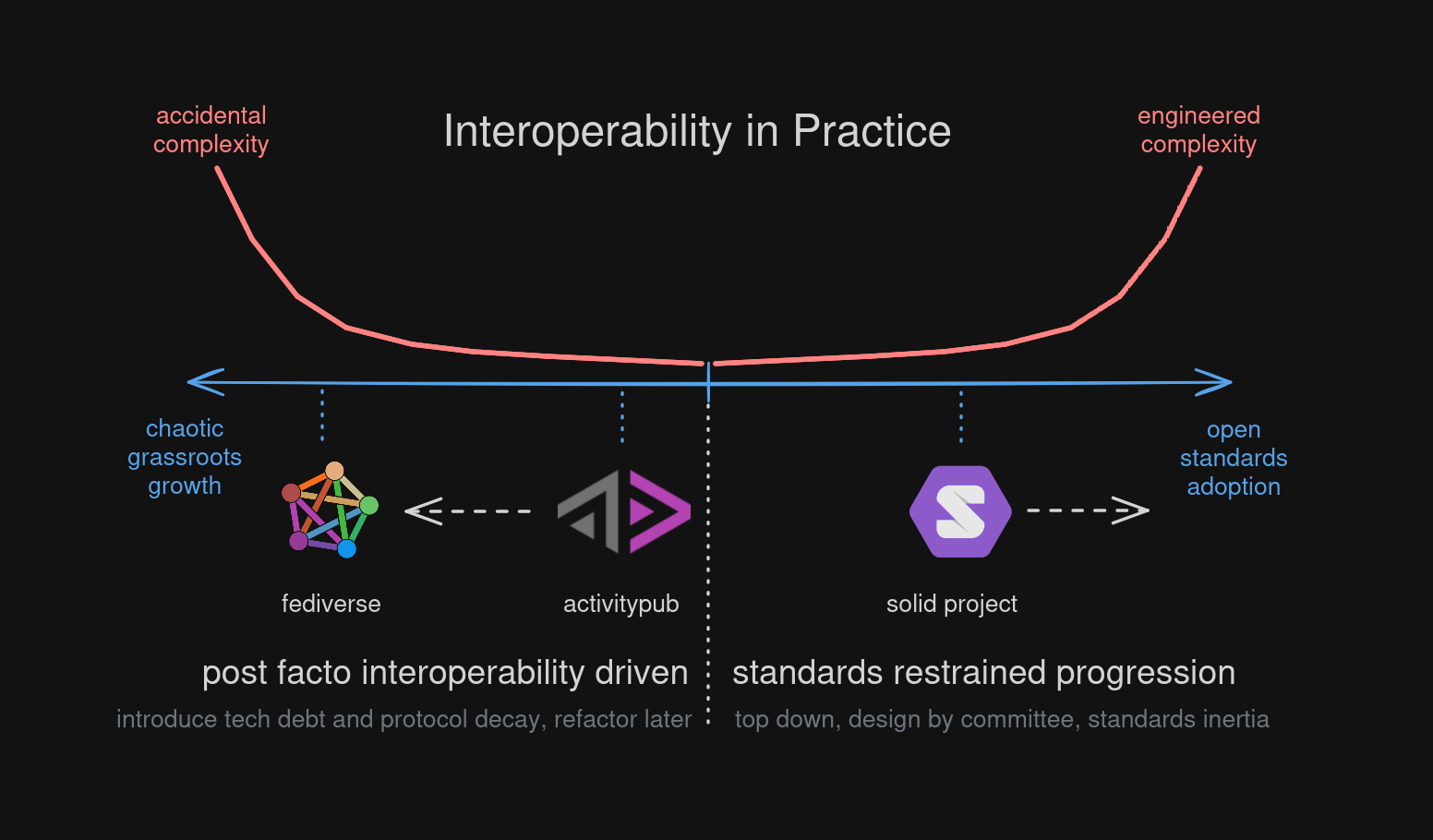
https://social.coop/@smallcircles/116119514853649098
To get back to 'shared ownership' and @ben article that triggered my blog post.
The #fediverse is certainly not all cheerleaders, but the question is whether critical notes can be properly heard and addressed in any meaningful way. After all who are the ones who should hear them and act on them? It is "the herd", the crowd, the commons that happens to receive toots via their social graph, and to the extent these manage to penetrate bubbles and echo chambers. To make a strong argument, to reach people, the only strategy is social media influence marketing of sorts. You have to dare to rock the boat enough to be heard. And that's a very bad way to grow a healthy ecosystem I think.
It relates to the oft-heared criticism that on the app-centric #ActivityPub fediverse, it is the app devs who are de-facto in charge and decide what goes and what goes not.
The social dynamics are tricky but fascinating. I hope to be able to spend more time at https://coding.social


@smallcircles
I remember this sentence from https://ufind.univie.ac.at/de/person.html?id=1001662, around 2013:
"Interoperability can only be proven after the fact."
@ben


@smallcircles @ben The interesting thing is that it's not really a trade-off at all.
The right side of the diagram almost never works in practice — unless there's a dominant player who can enforce strict compliance, like Walmart for a supply chain or the U.S. government for corporate filings — so it's typically a choice between messiness or failure, not between messiness or slow progress.


I sometimes feel that I must be crazy, and totally off the mark, as I - and luckily others with me - are saying these things for 7 years now. But it somehow hits a wall of inertia.
It is this inertia in itself, that has started fascinating me the last 2 years, and it is the reason why https://coding.social exists. We have to figure out how to deal with the grassroots social dynamics such that healthy long-term sustainable standards, ecosystems, and online environments emerge and further evolve.
Long ago I took notes on some major challenges that in my opinion hold back the fediverse from becoming The Future of Social Networking. These are all mostly social in nature, and are as relevant today as they were then. But this is also just imho. 😬
https://discuss.coding.social/t/major-challenges-for-the-fediverse/67
@smallcircles "grassroots social dynamics" may be actually digital NIMBY movement against targeted advertising and AI... :-)
@thisismissem
I've been a long-time advocate for #HumaneTechnology. Social coding commons adds something to that to become "humane and harmonious technology". Humane by default. #Humanity is an intrinsic value of the movement. And harmonious by #SocialCoding. Coding is social, and first of all deals with people coordinating to find solutions that align with and satisfy stakeholder needs. Coding happens somewhere in the process, an impl detail.
A core principle of Social experience design is Sustainability, which is holistic in nature via the (adapted) Circles of Sustainability model. https://coding.social/blog/reimagine-social/#circles-of-sustainability
With this in place a #SX software solution will cycle through its Free software development lifecycle i.e. #FSDL, which drives a tailored development based on needs and lifecycle phase. https://coding.social/blog/reimagine-social/#free-software-development-lifecycle
Together this completely avoids a pure technology-driven development, ensuring Needs-driven development, and a natural NIMBY of inhumane technology and practices.

@smallcircles@social.coop oh definitely, and like, I think part of that is down to the fact that W3C received the first version of each of the specs and went "that's good enough for 10 years", when there were so many unaddressed and incomplete aspects of these specs. The fact that there wasn't actually authn/authz in the original specs should have kept the WG open until that was resolved. Without it, half the spec was basically pointless.
I really hope the activitypub ecosystem can escape the inertia of the existing network and architecture that is widely deployed today. I've said a few times that Mastodon's threat isn't Bluesky, no, it's the next generation ActivityPub app that does microblogging well but built with C2S. That's what will unseat Mastodon from it's dominant position, not a social app on a different protocol that has different features.
And this time I am the one responding that I 100% wholeheartedly agree with that. Thank you.
(PS. I wouldn't describe it as "unseating" where it comes to the position of Mastodon. This would bring Mastodon in a better position too.. "uplifting"?)