The Kalshi prediction market, which has been operating in the US since its 2021 launch, has inked a partnership with CNN and CNBC because everything is gambling now. Much as you can no longer watch a hockey game without seeing a gambling advertisement every 13 seconds21, Kalshi prices will now appear beside news stories — inviting readers both to view them as probabilities, and encouraging them to place their own wagers. While there has been some research validating prediction markets’ accuracy in forecasting, most of this occurred prior to the explosion in uncapped betting, when bettors were limited to wagering small amounts in tightly-constrained academic experiments. Now, with so much money on the line and so much public attention on these markets, I suspect additional factors could influence their accuracy — from bettors attempting to arbitrage between different platforms, to people attempting to manipulate the perceived “odds” of an event to their advantage. The deal is probably a win-win for both Kalshi and the news groups: Kalshi gets the imprimatur of journalistic legitimacy, while CNN — fresh off layoffs — will enjoy an infusion of cash. The specific pricetag isn’t public, but Kalshi’s recent $1 billion raise suggests the platform isn’t exactly cash‑starved.
Kalshi quickly filed for an emergency stay pending appeal, writing that they face “a threat of imminent criminal enforcement by Nevada authorities.”23 The Nevada Gaming Control Board has opposed this, arguing that “Kalshi cannot claim irreparable injury when all of its harms are self-inflicted. That is especially true because this Court and the CFTC warned Kalshi of the risks of expanding its business, and Kalshi went ahead and did it anyway. ... Kalshi has refused to make any good-faith effort to even attempt to comply with Nevada law. In contrast to Crypto.com and Robinhood, which entered into agreements with State Defendants to prevent enforcement, Kalshi flatly refused every option that State Defendants suggested, refused to propose any alternatives, and demanded that State Defendants stand down while it continues to aggressively expand its business.”24 Judge Gordon has not yet made a decision on the stay.
It’s not all good news for prediction markets, though, as they face multiple cease-and-desist orders and lawsuits from state gaming regulators. A federal court in Nevada issued a devastating ruling late last month that event contracts based on the outcomes of sports games are not swaps that would fall under the Commodity Exchange Act, and dissolving a preliminary injunction protecting Kalshi from civil or criminal action by the Nevada Gaming Control Board. Prediction markets have been relying on the swaps argument, maintaining that the CFTC’s oversight preempts the authority of state gambling commissions. Judge Andrew Gordon, in his ruling, rejected this, and added: “Licensed gaming companies have invested millions of dollars to comply with state regulations only to supposedly find out that they could have just become CFTC-registered exchanges to offer sports gambling nationwide for anyone over the age of 18 without complying with Nevada’s gaming regulatory regime or paying taxes in this state.”22
The next day, a group of 192 consumer protection, financial reform, environmental protection, and advocacy groups, as well as some labor unions, signed a letter urging senators to “oppose any Senate cryptocurrency legislation that fails to meaningfully address the crypto industry’s many systemic failures and harms,” adding that “The legislative initiatives explored in the Senate so far have largely failed to address the widespread harms caused by the crypto industry”. The signatories include financial reform groups Americans for Financial Reform and Better Markets; consumer advocacy groups Public Citizen, the Center for Economic Justice, and the National Consumers League; advocacy groups Accountable.US, Demand Progress, Democracy for America, Our Revolution, and many local Indivisible groups; environmental groups Greenpeace, the Climate and Community Institute, and a long list of regional, state, and local environmental groups; and labor unions AFT and the Communications Workers of America.30
Then, on August 29, Alt5 Sigma employees received a letter from the law firm Thompson Hine warning that “litigation, regulatory investigations and other proceedings are reasonably anticipated” and that they had established a special committee to independently scrutinize Alt5’s financial records. It’s not clear if this was related to the Rwandan criminal case or some other matter. On September 4, Alt5 told employees it had suspended CEO Peter Tassiopoulos and its chief revenue officer pending the outcome of the Thompson Hine investigation, though an October SEC filing claims Tassiopoulos wasn’t suspended until October 16.33 In a November 21 SEC filing, Alt5 Sigma disclosed that Tassiopoulos’ replacement, the company’s CFO Jonathan Hugh, had been removed as both acting CEO and CFO “without cause”. The same filing also announced that the Chief Operating Officer had also been removed, and that a board member had decided to resign, with the latter citing “personal reasons”.34 On December 15, Tassiopoulos formally resigned as CEO and from the board.35
Trump business interests
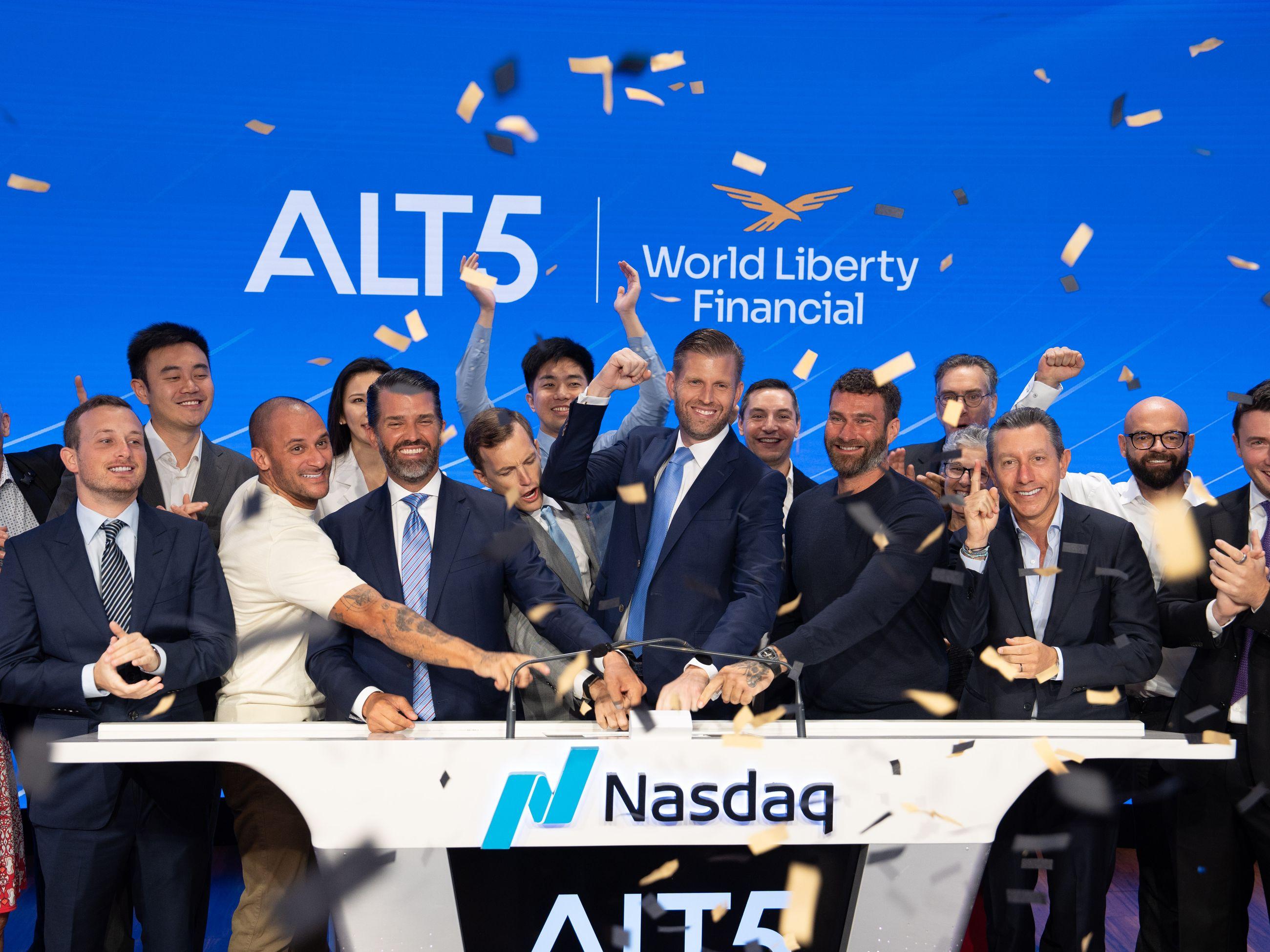
Alt5 Sigma, the WLFI treasury company established by Eric Trump and several other World Liberty Financial executives, seems to be in crisis. In August, World Liberty Financial announced that it would create a WLFI treasury company using the Nasdaq-listed fintech firm, Alt5 Sigma [I90]. Eric Trump and fellow World Liberty executives Zach Witkoff and Zak Folkman were slated to join Alt5 Sigma’s board, although the Nasdaq later prohibited Eric Trump from joining the board due to the blatant conflict of interest, relegating him to “board observer” [I92].

According to an SEC filing,31 on August 27 — only two weeks after Eric Trump, Donald Trump Jr., Witkoff, and Folkman rang the Nasdaq opening bell to celebrate the deal — the Alt5 board learned that the company and its former president and CEO André Beauchesne had been found criminally liable for money laundering in Rwanda in May and ordered to surrender $3.5 million. The filing claims that the existence of the Rwandan court decision “and other matters” had not previously been disclosed to the board, and were unknown at the time of the World Liberty Financial deal. Two former employees said that World Liberty had been provided with details of the Rwandan court proceedings, though a World Liberty Financial spokesperson refutes this.32
Trump business interests Alt5 Sigma, the WLFI treasury company established by Eric Trump and several other World Liberty Financial executives, seems to be in crisis. In August, World Liberty Financial announced that it would create a WLFI treasury company using the Nasdaq-listed fintech firm, Alt5 Sigma [I90]. Eric Trump and fellow World Liberty executives Zach Witkoff and Zak Folkman were slated to join Alt5 Sigma’s board, although the Nasdaq later prohibited Eric Trump from joining the board due to the blatant conflict of interest, relegating him to “board observer” [I92]. According to an SEC filing,31 on August 27 — only two weeks after Eric Trump, Donald Trump Jr., Witkoff, and Folkman rang the Nasdaq opening bell to celebrate the deal — the Alt5 board learned that the company and its former president and CEO André Beauchesne had been found criminally liable for money laundering in Rwanda in May and ordered to surrender $3.5 million. The filing claims that the existence of the Rwandan court decision “and other matters” had not previously been disclosed to the board, and were unknown at the time of the World Liberty Financial deal. Two former employees said that World Liberty had been provided with details of the Rwandan court proceedings, though a World Liberty Financial spokesperson refutes this.32