OK, one of key features of our book on #Synchrotron Light is that it considers a broader context for synchrotron sources, by no means limited to particle accelerators.
In the book we discuss three generalisations:
1. Synchrotron radiation is not exclusive to accelerators. In fact, synchrotron emission "dominates much of high-energy #astrophysics" (quoting Longair's High Energy Astrophysics book)
2. The accelerating force must not be necessarily electromagnetic. For instance, an electron accelerated by the gravitational force of a black hole (by virtue of its mass) will produce synchrotron emission (by virtue of its electric charge)
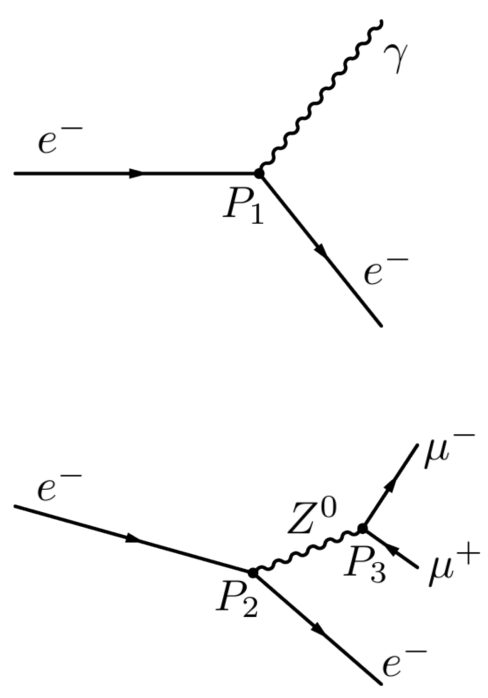
3. The particle radiation mechanism must not be necessarily electromagnetic. Example: electron radiation of Z0 particles mediated by the weak interaction is equivalent to (conventional) synchrotron photon emission by electromagnetic interaction as in the figure. This is true since the unification of the electromagnetic and weak forces, any electromagnetic interaction involving a photon (a vertex in a Feynman diagram) can have that photon replaced by a Z 0 gauge boson
4/N