Extra learning material for our Synchrotron Light book is freely available at
https://synchrotron-light.net
There's all the figures, links to most references, #python scripts and other bonus material.
Extra learning material for our Synchrotron Light book is freely available at
https://synchrotron-light.net
There's all the figures, links to most references, #python scripts and other bonus material.
OK, one of key features of our book on #Synchrotron Light is that it considers a broader context for synchrotron sources, by no means limited to particle accelerators.
In the book we discuss three generalisations:
1. Synchrotron radiation is not exclusive to accelerators. In fact, synchrotron emission "dominates much of high-energy #astrophysics" (quoting Longair's High Energy Astrophysics book)
2. The accelerating force must not be necessarily electromagnetic. For instance, an electron accelerated by the gravitational force of a black hole (by virtue of its mass) will produce synchrotron emission (by virtue of its electric charge)
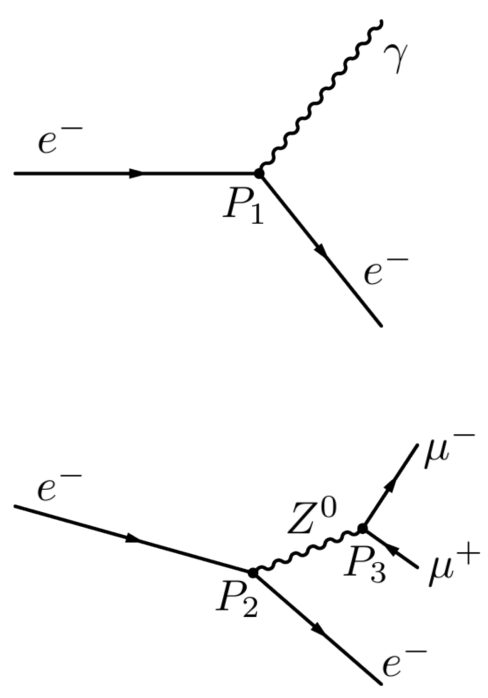
3. The particle radiation mechanism must not be necessarily electromagnetic. Example: electron radiation of Z0 particles mediated by the weak interaction is equivalent to (conventional) synchrotron photon emission by electromagnetic interaction as in the figure. This is true since the unification of the electromagnetic and weak forces, any electromagnetic interaction involving a photon (a vertex in a Feynman diagram) can have that photon replaced by a Z 0 gauge boson
4/N
Extra learning material for our Synchrotron Light book is freely available at
https://synchrotron-light.net
There's all the figures, links to most references, #python scripts and other bonus material.
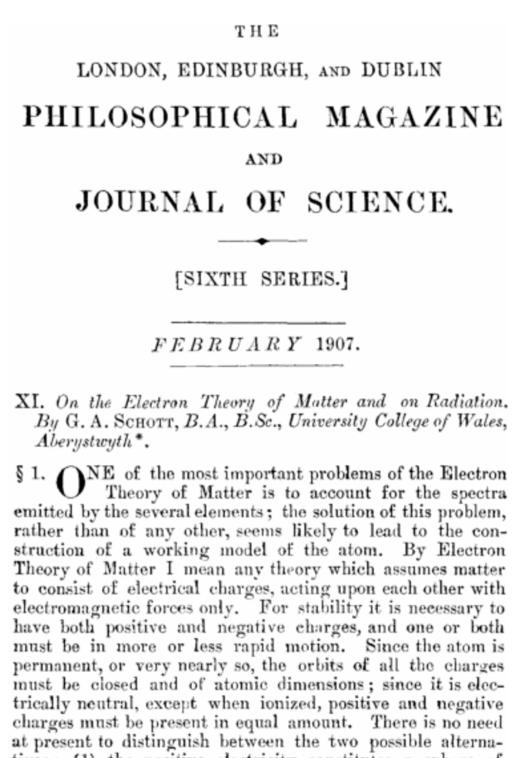
Quite surprisingly, most of the properties of (classical) synchrotron radiation were worked out by G.A. Schott in1907--1912 in his dissertation work.
Working in a 'pre-quantum' world, Schott wanted to explain the observed lines in the emission #spectra of atoms. He started with a ‘Rutherford-like' atomic model where point electrons move in closed orbits around a nucleus: what would the emission spectra of such accelerated particles be like?
Starting from these premises, Schott derived the emission spectrum of (what we know today as) synchrotron light!
As we understand today, the motion of bound electrons cannot be explained by classical #Electrodynamics. Schott's formulas didn't work in describing atomic spectra and his work was forgotten for a while, only to be rediscovered in the 1940s when the first synchrotron machines were being built.
Now, electrons moving on macroscopic curved trajectories are extremely well described by classical electrodynamics, and Schott's formulas work exceedingly well in predicting the properties of #synchrotron light.
3/N
OK, one of key features of our book on #Synchrotron Light is that it considers a broader context for synchrotron sources, by no means limited to particle accelerators.
In the book we discuss three generalisations:
1. Synchrotron radiation is not exclusive to accelerators. In fact, synchrotron emission "dominates much of high-energy #astrophysics" (quoting Longair's High Energy Astrophysics book)
2. The accelerating force must not be necessarily electromagnetic. For instance, an electron accelerated by the gravitational force of a black hole (by virtue of its mass) will produce synchrotron emission (by virtue of its electric charge)
3. The particle radiation mechanism must not be necessarily electromagnetic. Example: electron radiation of Z0 particles mediated by the weak interaction is equivalent to (conventional) synchrotron photon emission by electromagnetic interaction as in the figure. This is true since the unification of the electromagnetic and weak forces, any electromagnetic interaction involving a photon (a vertex in a Feynman diagram) can have that photon replaced by a Z 0 gauge boson
4/N
Synchrotron light is conventionally defined as the emission from accelerated ultra-relativistic electric charges.
Ultra-relativistic means that the speed of the charge is extremely close to the speed of light, v ≈ c.
The first part of the book deals with introductory concepts, starting from special relativity, and moving on emission from accelerated charges, then #synchrotron emission from charges in circular and undulating trajectories.
2/N
Quite surprisingly, most of the properties of (classical) synchrotron radiation were worked out by G.A. Schott in1907--1912 in his dissertation work.
Working in a 'pre-quantum' world, Schott wanted to explain the observed lines in the emission #spectra of atoms. He started with a ‘Rutherford-like' atomic model where point electrons move in closed orbits around a nucleus: what would the emission spectra of such accelerated particles be like?
Starting from these premises, Schott derived the emission spectrum of (what we know today as) synchrotron light!
As we understand today, the motion of bound electrons cannot be explained by classical #Electrodynamics. Schott's formulas didn't work in describing atomic spectra and his work was forgotten for a while, only to be rediscovered in the 1940s when the first synchrotron machines were being built.
Now, electrons moving on macroscopic curved trajectories are extremely well described by classical electrodynamics, and Schott's formulas work exceedingly well in predicting the properties of #synchrotron light.
3/N
I've no experience on MX, but in general the beamline scientists at the Aussietron seem to have a good time? Should be a great experience!
https://careers.ansto.gov.au/job/Melbourne-Beamline-Scientist-MX-VIC/1212983066/
Australians only, unfortunately.
#GetFediHired#Synchrotron#AustralianSynchrotron#Crystallography
I've no experience on MX, but in general the beamline scientists at the Aussietron seem to have a good time? Should be a great experience!
https://careers.ansto.gov.au/job/Melbourne-Beamline-Scientist-MX-VIC/1212983066/
Australians only, unfortunately.
#GetFediHired#Synchrotron#AustralianSynchrotron#Crystallography
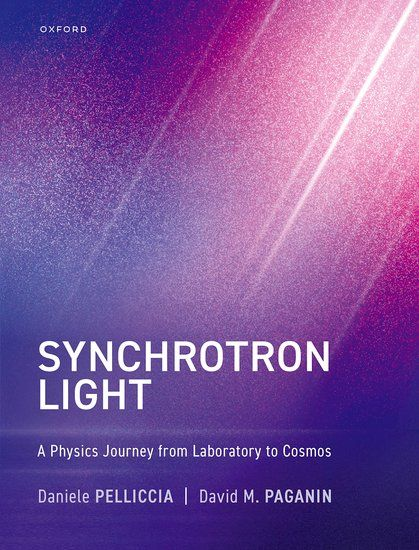
In a bit of shameless self-promotion, I'm proud to announce that I've a new book out!
"Synchrotron Light: a Physics Journey from Laboratory to Cosmos", was written together with my co-author Prof. David Paganin and published by Oxford University Press.
Target audiences include users of terrestrial synchrotrons, those studying astrophysical sources of synchrotron radiation, and high-energy physicists.
In the next few days/weeks, I'll introduce some of the topics and other tidbits in this thread.
https://global.oup.com/academic/product/synchrotron-light-9780192846280
1/N
Synchrotron light is conventionally defined as the emission from accelerated ultra-relativistic electric charges.
Ultra-relativistic means that the speed of the charge is extremely close to the speed of light, v ≈ c.
The first part of the book deals with introductory concepts, starting from special relativity, and moving on emission from accelerated charges, then #synchrotron emission from charges in circular and undulating trajectories.
2/N
In a bit of shameless self-promotion, I'm proud to announce that I've a new book out!
"Synchrotron Light: a Physics Journey from Laboratory to Cosmos", was written together with my co-author Prof. David Paganin and published by Oxford University Press.
Target audiences include users of terrestrial synchrotrons, those studying astrophysical sources of synchrotron radiation, and high-energy physicists.
In the next few days/weeks, I'll introduce some of the topics and other tidbits in this thread.
https://global.oup.com/academic/product/synchrotron-light-9780192846280
1/N