Discussion
Loading...

#Tag

Log in
  • About
  • Code of conduct
  • Privacy
  • Users
  • Instances
  • About Bonfire
Fabrizio Musacchio
Fabrizio Musacchio
@pixeltracker@sigmoid.social  ·  activity timestamp 3 months ago

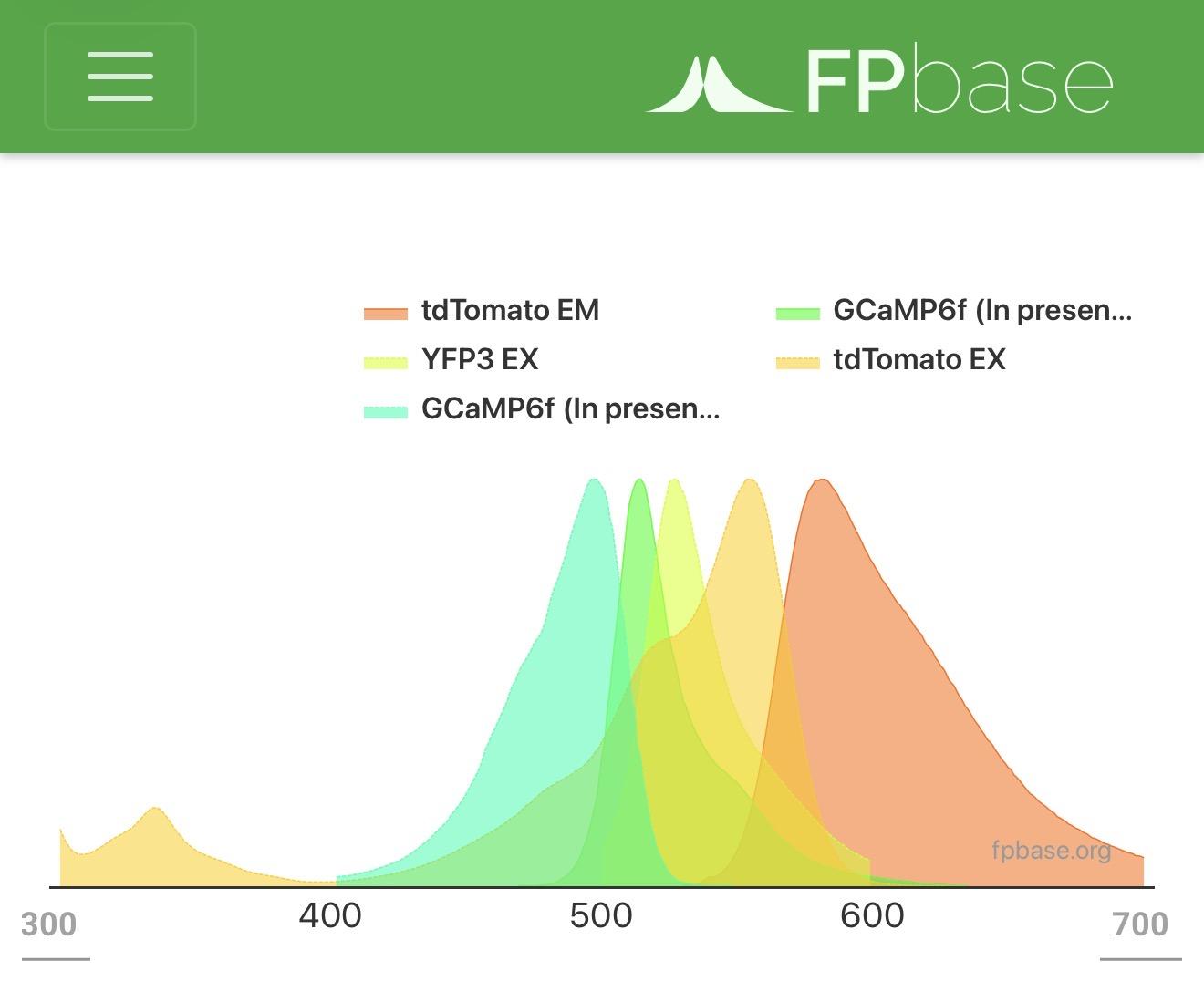
Just came across #FPbase, a community-driven database for #fluorescent #proteins and #spectral properties 🌈. Very useful for selecting reporters, comparing #excitation/ #emission #spectra, planning multi-color #imaging 🔬, and avoiding spectral overlap.
🌍 https://www.fpbase.org/about/

#Microscopy #Fluorescence #Neuroscience #OpenScience

Screenshot
Screenshot
Screenshot
  • Copy link
  • Flag this post
  • Block
Daniel Pelliccia
Daniel Pelliccia
@danielpelliccia@aus.social  ·  activity timestamp 6 months ago

Synchrotron light is conventionally defined as the emission from accelerated ultra-relativistic electric charges.

Ultra-relativistic means that the speed of the charge is extremely close to the speed of light, v ≈ c.

The first part of the book deals with introductory concepts, starting from special relativity, and moving on emission from accelerated charges, then #synchrotron emission from charges in circular and undulating trajectories.

2/N

#Physics #Electrodynamics #books #PhysicsBooks

Daniel Pelliccia
Daniel Pelliccia
@danielpelliccia@aus.social replied  ·  activity timestamp 5 months ago

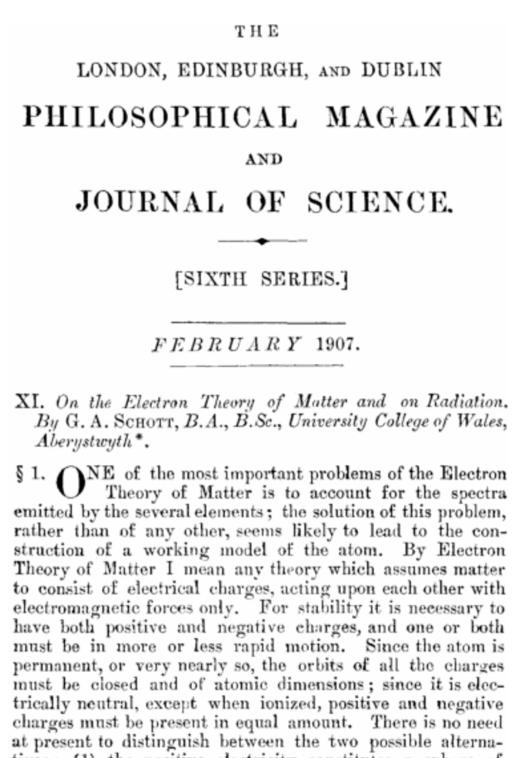
Quite surprisingly, most of the properties of (classical) synchrotron radiation were worked out by G.A. Schott in1907--1912 in his dissertation work.

Working in a 'pre-quantum' world, Schott wanted to explain the observed lines in the emission #spectra of atoms. He started with a ‘Rutherford-like' atomic model where point electrons move in closed orbits around a nucleus: what would the emission spectra of such accelerated particles be like?

Starting from these premises, Schott derived the emission spectrum of (what we know today as) synchrotron light!

As we understand today, the motion of bound electrons cannot be explained by classical #Electrodynamics. Schott's formulas didn't work in describing atomic spectra and his work was forgotten for a while, only to be rediscovered in the 1940s when the first synchrotron machines were being built.

Now, electrons moving on macroscopic curved trajectories are extremely well described by classical electrodynamics, and Schott's formulas work exceedingly well in predicting the properties of #synchrotron light.

#physics

3/N

The front page of the "London, Edinburgh and Dublin Philosophical Magazine and Journal of Science" dated February 1907. The page shows a scientific article by G.A. Schott titled "On the electron theory of matter and on radiation". The articles begins with the following words: "One of the most important problems of the Electron Theory of Matter is to account for the spectra emitted by the several elements; the solution of this problem, rather than of any other, seems likely to lead to the construction of a working model of the atom."
  • Copy link
  • Flag this comment
  • Block

bonfire.cafe

A space for Bonfire maintainers and contributors to communicate

bonfire.cafe: About · Code of conduct · Privacy · Users · Instances
Bonfire social · 1.0.1 no JS en
Automatic federation enabled
Log in
  • Explore
  • About
  • Members
  • Code of Conduct