
Discussion
Loading...

#Tag

Log in
  • About
  • Code of conduct
  • Privacy
  • Users
  • Instances
  • About Bonfire
Fabrizio Musacchio
Fabrizio Musacchio
@pixeltracker@sigmoid.social  ·  activity timestamp 2 weeks ago

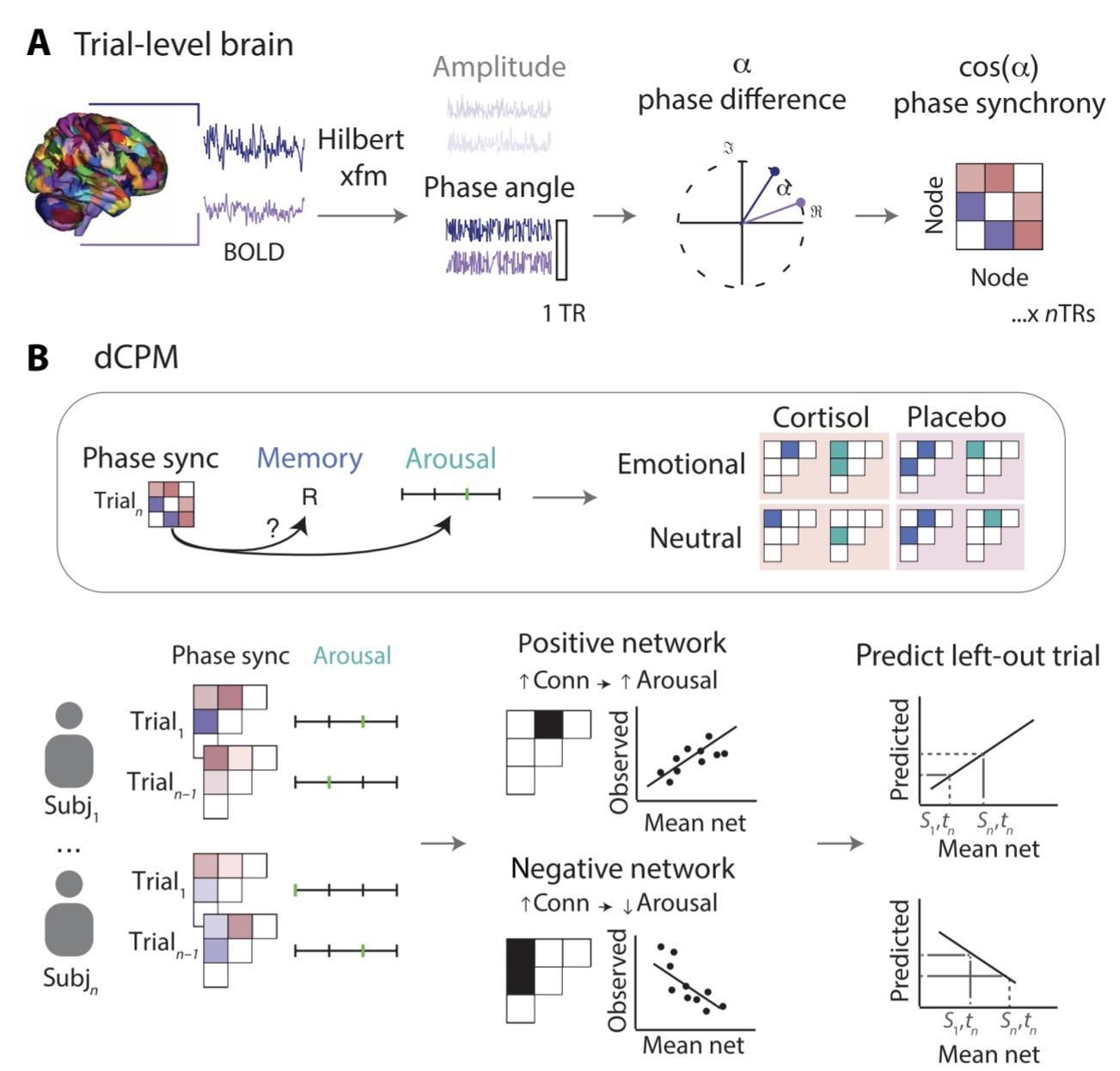
🧠 New paper by Huang et al.: By using #pharmacological #fMRI and dynamic #connectome-based #PredictiveModeling, they show how #cortisol reshapes whole-brain #NetworkDynamics during emotional memory encoding. Trial-level analyses reveal distinct but increasingly integrated #arousal and #memory networks under #stress, supporting a hormonally driven "memory formation mode".
🌍 https://doi.org/10.1126/sciadv.adz4143

#Neuroscience #CognitiveNeuroscience #BrainNetworks #CogSci

Dynamic brain mechanisms supporting salient memories under cortisol

Fig. 2. Analysis design. (A) Schematic of the trial-level phase synchrony extraction approach. (B) Schematic of dCPM. Edges that are significantly correlated with memory/arousal are selected. A linear model is then trained to predict memory/arousal on the left-out trial. This model is separately applied to all four study conditions (pill × emotionality) to yield four predictive networks. R, remembered.
  • Copy link
  • Flag this post
  • Block
Fabrizio Musacchio
Fabrizio Musacchio
@pixeltracker@sigmoid.social  ·  activity timestamp 2 months ago

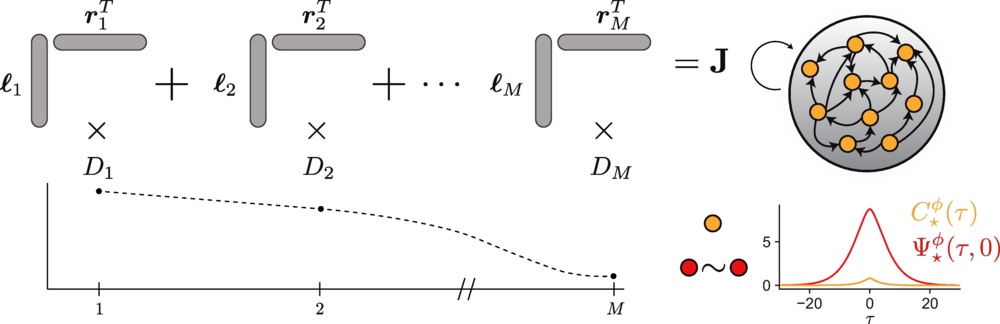
🧠 New paper by Clark et al. (2025) shows that the #dimensionality of #PopulationActivity in #RNN can be explained by just two #connectivity parameters: effective #CouplingStrength and effective #rank. Uses networks with rapidly decaying singular value spectra and structured overlaps between left and right singular vectors. Could be useful for interpreting large scale population recordings and connectome data I guess:
🌍 https://doi.org/10.1103/2jt7-c8cq

#CompNeuro #NeuralDynamics #Connectome

Connectivity Structure and Dynamics of Nonlinear Recurrent Neural Networks

Fig. 2.
Schematic of the random-mode model. Upper: couplings 
J
 are generated as a sum of outer products, 
ℓ
a
r
a
T
, with component strengths 
D
a
. Lower: the two-point function
C
⋆
ϕ
(
τ
)
 and four-point function 
Ψ
⋆
ϕ
(
τ
)
 are calculated in terms of the statistics of 
D
a
. The two-point function depends only on the effective gain 
g
eff
, while the four-point function depends on both 
g
eff
 and 
PR
D
, the effective dimension of the connectivity determined by the 
D
a
 distribution.
Fig. 2. Schematic of the random-mode model. Upper: couplings J are generated as a sum of outer products, ℓ a r a T , with component strengths D a . Lower: the two-point function C ⋆ ϕ ( τ ) and four-point function Ψ ⋆ ϕ ( τ ) are calculated in terms of the statistics of D a . The two-point function depends only on the effective gain g eff , while the four-point function depends on both g eff and PR D , the effective dimension of the connectivity determined by the D a distribution.
  • Copy link
  • Flag this post
  • Block
Ross Gayler boosted
jnpn
jnpn
@jnpn@mastodon.social  ·  activity timestamp 2 months ago

https://www.youtube.com/watch?v=PymMVna6T8A

Anne Churchland (CSHL) 1: How do brains decide?

#neurology #brain #connectome #neuroscience #decision

  • Copy link
  • Flag this post
  • Block
jnpn
jnpn
@jnpn@mastodon.social  ·  activity timestamp 2 months ago

https://www.youtube.com/watch?v=PymMVna6T8A

Anne Churchland (CSHL) 1: How do brains decide?

#neurology #brain #connectome #neuroscience #decision

jnpn
jnpn
@jnpn@mastodon.social replied  ·  activity timestamp 2 months ago

https://www.youtube.com/watch?v=cFpGbmqXWOI

Anne Churchland (CSHL) 2: Connecting movement & ...

#neurology #neuroscience #brain #connectome

  • Copy link
  • Flag this comment
  • Block
jnpn
jnpn
@jnpn@mastodon.social  ·  activity timestamp 2 months ago

https://www.youtube.com/watch?v=PymMVna6T8A

Anne Churchland (CSHL) 1: How do brains decide?

#neurology #brain #connectome #neuroscience #decision

  • Copy link
  • Flag this post
  • Block
Björn Brembs
Björn Brembs
@brembs@mastodon.social  ·  activity timestamp 3 months ago

The #connectome may be important, but it does not seem to help understand neuronal activity patterns:

"Comprehensive neuronal identification enabled us to examine the relationship between whole-brain activity and the connectome but we found no strong correlations between them."

https://doi.org/10.1016/j.cell.2020.12.012

Replication: https://doi.org/10.1016/j.cub.2022.06.039

The structure of a nervous system is one thing, but its relation to NS function seems to be much more tenuous than we may have hoped for.

#neuroscience

A set of hub neurons and non-local connectivity features support global brain dynamics in C. elegans

NeuroPAL: A Multicolor Atlas for Whole-Brain Neuronal Identification in C. elegans

  • Copy link
  • Flag this post
  • Block
Björn Brembs
Björn Brembs
@brembs@mastodon.social  ·  activity timestamp 3 months ago

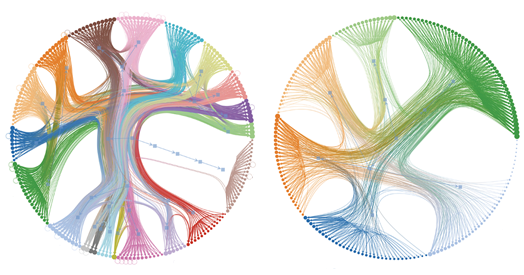
How much can a #connectome tell us about the activity of neurons? It seems not all that much:

"neuronal perturbation often prompted responses from cells that had no anatomical connections to the target cell"
https://www.thetransmitter.org/connectome/worms-help-untangle-longstanding-brain-structure-function-mystery/

#neuroscience #biology

The Transmitter: Neuroscience News and Perspectives

Worms help untangle brain structure/function mystery

The synaptic connectome of most animals bears little resemblance to functional brain maps, but it can still predict neuronal activity, according to two preprints that tackle the puzzle in C. elegans.
  • Copy link
  • Flag this post
  • Block

bonfire.cafe

A space for Bonfire maintainers and contributors to communicate

bonfire.cafe: About · Code of conduct · Privacy · Users · Instances
Bonfire social · 1.0.1-alpha.44 no JS en
Automatic federation enabled
Log in
  • Explore
  • About
  • Members
  • Code of Conduct