
Thanks for asking, it's something we're taking seriously. We're working on an AI policy for the project but want to do it thoughtfully and with care rather than rush something out, please bear with us.
Explore local activities
Our @fediforum@mastodon.social demo is up! 🔥
We showed off Bonfire Mosaic and our ongoing work on federated groups and new publisher tools we’ve been co-designing with jacobin.de, including federated discussion threads that can be embedded on their existing website.
Built on our modular framework for community-governed digital spaces.
Watch 👉 spectra.video/w/hV9wzGzsXvNj...
FediForum Demo: Bonfire Mosaic: co-designing federated groups and publisher tools with Jacobin DE & Totnes Pulse


@lauti Trying to leave a comment, but Codeberg's bugging out on me right now.
“Hashtags are represented as type Hashtag just like mastodon does it. Is there a fep for this?”
Hashtag is additionally specified as a type in a Community Group draft report on miscellaneous terms: https://swicg.github.io/miscellany/#Hashtag
It might get added to a 1.1 version of a proper W3C standard (AS-vocab I assume) now that the Working Group is active again.

@julian@fietkau.social Thank you very much for the review and answering the Hashtag question 🙏
And yeah codeberg seems to have some troubles lately..
If you are up for another review, we have a rough implementation for the instance actor with a basic inbox that handles follow and unfollow: codeberg.org/Klasse-Methode/...

We are a little bit late to the party, but on the 1. May we celebrated #lauti's first anniversary 🥳.
This year was crazy, we got in touch with so many amazing people a long the way. We did our first talk at the #39c3 self organized session of @techfrombelow@chaos.social
We visited #fosdem with our friends from @Bonfire where they announced our collaboration working on #events in the #fediverse.
We are just getting started, SSO is around the corner and we are working on #activitypub at the moment.
For more updates take a look at our last blog post
lauti.org/blog/lauti-updates...
@lauti 🍻
We are a little bit late to the party, but on the 1. May we celebrated #lauti's first anniversary 🥳.
This year was crazy, we got in touch with so many amazing people a long the way. We did our first talk at the #39c3 self organized session of @techfrombelow@chaos.social
We visited #fosdem with our friends from @Bonfire where they announced our collaboration working on #events in the #fediverse.
We are just getting started, SSO is around the corner and we are working on #activitypub at the moment.
For more updates take a look at our last blog post
lauti.org/blog/lauti-updates...

a great article by @thisismissem@hachyderm.io on going beyond binary approach to federation...
" > However, we've been presented with a false dichotomy here: we don't need to operate in a world where we either allow everything until blocked, or block everything until we allow it. There are other ways that we can look at federation management. Some of these include Consent Based Federation, where a moderator or administrator has to review and approve a server before accepting federation (or denying it), or models that resemble a firewall on a computer or server: you'd don't just have to accept or deny federation, but you can also apply filters to the federation between your server and another."
writings.thisismissem.social...


we are looking into your #Go #Activitypub library to implement federation in #LAUTI
One thing we need to do is implement the #FEP 8a8e by @linos@graz.social
Do you have time for a quick call to get an overview?
@linos@graz.social We got a first version implemented at codeberg.org/Klasse-Methode/...
Reviews by anyone with #activitypub knowledge is highly appreciated 🙏
The paper Governing Together: Toward Infrastructure for Community-Run Social Media by @s0hw@hci.social @andresmh@hci.social and colleagues at hci.princeton.edu (which we will discuss at #FediForum today) takes on a tension at the heart of decentralised social media. The fediverse promises to empower communities to govern themselves and set norms in their own context, on their own terms. But communities can't actually govern in isolation. Their members talk across boundaries, bad actors hop between servers, and the rules one community sets can directly undermine another's. The authors call these "governance frictions."
Their argument is that we've spent a lot of design effort looking inside communities, like improving moderation tools and onboarding, but almost none on what they call inter-community governance: the infrastructure that lets communities coordinate, share information, and manage their relationships with each other.
To explore what that infrastructure could look like, they ran four design workshops with 24 Fediverse admins, moderators, and developers. Participants imagined ideal tools, and the authors synthesized those ideas into six concrete challenges, like making governance decisions visible, sharing nuanced information about issues, controlling who you share what with, and minimizing barriers to adoption.
The synthesis lands on three design principles:
Modularity: communities need a shared vocabulary, like a "Governance Nutrition Facts" label, so they can read each other parsimoniously.
Polycentricity: communities should sit in overlapping "trust bubbles," not one global network, so they can have nuanced, evolving relationships.
And forkability: communities should be able to copy and adapt each other's governance structure and rules, preserving autonomy while reducing labor.
The big takeaway: decentralisation alone isn't enough. If we want community-run social media to actually work, we need to design the connective tissue between communities, and the design principles here may apply well beyond the Fediverse, to any platform where multiple communities coexist.
Today at #FediForum we'll have a discussion with some of the co-authors of the academic paper Governing Together: Toward Infrastructure for Community-Run Social Media. There's no better time to read this paper!

If you're attending #FediForum let's have a discussion tomorrow around this open access paper: Governing Together: Toward Infrastructure for Community-Run Social Media which argues that decentralized platforms like the Fediverse focus on governing within communities, but ignore the frictions between them. From workshops with 24 Fediverse community organisers, they identify six design challenges (visibility of governance decisions, collating issue information, controlling what's shared and with whom, enabling new inter-community relationships, customising governance, and minimizing adoption barriers) and propose three principles for "inter-community governance": modularity (shared vocabulary, like governance nutrition labels) and forkability (copy and adapt others' governance structure or rules), and polycentricity (overlapping trust bubbles instead of one global network, i.e. archipelagos).
Decentralisation and autonomy alone aren't enough, communities need connective tissues to interconnect them beyond just technical federation (a mycelium network if you like 😊)
If you're interested and are able to read or peruse it ahead of time that will help us have a more grounded and potentially productive discussion based on it...
Frauen in der Wissenschaft: Lena John
read this article in EnglishEin Interview über Vielfalt in der wissenschaftlichen Arbeit, Gleichberechtigung und Verbündete
Die Blogreihe „Frauen in der Wissenschaft“ stellt Frauen aus der TIB vor, die Einblicke in ihre Wege und ihre persönlichen Erfahrungen in der Wissenschaft geben. Lena John studierte Informatik an der Leibniz Universität Hannover und arbeitet heute als Doktorandin im Bereich Data Science & Digital Libraries an der TIB. Dort beschäftigt sie sich mit der Kuratierung von Forschungswissensgraphen und der Evolution von Wissensrepräsentation.
Im Interview spricht sie über die spannende Mischung ihrer Arbeit als Doktorandin, über Verbündete und die gemeinsame Verantwortung aller in der Wissenschaft tätigen Personen für Gleichberechtigung.
 Lena John // Foto: privat
Was fasziniert dich an der Arbeit in der Wissenschaft?
Jeder Tag kann anders aussehen. Es tun sich immer neue Gelegenheiten oder Ansätze auf, die ich wahrnehmen oder ausprobieren möchte. Meine Arbeit reicht vom Publizieren wissenschaftlicher Artikel über die Betreuung von Studierenden bis hin zu Teamarbeit oder die Entwicklung eines Software-Dienstes.
Mir gefällt, dass es bei allen Bereichen darum geht, Probleme zu lösen und dabei auch die Freiheit zu haben, unkonventionelle Methoden zu testen. Dabei sind auch Soft Skills relevant, zum Beispiel bei der Präsentation von Forschungsergebnissen oder beim Anleiten von Studierenden. Besonders spannend finde ich diese Mischung aus fachlicher Tiefe, Zusammenarbeit und der Möglichkeit, sowohl wissenschaftlich als auch persönlich etwas dazuzulernen.
Was hättest du als Frau in der Wissenschaft gerne früher gewusst?
Speziell in der Informatik sind Frauen* immer noch unterrepräsentiert und herrschende Strukturen tragen zu diesem Ungleichgewicht weiter bei. Ich habe von Kolleginnen gehört, die auf Konferenzen mit sexistischen Kommentaren konfrontiert wurden, und ich habe auch im Studium selbst negative Erfahrungen gemacht haben. Ich denke, hier ist noch viel Handlungsbedarf für Veränderung und das erfordert den Beitrag von allen Menschen.
Es gibt viele Verbündete da draußen, wir müssen sie nur finden. Ich habe das Glück, in einem sehr offenen, fortschrittlichen Team zu arbeiten, wo Sexismus keinen Platz hat. Es ist ein sehr angenehmes Umfeld, wenn sich auch Männer aktiv an Gleichberechtigung beteiligen. Das zeigt mir, dass es auch anders geht und wie wichtig es ist, dass alle gemeinsam Verantwortung übernehmen, um solche Räume zu schaffen.
Welchen Rat würdest du Mädchen und jungen Frauen geben, die eine wissenschaftliche Laufbahn anstreben?
Traut euch. Frauen werden leider oft so sozialisiert, sich eher zurückzuhalten. Deshalb ist mein Rat, sich mehr zuzutrauen und den eigenen Fähigkeiten zu vertrauen. Die Wissenschaft wirkt zunächst oft einschüchternd, doch einiges ist auch Fassade, da es viel darum geht, sich und die eigene Forschung gut darzustellen.
Außerdem kann ich nur empfehlen, sich früh ein Netzwerk mit Gleichgesinnten aufzubauen. Das erleichtert vieles und ermöglicht einen ehrlichen Austausch in herausfordernden Situationen. Es kann auch sehr hilfreich sein, sich Vorbilder zu suchen oder Mentor*innen zu finden, die einen auf dem eigenen Weg begleiten und bestärken.

Ein Wunsch für die Zukunft von Frauen und Mädchen in der Wissenschaft …
Im Grunde genommen wünsche ich mir das für die Wissenschaft, was ich mir auch gesamtgesellschaftlich wünsche: Gleichberechtigung, Vereinbarkeit von Familie und Beruf und Abbau von Vorurteilen.
Gleichzeitig würde ich mir wünschen, dass wir langfristig gar nicht mehr so stark zwischen „Frauen in der Wissenschaft“ und anderen unterscheiden müssen, sondern Menschen unabhängig von ihrem Geschlecht als selbstverständlichen Teil der Wissenschaft sehen. Gerade in Bereichen wie der Informatik würde das auch bedeuten, dass es nichts Ungewöhnliches mehr ist, eine Frau zu sein, sondern einfach normal.
Frauen in der Wissenschaft – eine Blogreihe
In der Blogreihe „Frauen in der Wissenschaft“ werden Frauen an der TIB vorgestellt, die Einblicke in ihre wissenschaftlichen Wege, Rollenbilder und ihre Erfahrungen aus dem Arbeitsalltag geben. Sie alle teilen ihre Perspektive und ihre Wünsche für die Zukunft der Wissenschaft und ermutigen andere Frauen, ihren Platz selbstbewusst einzunehmen.
3 media files




@henningtillmann
Sehr gute Gedanken! Das trifft bei mir aus offene Ohren.
Ich versuche seit ein paar Monaten, Informationen zu Neuigkeiten, Terminen, Infrastruktur und Angeboten unseres Dorfs und der Kommune besser zugänglich zu machen. Aber es ist schwer. https://schandelah.de/
Dabei setze ich auf Open Source und Dezentralisierung. Neuigkeiten und Termine werden von Vereinen, Institutionen und Parteien aggregiert. Das funktioniert nur mäßig, nicht alle bieten RSS. Termine werden gar nicht als iCal angeboten. Alle tun sich schwer mit der eigenen Website.
Als IT-Architekt denke ich in Fähigkeiten und Schnittstellen. Kalender, Diskussionen, Marktplatz, Dorfflohmarkt, Karten, Mangelmelder, Belegungspläne, Bürgerbeteiligung etc.
Ich träume vom Open Source #CommunityOS für all das, habe bisher aber nicht viel gefunden. Es gibt einzelne Bausteine wie @lauti für Kalender. Aber wenig und schon gar keine Integration.
Hast du Ideen in diese Richtung?
@mrkslrnz@digitalcourage.social @henningtillmann@d-64.social
Du bist nicht alleine mit deinen Wünschen, wir hören sowas immer wieder in Gesprächen mit Communities. In die Richtung was du suchst könnte @Bonfire sein. Bonfire Social ist bisher nur Microblogging, aber das Community Flavor bekommt gerade ein Gruppen-Feature und die Roadmap sieht noch viel mehr vor. Außerdem arbeiten wir gerade an einer Integration von LAUTI in Bonfire, damit sind dann auch Veranstaltungen abgedeckt.
Wenn du interesse hast das Gruppen Feature auszuprobieren, sag Bescheid.
we are looking into your #Go #Activitypub library to implement federation in #LAUTI
One thing we need to do is implement the #FEP 8a8e by @linos@graz.social
Do you have time for a quick call to get an overview?
@reflex@retrogaming.social ah blogposts have date at the end of the page, we'll move at the top for clarity, but we're alive and thriving... will share more of our ongoing work at the next @fediforum@mastodon.social if you are interested 😊
Resisting the Monoculture of the Mind, Donna Haraway in conversation with Laura Flanders
lauraflanders.org/donna-hara...
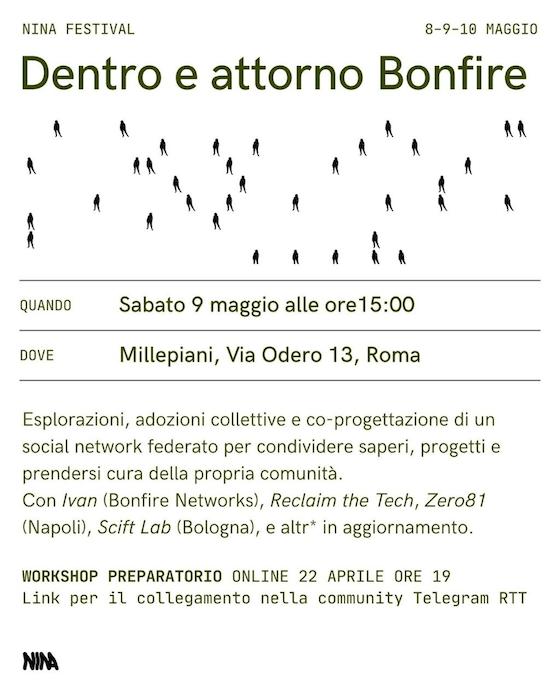
@elettrona@poliversity.it ouch! though today at 19.00 we will hold a workshop online for preparing the structure and priorities, we can share the link via DM if you can make it...
On Saturday May 9th in Rome, as part of the Nina Festival, we're hosting a workshop to think with Bonfire, exploring and co-designing federated digital spaces for caring for our communities.
Together with @reclaimthetech@mastodon.uno, Zero81, Scift Lab and more.
📍 Millepiani, Via Odero 13, 3pm
If you're in (or near) Rome, come join us!
The Gentlemen e SystemBC: anatomia di un’operazione ransomware con botnet da 1.570 vittime aziendali
Check Point Research ha documentato come il gruppo ransomware-as-a-service The Gentlemen impieghi la botnet SystemBC per orchestrare attacchi devastanti: 320 vittime rivendicate, 1.570 host aziendali compromessi e un toolchain che combina Cobalt Strike, Mimikatz e GPO per cifrare…
Unknown
Kill Yr Substack
I've been tired of Substack platforming white supremacists, Nazis, neo-confederates, and so many of the worst people on the internet for a long time now. So I made a browser extension for all of us.
Kill Yr Substack intercepts every Substack link you click and redirects it to the web snapshotting site archive.is. The request to Substack never fires, which means that they never see your traffic, which means that their numbers go down. You still get to read the thing tho.
Install Kill Yr […]
This content is not available.
