You are given limited access to the Gearworks of Reality. You may delete one of these from human civilization.
77
Replies
0
Boosts

@mttaggart they’re the same picture
@ajn142 I don't know that I've ever seen an employer require employees to sit at a blackjack table outside of Vegas, but I do agree there are similarities.
@mttaggart I mean, both amount to "put money in, trigger nondeterministic statistical system, maybe get something back, repeat". It's just that employers have been sold the idea that putting money in and pulling the lever until they get something usable is less expensive than hiring someone who can do the work without GenAI, or will let that person do so much more work for the same wage, but they don't recognize the equivalence to feeding the rent money to a slot machine.


@mttaggart There's a difference?


@mttaggart Limited only to casinos, prediction markets, etc.. GenAI and it's not close.
Far more destructive.
@distractal Watching what gambling's done to a lot of lives, I'm really not so sure, hence the poll.


@mttaggart As a Methodist, I chose gambling. Maybe we can compromise somewhere on no one being a billionaire.
@vwbusguy Extreme wealth and poverty is such a low bar to clear for a just society, but right there with you
I don't want to remove responses, but for clarification, I am referring to recreational gambling such as casinos, sports betting, and prediction markets. An overbroad definition of "gambling" is pointless.
Edit: And yes, day-trading and otherwise gamifying securities markets.
And yes, day-trading and otherwise gamifying securities markets.
To confirm, you are saying that yes, these count. Yes, I can consider speculative investments of stocks to be gambling.
@mttaggart Well, get rid of speculative stock trading and Generative AI remains a toy that produces a funny form of gibberish (my favorite era for the tech). I know which I would choose.
Fascinating to see how many folks think these are identical.
I remember once being called a "lumper" in school—trying to make the case that many different categories were in fact indistinct, thereby rendering the discussions of differences moot. This is in contrast to "sorters," who prefer to highlight differences.
I can see how these two things look similar, but I also think it would be imprudent to regard all the tools of oppression without distinction.
Or perhaps y'all think one is a subclass of the other? Are LLMs just gambling? I find that a tad reductive, if I'm honest.
I guess I turned into a sorter with time.

@mttaggart Both arise from the same character flaw: the belief that success can be attained via shortcuts and that effort and dedication are not necessary. Removing a single stick of dynamite from the barrel does not defuse the bomb.

@mttaggart I think that our problems with llms are problems at all because of gambling - this wouldn't have gotten so big if a certain group of people weren't so ready to bet the farm on its success

@mttaggart They shouldn't be lumped together because, on the surface, they are different. But Generative AI uses addictive mechanics, whether accidentally or by design, which is what gambling (and gaming) does to a lot of people. We could blame the users of the technology, but it takes two to tango.


I answered before reading your clarification. Generative AI is far more important to get rid of, but I voted for gambling as that genAI would not exist without gambling.
Not, however, because they are the same, or one is a subset of the other. They are quite different. But GenAI doesn't produce anything - it exists only as a by-product of a circle-jerk of companies inflating each other's stock prices.
The stock market *is* gambling.
No gambling -> no stocks -> no AI. QED

@mttaggart “these are the same thing” was my first response… I see they’re not the same but the economics behind generative AI - which makes it both possible at scale and a problem for society at large - is most definitely all gambling and, almost certainly fraud.


Venn diagram of 4 different cognitive associative classification mechanics/methods people apply and each individual has their preferred favorite.
These are like tools in cognitive toolbox, use the appropriate tool for the challenge, not “law of instrument”- https://thedecisionlab.com/biases/law-of-the-instrument
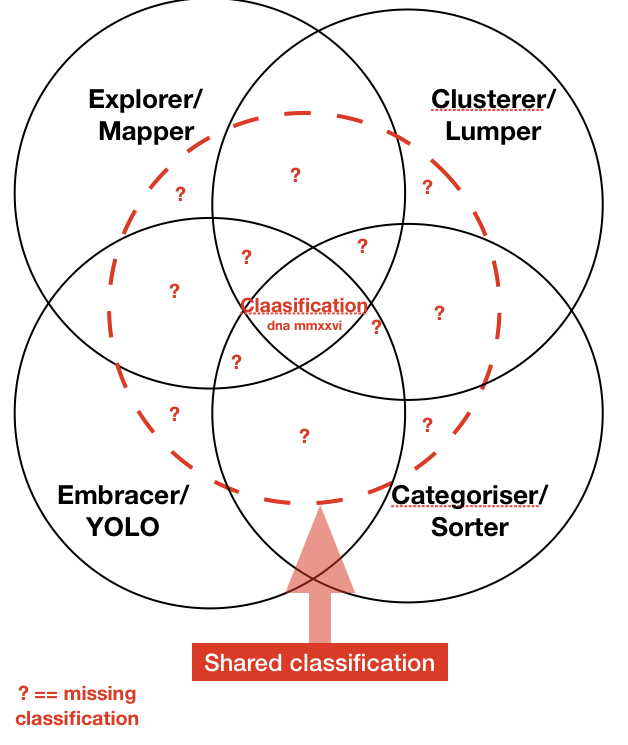



@mttaggart we're just looking for a loophole to get rid of both.
(Although to be honest, I like the transformer model a little bit for options it gives to human computer interfaces, but I really don't like how many people are gambling everything on LLMs doing more than just predicting the most likely next word)

@mttaggart LLMs as gambling is horseshit. That's like saying statistics is gambling. And cryptocurrency = gambling. People, save your anger for the things that are truly evil.
@codinghorror @mttaggart How about an argument that investment in LLMs is turning into gambling? (I'd accept early investment really was investment, but I think at some point the desperate pursuit of 'AI' by governments and corporations is not going to be distinguishable from problem gambling - kind of "I've got to keep going to recover my losses".)
@GerardThornley @mttaggart yes, stock market type stuff, sure


@codinghorror @mttaggart operating AI is closer to gambling than it is to statistics. If it answered consistently I might say otherwise, but it doesn't, & that's not even disputed.
Crypto is closer to fraud than gambling, despite many people gambling on crypto.
AI very much is something to be angry about. I'm a little confused as to why you'd think otherwise?
@vex @mttaggart I dunno, it's like being really angry at screwdrivers. There is utility there with LLMs. I know because I've saved hours of work with them as research assistants. It's a tool. If you know how to use it, what it's good at (screws) and what it's not good at (driving nails).. it's a useful tool. I can provide dozens and dozens of specific examples, but only in the "research assistant" area. I just don't find it practical or useful to be really pissed off at screwdrivers. YMMV. If people want to be really pissed off at screwdrivers, I love that for them but I humbly submit crypto is FAR more dangerous and has NO good use cases that aren't like, crime or gambling. Assuming you have limited wells of anger, perhaps.. direct it.. there? Or if you have unlimited anger, I dunno, go nuts?
@codinghorror @mttaggart I wanna see where the middle ground is between us so I'll try engaging with the tool analogy.
I think AI is closer to a gun than a screwdriver. I'm going off of majority use case, as approximated by energy & money. & When there's a larger excess of guns, there's a larger excess of harm by guns (e.g. the US). I think that analogy translates well, except guns kill directly & AI indirectly.
I say this because the way AI is being implemented seems to have more destructive than constructive outcomes.
@vex @mttaggart well, in the sense that poor use of it has actually killed some people, perhaps.. but I would put it in the category of automobile rather than gun, because a gun is purpose built to kill, and I just don't believe global brain stats with every word ever written ever, ever had that design intent of killing that a gun does .. what other utility do guns even have .. you'd need to do a LOT of convincing for me to get on board with that
@codinghorror @mttaggart I can make my case more easily comparing AI with a car than a gun. It's only been within the last decade that gun deaths have surpassed automobile deaths. & that's without including climate-related deaths indirectly caused by over a century of automotive pollution.
Cities being designed around cars have also shown to have a net negative effect on life satisfaction, with cities banning cars becoming measurably happier after.
& despite cars being transportation devices, car-centric cities actually make transportation less accessible, making walking & biking longer & more dangerous. They also exacerbate poverty by being a common requirement for employment.
The detriment of cars comes from their application rather than their existence. Requiring individual purchase for collective transportation is an act of class warfare that exacerbates poverty. It has financial, environmental, emotional, & health costs that all get passed down to the end users & their neighbors. & we as individuals had little say in their integration into society.
AI is currently undergoing such an integration, with data centers being forced through despite 70% dissent from residents. It's also being integrated into technology in a way that's clearly for surveillance & control. The systemic integration of AI can only be prevented through mass rejection of the tool, because consistent use of it would otherwise deteriorate resistance to its forced integration.
So even though you're right that people are directing their ire at a tool, we have little ability to direct the anger at the forced systemic integration of the tool, since such dissent is simply ignored. The only power we have in resisting such integration is rejecting the tool itself en massé.
@vex @mttaggart it wasn't forced on me. I use it appropriately and save SO many hours of human work, but I centauir everything.


@codinghorror @mttaggart You give it a prompt. You push the button. Maybe you get what you were looking for, most likely not. You give it a prompt, you push the button…
In terms of behaviour and feedback that seems fairly similar to playing a slot machine.


> Fascinating to see how many folks think these are identical.
I came here to mention I think there's an overlap. But I think I could also argue generative tools can also be a higher-level paintbrush, which gambling never is.


@mttaggart Most people are sorters in my experience. I have that experience because I'm often accused of being a lumper. Thing is, I'm neither.
If I see a duck and a goose, I don't think of them as the same. I don't think of the goose as a big duck, or the duck as a small goose. I see the value of each.
But I do think that their similarities warrants a waterfowl category, and some properties most waterfowl share.
People tend not to have patience with that and accuse me of lumping.
@mttaggart Anyway, genai and gambling share something, yes.
The commonality is the variable ratio reinforcement schedule. You can't be sure that the next prompt is going to reward you with a good result, so you pull the one armed bandit's lever again. And again. And again.
And you focus on the great results you sometimes get, and not the many in-between failures. Those are explained away with "prompt skill issues" and whatnot.
@jens @mttaggart I'll tell you this .. you will almost always get terrible results on any question (beyond incredibly trivial, simple questions) unless you pick the longest think modes. Gemini is the worst for this.
@codinghorror I'm not known to be a fan of LLMs, and never got great results out of them. But then, I don't keep trying... 😂

I'm more of a schmeerer then. There are distinct boundaries, but there's lots of schmeer in between.
I had so many arguments in college about the definition of a species. Turns out that homo neandertalis is homo sapiens (neandertalis).
There are places where bright lines can be drawn, I'm not sure this is one of them.
@johntimaeus Here are a few worth considering:
- Gambling actually makes money for the game operators (unless you're DJT, who couldn't even make a casino profitable)
- The ability to create a gambling operation is far more accessible to more people than LLM generation
- Nobody is claiming gambling is the key to a new future for humanity. While that's marketing, I do think some of the leaders of the adventure are true believers.
- This last one is a matter of degree, so definitely fuzzier. But the "win rate" for LLMs is, objective depending, not nearly as poor as recreational gambling, IME. It would be much easier if the technology never worked. But in many cases, it does upsettingly well.

@mttaggart One could argue that generative AI is a form of gambling, but so would farming and moving to a new town.
@linuxandyarn I think you need a useful distinction between recreational gambling and risk-taking.


@mttaggart generative AI wouldn't be so bad if the world's wealthiest and most powerful weren't gambling so much wealth on it being able to replace human labor.