The Trump regime's all-out war on fair elections -- spanning myriad tactic and agencies, often blatantly illegally -- should be a front-and-center preoccupation of every American journalism organization. At best we're getting episodic coverage. ProPublica gets it. https://www.propublica.org/article/trump-midterm-elections-takeover-takeaways
I’m tinkering with doing a run of zines exploring how different autonomous and self-organized community functions can be made ultra lightweight and cargobike-portable: the School at Hand, the Station at Hand and the Clinic at Hand.
My polestars here, as they have been, are raumlaborberlin, Luca Weste’s work on latterday pirate radio, Cassie Thornton’s Hologram, Paulo Freire and bell hooks, and inevitably and for all that I have beef with him, Ivan Illich. And the intent is simply to demonstrate what mobile community infrastructure might look like when built along these lines.
من قلب غزة... ما زلنا نعيش أيامًا لا تشبه الحياة. الخوف، الجوع، وانعدام أبسط مقومات العيش أصبحوا جزءًا من يومنا. كأم أعيل أسرتي، أشاهد أطفالي يحاولون التعايش مع واقع قاسٍ لا يستحقه أي إنسان.
نحن لا نطلب المستحيل، بل فرصة لنعيش بكرامة، وطعامًا يسد الجوع، ومأوى يحمينا، وأملًا يمنح أطفالنا مستقبلًا أفضل.
إذا كنتم قادرين على المساعدة، فكل دعم مهما كان بسيطًا يصنع فرقًا حقيقيًا في حياتنا. وإن لم تتمكنوا من التبرع، فمشاركة رسالتنا قد تصل إلى من يستطيع.
لا تنسوا غزة..العائلات التي ما زالت تنتظر بصيص أمل.
Fake references.
While peer-reviewing an academic paper, I checked the reference list and found that around 80% of the cited sources simply do not exist. It seems highly likely that they were fabricated by GenAI.
This isn't a mistake. It's academic misconduct. Brazen, lazy, and profoundly unethical.
This is an abuse of the peer-review process and a waste of reviewers' time.
If the references are made up, I have no way of knowing whether the experiments were run at all, or whether the results are made up.
This is why I have stopped reviewing. A large enough fraction of paper authors are willing to submit complete fabrications that I no longer trust a process of reviewing a paper as an adequate safeguard. Unless a publication process has some mechanism to ensure that the experiments conducted in the paper actually took place, I see no value in doing the review. Slop merchants have made academic misconduct cheap and easy, and academic promotions and hiring processes have incentivised it.
I think, at least for computer science, we need to move away from papers as the principal output from research. They serve two purposes and are bad at both:
- Communicating science.
- Being a record of specific experiments.
The fixed page limits and rigid style (which largely enforces in-group bias because it’s rarely a documented style, but if you don’t know how to write a paper that sounds like a good {venue} paper, it will be rejected) limit the first. No interactive visualisations, no videos, and often a requirement to minimise colour mean that we’re leaving a bunch of tools for effective communication on the table. And the long delay for publication means that the research is often superseded as state of the art by the time anyone actually sees the publication. There are far better ways of communicating science.
The record is also poor. There’s some work now on artefact evaluation, but that doesn’t happen until after the paper is accepted and it’s rarely mandatory. If you do science well, make everything public and solicit early and wide feedback, you’re actively penalised because you can’t deanonymise yourself and so you find yourself in the ludicrous position of getting negative reviews because the reviewer is familiar with your work and doesn’t see much delta between your work and your paper about the work.
I would love to see a focus on public and transparent work, with papers being invited submissions based on already-evaluated work. Organisations such as IEEE and ACM could then fund at least copyeditors, if not writers, to make sure that the papers are readable and clearly communicate the work.

@datak @informapirata @andre123 @privacypride
Pardon ...
Parlando di indirizzo email...
Io ne uso uno .LV
e mi chiedono:
-che vul dire ?
- Laguna Veneta ovviamente
😂
Uno mi ha chiesto se poteva averlo anche lui
😂
come no! Pagando il canone annuale
(si tiene il gimeil gratis)
🤷♂️
[Nouvel article] La stratégie Ender de l'IA. Le monde comme délégation et comme simulation. https://affordance.framasoft.org/2026/07/la-strategie-ender-de-lia-le-monde-comme-delegation-et-comme-simulation/
@pluralistic this is also one reason why the supposed efficiency of capitalism often fails . . . the people with the most information about the business are often the workers, and often have the least input on decisions.
@PabloMartini @quixoticgeek @peterbrown @Su_G @BillySmith
My point is, yes they work - but they work less efficiently than cheaper plain solar panels would. They'd be far better installing cheaper ordinary panels on poles as a canopy overhead paths and car parks. It would overall be cheaper, and harvest more energy in the same amount of time as a ruggedized, more expensive, ground mounted panel.
Joggers always look unhappy but are hard to cuddle
wait. we have never seen @TheBreadmonkey and @CountBinface in the same room, have we?
Partial shading of panels is a big problem that is often overlooked by solar installers. Any shading of a section of a panel not only stops they bit of the panel generating electricity, but it turns it into a higher resistance section of panel, reducing even further the output of the rest of the panel. Having support posts and knitting and all that other gubbins above and around the track to shade the panels is a really suboptimal situation to build solar.
5/n
Railways also come with a lot of extra gubbins beyond the two rails nailed to wood planks (or more often bolted to concrete these days). In more modern networks, rather than burning dinosaurs, the railways have power which comes from all that knitting above the tracks. The above here is the problem. Cos it's going to shade the panels. "But it's only a thin wire, so a small shadow" I can hear some techbro angry typing. You don't need to fully obscure a whole panel to reduce it's output.
4/n
What's going on at Meta?!
Meta removed support for end-to-end encrypted messages in Instagram, & now it lets users create AI images with other people's public photos? 🤯
To make it worse, users must OPT OUT if they do not want this.
Find out how to opt out here 👉 https://tuta.com/blog/meta-ai-feature-lets-people-edit-your-instagram-pictures
is "Muse" short for "Misuse"?
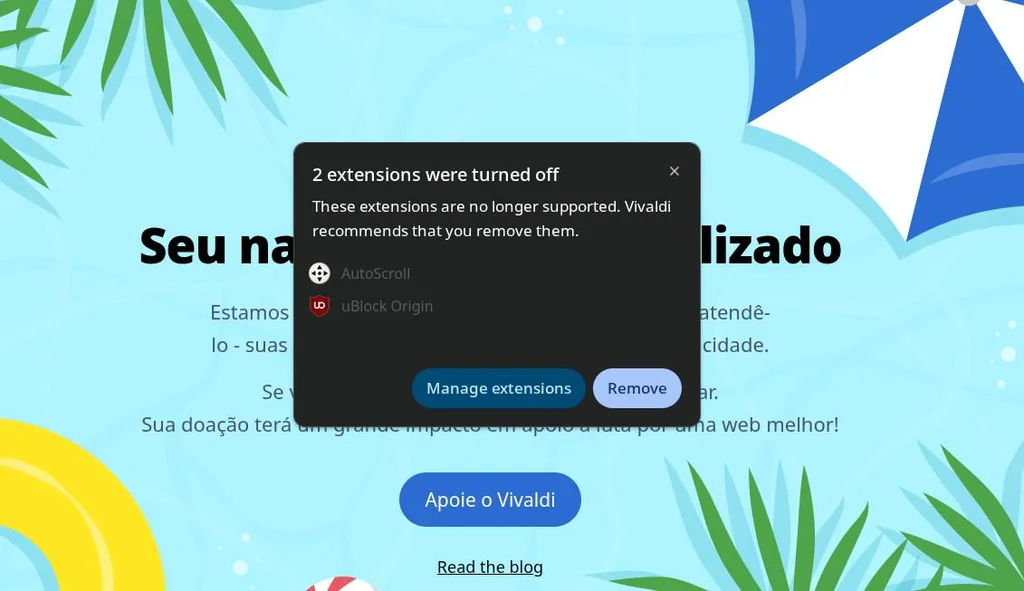
What's going on here then, @Vivaldi? I thought you where supposed to be better than this? No warning about this coming either?
@forteller @Vivaldi damn.