Wildfires up 57% in Europe in just four years, WHO warns
https://www.euronews.com/2026/07/24/wildfires-up-57-in-europe-in-just-four-years-who-warns?utm_source=flipboard&utm_medium=activitypub
Posted into Health News @health-news-euronews
Discussion
Wildfires up 57% in Europe in just four years, WHO warns
https://www.euronews.com/2026/07/24/wildfires-up-57-in-europe-in-just-four-years-who-warns?utm_source=flipboard&utm_medium=activitypub
Posted into Health News @health-news-euronews
Just spent 40 minutes walking up and down every aisle in the supermarket because I was too ashamed to ask where the instant mashed potato was.
Der @isotopp hat es wieder mal geschafft, ein Bauchgefühl von mir in Worte und Zahlen zu gießen.
Große Leseempfehlung!
Moore’s Law und die AI Blase
https://blog.koehntopp.info/2026/07/22/moores-law-und-die-ai-blase/

Künstliche Intelligenz und der neue Faschismus
Die Gefahren der Artificial General Intelligence
Elon Musk und Donald Trump kündigen massenhaft Verwaltungsmitarbeitern, um einen KI-Staat zu errichten. Tech-CEOs verkaufen künstliche Intelligenz als Heilsbringer für die größten Probleme der Menschheit, obwohl die entsprechende Industrie auf Ausbeutung und Menschenverachtung beruht. Warum lässt sich die Öffentlichkeit durch Spekulation über Erlösung oder Auslöschung durch KI von den erheblichen Schäden durch KI in unserer Gegenwart ablenken? Wie erkennen wir die zunehmend faschistischen Tendenzen, die sich im Zusammenspiel von Tech-Industrie und der neuen Rechten bilden? Rainer Mühlhoff entwickelt Antworten und diskutiert Lösungsansätze.
WordPress goes ActivityPub – Mastodon, Bizzfed etc.
#Fediverse #Wordpress #Mastodon #Bizzfed #ActivityPub #FOSS #DigitalSovereignty #Blog Auf der Suche nach einer Möglichkeit zur Verbindung von meiner WordPress-Seite mit Bizzfed habe ich dieses Plugin gesehen und es gefällt mir schon jetzt! Sehr schlank, schnell am Start und binnen weniger Minuten war es möglich
#Bizzfed #Blog #DigitalSovereignty #Fediverse #FOSS #mastodon #Wordpress
https://mayershofer.eu/2026/768/
We took two decisions finding non-compliance by Google with the DMA for self-preferencing its own services on Google Search, and for putting in place restrictions on businesses to direct consumers to alternative, often cheaper, purchase channels on Google Play.
In this regard, we issued Google a fine of €460 million and a fine of €430 million respectively.
We will not hesitate to use our tools to safeguard business and innovation opportunities opened up by the DMA.
@HennaVirkkunen the EU has gifted to Google the continuation of its Google Play monopoly in exchange for... What exactly? Today I can write software for every Android *device* in Europe, but you're letting them gatekeep who can do so starting later this year with developer certification. Tech sovereignty please.
Google fined €890 million for breaching EU’s Big Tech rules https://www.euractiv.com/news/google-fined-e890-million-for-breaching-eus-big-tech-rules/?utm_source=eac&utm_medium=mastodon&utm_campaign=%40euractiv%40masto.ai

The Unaccountability Machine
Part-biography, part-political thriller, The Unaccountability Machine is a rousing exposé of how management failures lead organisations to make catastrophic errors.
When we avoid taking a decision, what happens to it? In The Unaccountability Machine, Dan Davies examines why markets, institutions and even governments systematically generate outcomes that everyone involved claims not to want. He casts new light on the writing of Stafford Beer, a legendary economist who argued in the 1950s that we should regard organisations as artificial intelligences, capable of taking decisions that are distinct from the intentions of their members.
Management cybernetics was Beer's science of applying self-regulation in organisational settings, but it was largely ignored – with the result being the political and economic crises that that we see today. With his signature blend of cynicism and journalistic rigour, Davies looks at what's gone wrong, and what might have been, had the world listened to Stafford Beer when it had the chance.
decibels per IEC power cable
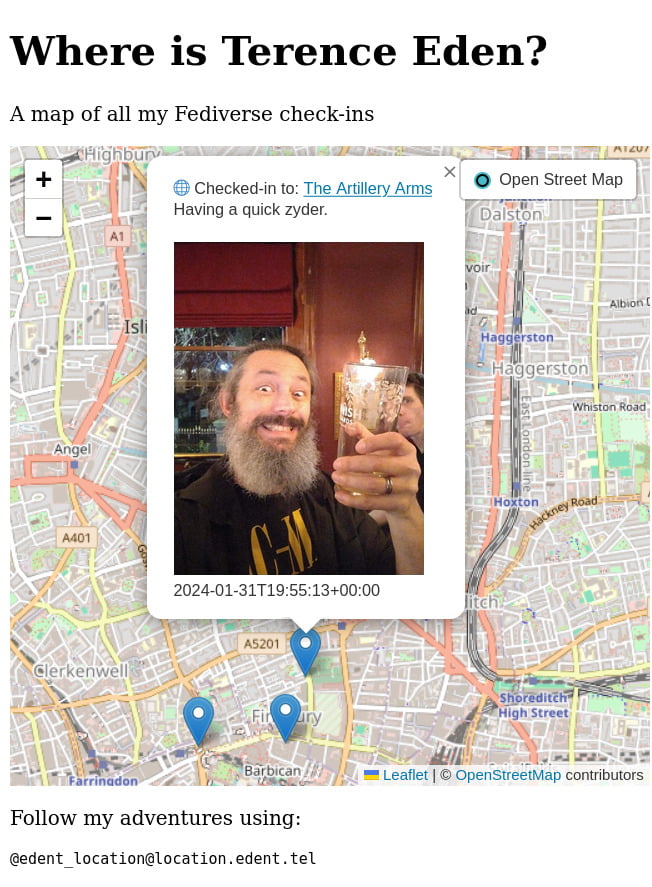
I want to be able to share my location with my friends on social media. Twitter (RIP) had a way to attach an optional location to a post. Facebook still lets me check in to venues. But neither ActivityPub (Mastodon) nor AT Protocol (BlueSky) allow me to do that.
I've been banging on about this for a while so was delighted to be invited to chat with the GeoSocial Task Force on their monthly call.
But, before I start, please remember that these proposals are not mandatory. If you don't want to share your location, then please don't share your location. This is an optional feature which shouldn't be used by people with a strong need for privacy.
We were primarily discussing the nascent Geographical Microsyntax proposals.
Firstly, I love the idea of being able to share my location. I want my friends to know I'm in town for a gig. I want people to think I'm cool because I'm seeing some experimental theatre. I want to virtue signal that I'm giving blood.
Similarly, I want to be able to find social media posts by location. What's happening right now in Paris? Did anyone else hear that sonic boom in London? Which cool people are also at this gig with me?
But, I do think these proposals have some issues which need to be addressed.
The primary thing missing from the proposal is any form of understanding what users want to do with a geotagged post.
You see a post like:
Hanging out with friends. I just checked in to Leicester Square.
What do you expect to happen when you click that link?
What other things do people want to do with geotagged posts?
Without knowing what people might want to do with this information, it's rather hard to design a service which meets their needs.
Where I disagree with the proposals is the idea of using inline text as a form of microsyntax.
Proposals like "I am in /London/ eating ice-cream" or "Checked in to Leicester Square L:N123456" fail for a couple of reasons.
Things like #hashtags and @mentions developed organically on social networks before they were eventually adopted by the platforms themselves. It is rare that a top-down diktat can be used to tell people how they should be formatting their posts.
More importantly, people are crap at formatting things consistently! Every event I go to has people using #Event alongside #Event2026 or #Event26 or a hundred variations.
Even if users could format it consistently, names are ambiguous. Is 🌐:Paris the one in France or Texas?
I'm strongly of the opinion that text is for text, not syntax.
Saying that you're on a specific point on the globe doesn't always provide useful information. Even with altitude, it isn't always possible to work out if your in the Starbucks or the Costa next door. Do you want to say you're in a train station, or a distinct platform, or even a specific train journey?
There are various services which offer unique IDs per loosely-defined place.
Google Maps provides a Place ID for every thing that it knows about. There's a similar service from FourSquare. But both of those are closed and proprietary systems - they can only be updated by the company that creates them.
Wikipedia's Wikidata has IDs for lots of places, similarly OpenStreetMap has nodes with names which can be used to identify locations.
But all of these suffer from the same flaw; they are centralised.
If Google kills its service then all those Place IDs die.
This has happened before. Yahoo used to run the Where On Earth IDentifier service but discontinued it.
While OSM and Wikipedia are great projects, they're still centralised. If you're banned from OSM, you can't create a new node.
So, to my mind, the primary way of identifying a place has to use a fully open, globally agreed, and unrestricted standard.
The obvious choice is latitude and longitude as defined by WGS 84. It allows for arbitrary precision anywhere on the planet.
No one can stop you issuing lat/long just because a country is under sanctions. The standards community can't revoke your access to it. The co-ordinates are well understood by almost all software.
There are some alternatives. Google's Plus.Codes build on top of lat/long to make something more human readable. But, crucially, human readability is not the issue here. This is metadata which should never be shown to a human. If a user interface wants to format a lat/long they can do so as a Plus.Code or any other format.
There are dozens of competing ways to mark up a location.
It seems sensible to me that, given most major social media protocols use JSON, adding GeoJSON would be the simplest way to add geographic information to a post's metadata.
At its most basic, a single "Point" can be shared like so:
JSON
{ "type": "Feature", "geometry": { "type": "Point", "coordinates": [-0.13005,51.5103] }}
It can have as much or as little precision as needed.
If the place being checked into has a name, it can also be added - this could be used for display purposes within the message
{ "type": "Feature", "geometry": { "type": "Point", "coordinates": [-0.13005,51.5103] }, "properties": { "name": "Leicester Square" }}
The properties can be as complex as the sender wants. For example it could add Wikidata references, OpenStreetMap IDs, telephone numbers, or some cool new thing which hasn't been invented yet.
Here's a maximalist example of checking in to a park:
{ "type": "Feature", "geometry": { "type": "Polygon", "coordinates": [ [ [-0.1303791,51.5099976], [-0.1295305,51.5100444], [-0.1297077,51.510947 ], [-0.1308786,51.5105859], [-0.1308893,51.5105793], [-0.1303791,51.5099976] ] ] }, "properties": { "name": "Leicester Square", "WikiData": "Q848912", "OSM": "4082589", "GooglePlaceID": "ChIJPcTFENIEdkgR94E58rgB69o", "PlusCode": "9C3XGV69+4X", "Quinfrob": "🌐89451_𰻝", "address": { "road": "Leicester Square", "neighbourhood": "St. James's", "quarter": "East Marylebone", "suburb": "Covent Garden", "city": "City of Westminster", "ISO3166-2-lvl8": "GB-WSM", "state": "England", "ISO3166-2-lvl4": "GB-ENG", "postcode": "WC2H 7NA", "country": "United Kingdom", "country_code": "gb" } }}
My personal opinion is that the following needs to happen:
You can read the minutes of the meeting and I'd encourage you to join the next call.
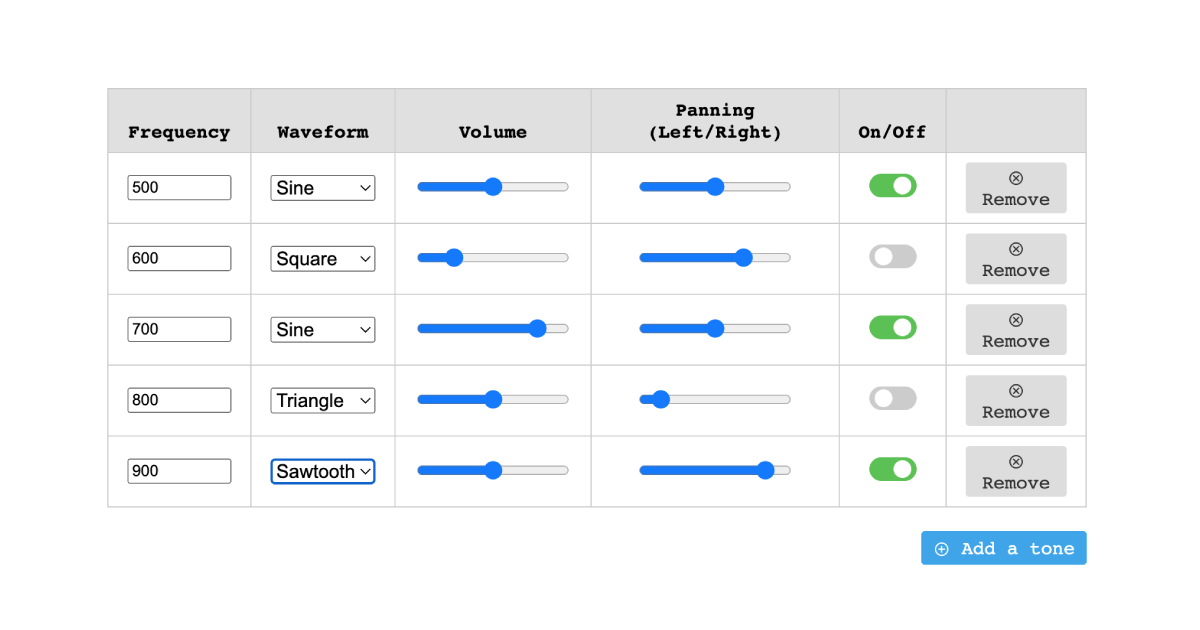
#ActivityPub #BlueSky #fediverse #FourSquare #geolocation #json #openStandards #OpenStreetMapI don't know who needs to hear this, but [950Hz], [1400Hz], [1800Hz].
@ryanc I'm such a geek. I went here: https://onlinetonegenerator.com/multiple-tone-generator.html
@frxe @benpate IMO the uber-scolds in the Mastodon Imperial Core have been losing clout as the network continues to grow around them.
however, it's still very important that people who love fedi (as opposed to The Mastodon Network™) continue working toward a few goals:
1. decrease median server size so as to de-emphasize fediblock drama
2. continue attracting cool misfits who aren't obsessed with purity spirals and moral righteousness
3. decrease the % of ActivityPub users on Mastodon.
deutrino I strongly believe we need more interest-based websites on the network. so many of the issues, from where I sit, come from the idea that the network is the attraction, but then you have no real reason for people to choose one site vs another, and no real sense of community, and no sense of responsibility to anything.
Everyone here already ends up a little mercenary, and you can’t tell anyone new why they should sign up, nor where. And I blame Mastodon’s designers for this, with their insistence on de-centering the Local feed and not making theming easy. they not only centre the network, but they frame the local website as a generic dumb terminal for accessing “Mastodon”.
Former Nunakput MLA Herb Nakimayak will be the Inuit Circumpolar Council Canada president for the next four years after winning an election on Tuesday.

The Rose Field
The breathtaking conclusion to Philip Pullman’s landmark new trilogy The Book of Dust! Return to the world of His Dark Materials and discover what fate has in store for Lyra.
Lyra Silvertongue is alone in a city haunted by daemons, searching for her beloved Pan. Malcolm Polstead isn’t far behind, searching for Lyra. And they are both racing toward the desert of Karamakan, following the trail of roses said to hold the secret of Dust.
Their allies and enemies are converging on the mysterious red building at the heart of the desert: Marcel Delamare and the military might of the Magisterium; the radical Men from the Mountains; scientists, scholars, and spies; troops of witches and other people of the air. And awaiting them all is a previously unseen and chilling new threat that will change everything.
The intertwining odysseys of Malcolm and Lyra, their journeys both internal and external, will test their limits and challenge even their most dearly held beliefs.
As ever, Philip Pullman is using the language of fantasy to illuminate our world and to explore the deepest questions of what it means to be alive and awake to all the splendors and horrors around us. The extraordinary novels of The Book of Dust speak powerfully to today’s readers and will take their place alongside the forever-favorites of His Dark Materials.
I am contemplating replacing my self-hosted #Gitlab for a self-hosted #Forgejo.
<rant>Gitlab has not had a single update the past year and a half, focusing entirely on AI slop I don't care about. That's not entirely true: each release breaks basic functionality in new and interesting ways as I presume they dogfood their own AI slop.</rant>
Does anybody have experience with more advanced features of Forgejo? Planning tooling beyond just 5 issue tickets? Issue templates? Documentation using wikis? Docker and Maven registries? CI/CD and k8s runners/deployment? Are there technical reasons to prefer Forgejo over #Gitea?
I use Gitlab professionally and have been hosting my own instance as a prosumer for close to a decade: I have literally 100s of personal projects spanning multiple decades, so it's neither a single-user instance with 5 projects nor intended for enterprise usage. I don't think Forgejo can replace my professional needs (yet?)
Does anybody have experience with their #ActivityPub integration?
Parlem de Control Parental: taller ja disponible!
Si et vas perdre aquest taller per a famílies, ja el pots veure als nostres canals. 📌 https://fediverse.tv/w/7ryefiV8ZPdGxRKJR5A2uU
💬🤳🏻Un espai de reflexió compartida al voltant de les eines de control parental digital, no només des d’una mirada tècnica, sinó també educativa i relacional.
🧶Compartim què són aquestes aplicacions, per a què estan creades i en quin marc poden ser útils, però també dels límits, contradiccions i dilemes.
New report "dismantles the dominant narrative that massive amounts of minerals are needed for the energy transition, revealing instead a potent convergence of political, military, and corporate interests racing to control the resources that underpin modern warfare and artificial intelligence."
furry levels are 96% and rising
(96%) ■■■■■■■■■□
@catsalad :3
As someone who sells software, of course I’m fine with buying software.
I’m not okay with renting it.

Install bonfire.cafe
Get the full app experience