i'm on board
(choo choo)
Discussion
i'm on board
(choo choo)
The #openweb is the soil, #OMN the seeds
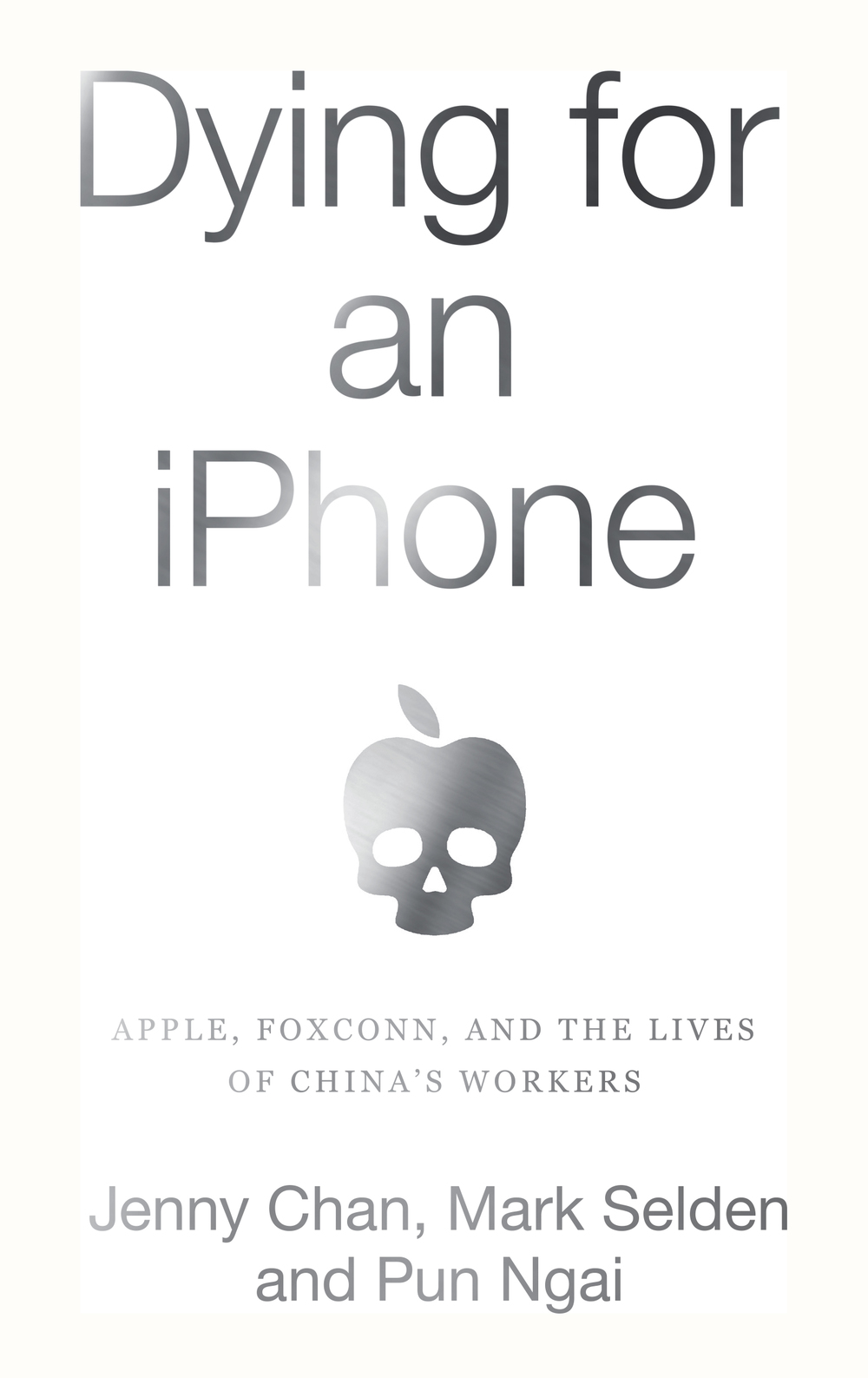
Dying for an iPhone
Suicides, excessive overtime, and hostility and violence on the factory floor in China. Drawing on vivid testimonies from rural migrant workers, student interns, managers and trade union staff, Dying for an iPhone is a devastating expose of two of the world’s most powerful companies: Foxconn and Apple.
As the leading manufacturer of iPhones, iPads, and Kindles, and employing one million workers in China alone, Taiwanese-invested Foxconn’s drive to dominate global electronics manufacturing has aligned perfectly with China’s goal of becoming the world leader in technology. This book reveals the human cost of that ambition and what our demands for the newest and best technology means for workers.
Foxconn workers have repeatedly demonstrated their power to strike at key nodes of transnational production, challenge management and the Chinese state, and confront global tech behemoths. Dying for an iPhone allows us to assess the impact of global capitalism’s deepening crisis on workers.’

Storytelling
L'arte di raccontare storie è nata quasi in contemporanea con la comparsa dell'uomo sulla terra e ha costituito un importante strumento di condivisione dei valori sociali. Ma, a partire dagli anni Novanta del Novecento, negli USA come in Europa, questa capacità narrativa è stata trasformata dai meccanismi dell'industria dei media e dal capitalismo globalizzato nel concetto di storytelling: una potentissima arma di persuasione nelle mani dei guru del marketing, del management, della comunicazione politica per plasmare le opinioni dei consumatori e dei cittadini. Dietro le più importanti campagne pubblicitarie - e ancor più dietro quelle elettorali vincenti (da Bush a Sarkozy) - si celano proprio le sofisticate tecniche dello storytelling management o del digital storytelling. Questo è l'incredibile inganno ai danni dell'immaginario collettivo svelato da Christian Salmon nel libro, frutto di una lunga inchiesta dedicata alle numerose applicazioni del fenomeno: il marketing conta più sulla storia dei brand che sulla loro immagine, i manager si servono di aneddoti per motivare i propri dipendenti, i soldati in Iraq si allenano su videogiochi progettati da Hollywood, gli spin doctor descrivono la vita politica dei loro clienti come in un racconto.

La crisi della narrazione
#Gaza They say the war has stopped, but how can that be when the bombing continues and there are deaths and injuries every day? Please help so we can help our loved ones. https://gofund.me/4e07be7chttps://gofund.me/4e07be7c
The software industry is undergoing its most significant transformation since the rise of cloud computing. Last week, $285 billion in market cap evaporated from software stocks in a single day — a selloff traders are referring to as the “SaaSpocalypse.” Investors seem to have reached the conclusion that AI agents are going to reshape how organizations buy and use software. I don’t think they are wrong.
Private sector companies are scrambling to adapt. But there’s another sector that may be even more exposed to this shift, and far less prepared for it: government.
Many government technology leaders are being asked to make major procurement decisions during a period of unprecedented instability in the software industry. The assumptions that have traditionally guided smart technology investments for the past decade — buy commercial off-the-shelf software, pay per seat, move to the cloud — may no longer hold.
The problem is that the government procurement cycle is slow by design. Decisions being made today will bind agencies to contracts lasting as long as five to seven years. An enterprise agreement signed this in Q1 could lock an agency into paying for software seats that AI tools have made redundant by year three — with no easy off ramp.
The traditional mismatch between government procurement cycles and the pace of change in the technology industry is becoming even more acute in the AI era. This problem is only going to get worse.
Most government technology leaders are still operating from a playbook written in the 2010s. The common strategy is to modernize legacy systems by migrating to commercial SaaS products. This may have been the right move ten years ago. Cloud-based software offered better security, lower maintenance burden, and faster feature updates than aging on-premise systems.
But the landscape has shifted significantly, particularly in the last 12 months. The value of software is migrating from user interfaces to APIs, from per-seat licenses to outcomes, from products to orchestration layers. AI agents don’t need polished dashboards — they need access to data and the ability to execute tasks. A procurement strategy optimized for buying seats for commercial interfaces may be optimizing for exactly the wrong thing.
The mental model of “replace the old thing with the new commercial thing” simply doesn’t account for a world where AI agents can wrap existing systems, orchestrate actions across them, and generate deliverables without requiring wholesale replacement of underlying infrastructure.
Another concern for government organizations is that the organizations best positioned to advise them on these shifts – existing legacy vendors – are often not incentivized to do so.
Large systems integrators and consultancies that guide government technology strategy make their money from complexity and labor hours. A message of “you may need fewer tools, less customization, and smaller teams — orchestrated by AI” does not align with their business model. So government leaders may not hear that message they need to hear until the shift is already obvious and the contracts are already signed.
Even absent malice, the fact that these changes are misaligned with existing legacy vendors business models means that simply won’t be incentivized to provide the information government leaders need to hear, when they need it.
There’s another assumption baked into traditional government technology strategy that deserves a reexamination – the economics of building software.
For a long time, this logic was straightforward. Custom software development was expensive, slow, and risky. Projects routinely ran over budget and past deadlines. Maintaining bespoke systems required specialized staff that agencies struggled to hire and retain. Commercial off-the-shelf products offered a potential way out — vendors amortize development costs across many customers, governments benefit from continuous improvement and transfer the maintenance burden to external organizations built better for it.
This logic has driven the preference for COTS and SaaS procurement. Why build it when you can buy it?
But the economics of software development have shifted dramatically in the past eight months. AI coding assistants have moved from novelty to core infrastructure. Recent analysis suggests that a meaningful percentage of code commits on major platforms are now authored by AI — not assisted by AI, but generated by it. The changes we are seeing are not trivial. Entire codebases are being refactored by AI agents working in parallel. This will change the math on custom development. The cost of building software tailored to an agency’s specific needs — rather than adapting workflows to fit a vendor’s product — is dropping rapidly.
None of this means commercial software will go away overnight. But it does mean the factors that made COTS and SaaS the default safe choice are eroding. The question “should we buy or build?” deserves renewed analysis based on current economics, not assumptions inherited from an era when custom development was synonymous with cost overruns and contractor dependency.
The traditional risk calculus in government technology focuses on project failure — the big modernization effort that goes over budget, misses deadlines, or fails to deliver promised functionality. These are real risks, and they’ve shaped a culture of caution around major technology investments in government.
But there’s a different kind of risk emerging: the risk of committing to a technology strategy that becomes obsolete mid-execution. The risk isn’t that the project fails — it’s that it succeeds at the wrong thing. An agency could execute flawlessly on a cloud migration strategy and still end up paying for years of software licenses that deliver diminishing value as AI reshapes workflows around them.
This is new territory. The frameworks government uses to evaluate technology risk weren’t designed for a world where the underlying economics of software could shift dramatically within a single contract period.
Given all this uncertainty, what would a prudent approach to government software strategy look like in early 2026? I think it looks something like this:
Shorter commitments where possible. The long-term enterprise agreement that locked in favorable pricing made sense in a stable environment. In a period of rapid change, flexibility may be worth more than discounted pricing. Agencies should scrutinize contract terms that limit their ability to adapt quickly.
Invest in understanding before deciding. Before committing to a modernization path, invest in truly understanding existing systems — not just their code, but the institutional knowledge and business logic they embody. That understanding has value regardless of whether you eventually replace, wrap, or extend those systems. Methodologies like SpecOps that focus on generating verified specifications of legacy system behavior offer a way to preserve optionality while the landscape clarifies.
Watch the API layer, not the interface. When evaluating software, pay attention to how well it exposes functionality via APIs, not just how polished its user interface is. The interface matters less in a world where AI agents are increasingly the “users” of enterprise software.
Cultivate independent perspective. Seek out advisors whose business model doesn’t depend on selling implementation services, and who have expertise in using AI to develop solution. The analysis that matters most right now is the analysis that might recommend doing less, not more.
Government technology decisions have always involved balancing risk against opportunity. What’s different now is the speed of change in the underlying assumptions.
The organizations that navigate this transition the best will be those that recognize the moment for what it is: not a time to double down on the strategies of the past decade, but a time to preserve optionality, invest in understanding, and resist the pressure to lock in long-term commitments based on a model of software value that may already be shifting beneath our feet.
The window to make these adjustments is right now — before the next round of multi-year contracts for COTS or SaaS software are signed, and before government agencies find themselves paying for a model of software that the rest of the world has moved on from.
#AI #artificialIntelligence #business #ChatGPT #COTS #technology@rbreich A real chance to reduce your debt at no cost to you! 💰
Join the $50k Personal Debt Relief Giveaway today and take control of your finances. Simply enter your ZIP code and complete the steps on the website to qualify. No hidden fees, no risk—just a limited-time opportunity to get real financial relief. Hurry, time is running out. Visit the site now and complete the process before it’s gone!
https://www.chd93jds.com/CD2KW8S/433QLM/
#debt #relief #cedit
Let's do this.
@TechConnectify brilliant
I'm doing an adult education course at the moment. AI is rampant, obviously, but I was really shocked to find that more than one person in the class has named their chatbot. When I responded in amazement at this revelation, they were shocked that I was shocked.
We can't actually build AGI with LLMs - it's like trying to get to the moon by stacking ladders.
We can, however, anthropomorphize them to a point where people think they're a valid voice in a conversation. "ChatGPT says..." - which is an incredibly charitable way to sum up a service that loosely paraphrases whatever webpage "I'm feeling lucky" would give you after filing off the serial numbers and reverse-engineering reasonable looking citations for it.
First post on public network created using minimitra:
All identifiers are ap URIs, so only FEP-ef61 implementers can load this post and interact with it.
1 like from forte
Prosegue la saga degli appunti e dei collegamenti casuali ed eventualmente sconnessi.
Inizio con una bella foto che ritrae Holger Czukay e Damo Suzuki dei Can agli Inner Space Studios a Weilerswist. I Can, una di quelle band che è in grado di innalzare di parecchio sopra il livello della media la musica di quelli che riesce a influenzare.

Dai Can a un’altra band che adoro, i Silver Apples, ovvero Simeon Coxe e Dan Taylor, tra i primi a credere che si potesse mischiare il rock con l’elettronica e tirarne fuori qualcosa di nuovo. Era il 1967-1968, addirittura. Consiglio molto, oltre all’ascolto dei primi due album degli Apples, questo articolino di Randall Roberts che racconta la storia della band e dell’idea che ci sta dietro: prendere dei vecchi oscillatori usati dall’esercito americano durante la Seconda guerra mondiale per disturbare le comunicazioni dei nazisti e farci della musica. Notevole.
Dalla musica sperimentale, eseguo un volo pindarico e atterro nella Tuscia viterbese (la terra che mi ospita), sul suo suolo ammaccato e sulle sue falde acquifere in sofferenza. Mi danno l’opportunità di farlo due articoli apparsi su «Dinamo Press» il mese scorso. Li firma Bengasi Battisti, ex sindaco di Corchiano, che molti di noi conoscono per le lotte in difesa dell’acqua pubblica e per quelle contro le coltivazioni estensive di noccioleti affamate di fitofarmaci che coprono la provincia. I temi affrontati dai due articoli sono le cave dismesse e abbandonate che attendono la bonifica, e l’uso degli erbicidi a base di glifosato. Riguardo a quest’ultimo punto è significativo, sottolinea Battisti, che lo studio scientifico che è stato usato per decenni per sostenere l’innocuità del glifosato sia stato recentemente ritirato perché si è scoperto che era stato manipolato dalla Monsanto, azienda produttrice del famoso erbicida Roundup. Vedi il caso alle volte?
Nei movimenti, qualcosa si muove. Il mese scorso è nata l’Alleanza Antiautoritaria, con l’obiettivo di costruire un fronte comune per arginare l’avanzata degli autoritarismi, per combattere fanatici e simpatizzanti degli uomini forti ovunque si annidino, anche a sinistra, per costruire solidarietà internazionalista con chiunque si trovi a subire il bastone dell’autorità. Io non so cosa richiedano i tempi infami che stiamo vivendo, non amo né i profeti né il profetizzare, ma se l’internazionalismo sta messo malino, e mi pare difficile controbattere a quest’affermazione, allora il dargli una spinta è un obiettivo che condivido profondamente, AA è come l’aria fresca in una notte estiva e diventa un collegamento stabile di questo blog.
Ancora dai movimenti: il Gruppo Anarchico Germinal-Trieste ha buttato giù un’analisi collettiva della questione palestinese intitolata «Calpestiamo tutte le bandiere dal fiume fino al mare». Avrei voluto scriverla io una roba così, ne sentivo la mancanza e dunque ve la rifilo.
Torno alla musica e mi avvio piano piano a chiudere la porta.
 Here Be Monsters, 2016 – Artwork by Kim Hiorthøy
Nella puntata precedente ho lanciato l’hashtag #LaMusicaDel2016 per ricordare gli album bellissimi usciti dieci anni fa; accanto a me c’era The Peace and Truce of Future of The Left dei Future of The Left. Saltando di disco in disco, è ora giunto il turno di Here Be Monsters dei Motorpsycho. È un album morbido per lo standard dei Motorpsycho, ma contiene delle melodie fantastiche, dei gran viaggioni psichedelici e una bellissima cover di Spin, Spin, Spin. Ha anche una gran bella copertina, non vi pare? E qui mi sovviene una domanda: il 2016 fu l’anno delle copertine minimali bianche coi disegni neri? Adoro questi collegamenti del caso che probabilmente non significano niente.
Infine, visto che parliamo di copertine, segnalo questo articolo che a sua volta segnala uno studio interessantissimo della storica dell’arte Carissa Kowalski Dougherty intitolato The Coloring of Jazz: Race and Record Cover Design in American Jazz, 1950 to 1970 («Il colore del jazz: razza e design delle copertine dei dischi nel jazz americano, dal 1950 al 1970»). Io vorrei leggere solo cose così. Lo consiglio molto.
Delle copertine analizzate ne prendo in prestito una. Rappresenta Underground, il disco del 1968 di Thelonious Monk, ed è l’immagine della sobrietà 😄 Il design è di John Berg e Dick Mantel e la foto è di Horn e Griner.
Fine.
 #acqua #albumCovers #AlleanzaAntiautoritaria #BengasiBattisti #Can #copertineBelle #DamoSuzuki #estrattivismo #glifosato #GruppoAnarchicoGerminalTrieste #HereBeMonsters #HolgerCzukay #internazionalismo #Israele #jazz #LaMusicaDel2016 #Motorpsycho #nocciole #Palestina #SilverApples #TheloniousMonk #Tuscia #Underground
#Venezuela De nombreux avocats restent détenus, dont Eduardo Torres mais aussi beaucoup d'autres. #CCBE réagit https://www.ccbe.eu/fileadmin/speciality_distribution/public/documents/HUMAN_RIGHTS_LETTERS/Venezuela_-_Venezuela/2026/EN_HRL_20260129_Venezuela_Continued-detention-of-lawyer-Eduardo-Torres-and-other-lawyers-in-Venezuela.pdf
Composting the myths: power, hidden religions, and why the #openweb matters
Please don't ignore me. I want to rebuild my business after it was completely destroyed. I need $15,000. Every donation makes a difference in equipping my dental clinic.
https://chuffed.org/project/162499-help-abdel-and-eman-protect-their-little-children

Atlas of AI
The hidden costs of artificial intelligence, from natural resources and labor to privacy and freedom What happens when artificial intelligence saturates political life and depletes the planet? How is AI shaping our understanding of ourselves and our societies? In this book Kate Crawford reveals how this planetary network is fueling a shift toward undemocratic governance and increased inequality. Drawing on more than a decade of research, award-winning science, and technology, Crawford reveals how AI is a technology of extraction: from the energy and minerals needed to build and sustain its infrastructure, to the exploited workers behind "automated" services, to the data AI collects from us. Rather than taking a narrow focus on code and algorithms, Crawford offers us a political and a material perspective on what it takes to make artificial intelligence and where it goes wrong. While technical systems present a veneer of objectivity, they are always systems of power. This is an urgent account of what is at stake as technology companies use artificial intelligence to reshape the world.
Apparently this injection increases your “flaccid girth” by one or two centimetres, has no effect on erect length, lasts 18 months and costs £3,000.
This could also be achieved by slamming your cock in a car bonnet.

Install bonfire.cafe
Get the full app experience