
@jonny Interesting. I can think of "a cultural history of _______" type books on so many topics but can't think of one on that. I hope someone writes it if it doesn't already exist
23
Replies
5
Boosts
@jonny Interesting. I can think of "a cultural history of _______" type books on so many topics but can't think of one on that. I hope someone writes it if it doesn't already exist

@jonny
Re: “that kind of thing. what would you call that”? Fascinating, that’s what I would call that: a history of driveways. 🤗


@jonny egress? I agree with others. i don't think this has been written. Urban planning might hold more info than architecture would, civil engineering would also be worth a glance. Private roadways....


@jonny it's not a book, but the academic article David Salomon. ‘Research Notes: Toward a History of the Suburban Driveway’. Buildings & Landscapes: Journal of the Vernacular Architecture Forum 24, no. 2 (2017): 85. https://doi.org/10.5749/buildland.24.2.0085. might be of use?
Also, I have not read it, but this book purports to have a chapter touching on para-residential vehicular spaces: Ford, Larry. The Spaces between Buildings. Johns Hopkins University Press, 2000. https://doi.org/10.56021/9780801863301.


@mpe I had bookmarked the first but the second looks extremely interesting as well, i love the framing as "things that are not buildings" as the exception, rather than buildings being the exception to not buildings. thank you:)
@jonny You're welcome. I don't think there is a precise book on the subject you seek, and it's going to be more a case of walking around the edges of that question, but also seeing whether there might be analogous spaces. For instance, I wondered whether driveways were linked to the rise of front yards in American culture. That American adjective there also made me wonder what the situation is outside of the USA and other Anglophone nations.
Where do driveways appear, and where do they not? Under what class situations of property? In what types of national setting? It's definitely worthy of a book!
@jonny it's not a book, but the academic article David Salomon. ‘Research Notes: Toward a History of the Suburban Driveway’. Buildings & Landscapes: Journal of the Vernacular Architecture Forum 24, no. 2 (2017): 85. https://doi.org/10.5749/buildland.24.2.0085. might be of use?
Also, I have not read it, but this book purports to have a chapter touching on para-residential vehicular spaces: Ford, Larry. The Spaces between Buildings. Johns Hopkins University Press, 2000. https://doi.org/10.56021/9780801863301.


@jonny I would think you’re looking for a cultural history of, well, entrances? Driveways?
@slothrop entrances seems to be too coded to "doors", archways, foyers - interior and surface features, not the space leading up to a building
@jonny yeah, you’ll probably need to cast your net wider.
I found this on suburban driveways. Probably too narrow: https://www.jstor.org/stable/10.5749/buildland.24.2.0085


@jonny
That would be a fascinating book! Sadly, I'm pretty sure it doesn't exist. Neither architectural historians, architects, or archaeologists slice up their understanding of the field like that. You do get studies of specific forms across history — some of Ching's books will have a few pages dedicated to entrances, approaches, doors, or corridors across different eras, but they're focused on form and possibly material, not a sociotechnical study. It would be lovely if someone dug in and wrote a popular book on it, though.
@dymaxion
Thank you for this disciplinary perspective! Useful to know how they are sliced up normally :)


@jonny seems like something that should have been written about in the architecture space. “Entrances” and “procession” are two terms of art that I think are applicable
there is a lot of architectural literature but i don't know what anything is called


@jonny This is almost what I feel like an LLM _should_ do. Reverse dictionary lookup.
I want to know the jargon I don't know to look for, here is the profession and this is the thing I want to find, what magic keyword am I missing?
I really don't think it would take a very big model to do this well either.
However, I bet even this could be done better with a custom tool. I'm imagining a word association graph where every word I add reweights the intersection of words associated with my query.
@theeclecticdyslexic it returned basically a google scholar search with the terms i gave it, parsed by sentence, presented as an authoritative list of e.g. 3 per topic rather than an actual search index into hit matches, which is i guess not unhelpful but i already have plenty of tabs open and these are not necessarily better or more relevant, just presented with an air of like 50% accuracy statements about the relevance to my question
@jonny cool, word association box fails at associate words. Got it. 🫠
as in there are so many things i don't know which things are even what i want. like i am finding a book "corridors, passages of modernity", things about doorways, entranceways, large city-scale features like arches, but not like, in general how you structure the way people arrive at a place, but i'm sure that's a topic of study


@jonny do you notice most architecture PR pieces only contain 1, 2 or 3 people in it- the person who commissioned the work and is picking up the bill, blueprint maker and the celebrity PR seller ?
Not the builders-brick layer, electrician, plumber or even the people who occupy, work in or live in the building.
Example: 7 most beautiful airports pictures has no people in it, apart from 1 - https://www.architecturaldigest.com/story/the-most-beautiful-airport-terminals-in-the-world-including-two-in-the-us

@dahukanna oh yeah looking for critical architectural work for sure. that bamboo orchids airport terminal is beautiful but i can't quite find an image that doesn't look significantly ai generated except for google streetview, i'd like to get a good look at it but i have like 30 tabs open and the terminal looks different in every single one of them
the thing i was looking at was the page for the east wing of the white house because i saw someone saying "it had been there for decades before being destroyed" and i was like "i thought it was longer than that," and wikipedia tells a sort of three stage history: first there was just the side of the building, then they added stepped terraces with little collonade passages with washrooms, because i guess people would be arriving by horse/carriage or walking and would just be filthy. then they added a U shaped driveway that was mostly an entryway for dignitaries in 1902 shortly after the mass manufacture of cars began. then in WWII it ceased to be an entryway at all, sort of exactly the opposite, a bunker, to keep the out out rather than the in in.
and since i was also reading about some of the biblical wall fist shaking the other day it made me want to know more about the architectural/political history of approaches to buildings
this is totally unrelated but i was looking at an architecture firm's pitchbook and like this seems like one of those "when the architect and the government's terraforming budget do not agree"



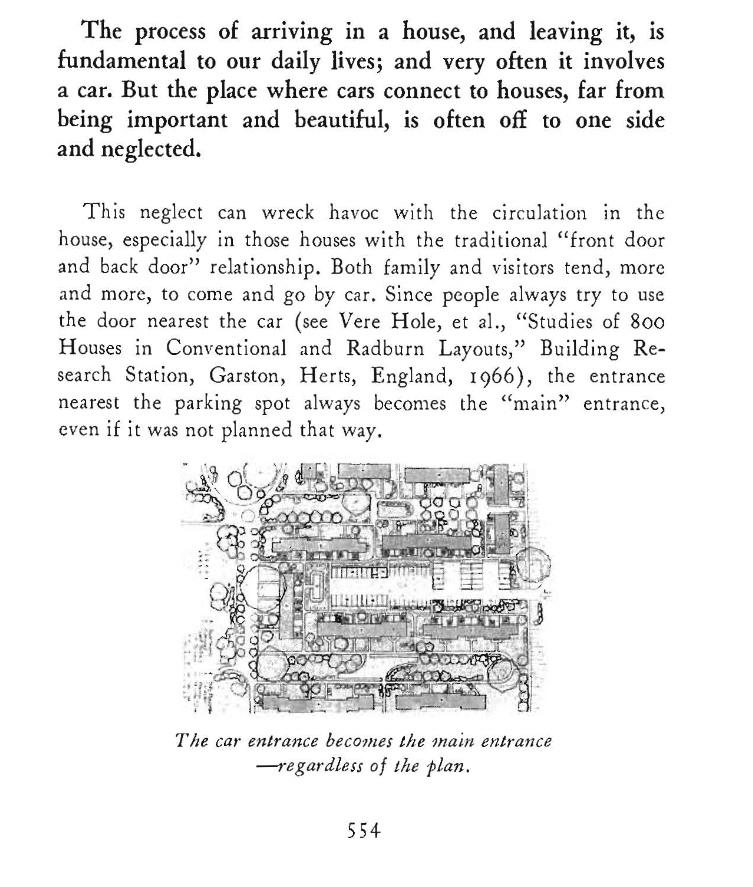
@jonny I think you will like A Pattern Language by Alexander et al https://en.wikipedia.org/wiki/A_Pattern_Language
I found nothing in there about the particular type of driveway you describe —it is too opinionated and conviviality-focused for that— but still you will like it
found it a few years back when rabbitholing and it is breathtaking