
Discussion
Loading...

Post

Log in
  • About
  • Code of conduct
  • Privacy
  • Users
  • Instances
  • About Bonfire
Miss Gayle
Miss Gayle
@MissGayle@urbanists.social  ·  activity timestamp last week

"We do need some renewables. But the ‘transition’ must be radically reframed. We must not start by asking “how do we transition the current global economy to renewable energy” – that proposition is a death sentence. We must start by asking “what are our real human energy needs, and how do we meet them in the wisest way possible?” In other words, what are the needs of thriving local economies."

Link: https://www.resilience.org/stories/2026-02-13/humanity-is-not-the-problem/
#Localization #DeGrowth #Community #Sustainability #Economy

Humanity Is Not the Problem!
Helena Norberg-Hodge Henry Coleman, originally published by Local Futures
February 13, 2026

True climate action doesn’t require vast data centers, billions of liters of water, or mineral-intensive hardware. It requires shorter distances, stronger communities, healthy soils, local food webs, and diverse, place-based economies that reduce demand at the source.

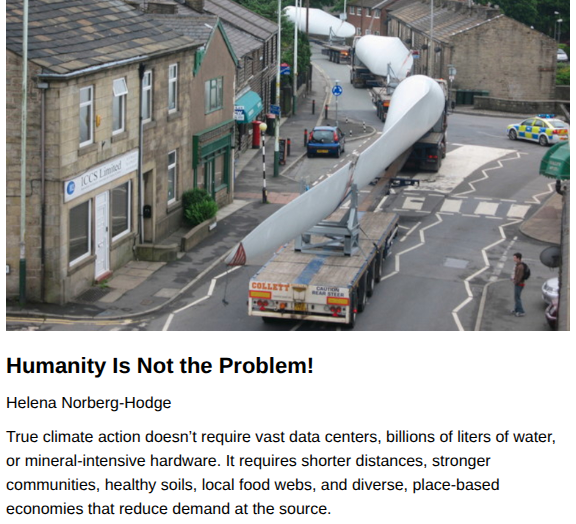
Teaser image credit: A turbine blade convoy passing through Edenfield, England. By Paul Anderson, CC BY-SA 2.0, https://commons.wikimedia.org/w/index.php?curid=5159931
Humanity Is Not the Problem! Helena Norberg-Hodge Henry Coleman, originally published by Local Futures February 13, 2026 True climate action doesn’t require vast data centers, billions of liters of water, or mineral-intensive hardware. It requires shorter distances, stronger communities, healthy soils, local food webs, and diverse, place-based economies that reduce demand at the source. Teaser image credit: A turbine blade convoy passing through Edenfield, England. By Paul Anderson, CC BY-SA 2.0, https://commons.wikimedia.org/w/index.php?curid=5159931
  • Copy link
  • Flag this post
  • Block

bonfire.cafe

A space for Bonfire maintainers and contributors to communicate

bonfire.cafe: About · Code of conduct · Privacy · Users · Instances
Bonfire social · 1.0.2-alpha.34 no JS en
Automatic federation enabled
Log in
Instance logo
  • Explore
  • About
  • Members
  • Code of Conduct