
just stumbled upon an incredible piece of MUD/MOO history from the mid-90s web that disappeared in the 2000s and is now all but forgotten. it is a testament to the interactive and creative possibilities real people imagined in the 90s, before greed and pessimism spread through the world wide web.
MOOSE Crossing: A MUD for Kids was a mud/moo designed by Amy Bruckman at MIT as her doctoral dissertation project in 1996
"MOOSE Crossing is a MUD designed to get kids 9-13 excited about reading,
writing, and computer programming. It includes a new programming language
(MOOSE) and client interface (MacMOOSE) designed to make it easier for kids to
learn to program.
Kids have made things like pigs you can hug, light bulbs that tell light
bulb jokes, and pots of gold at the end of the rainbow that ask you a
riddle! They're doing creative writing and computer programming in their
spare time for fun, and meeting other kids from around the world."
(from a rec.games.tiny.mud announcement https://groups.google.com/u/1/g/rec.games.mud.tiny/c/MhnTf0G3C_0/m/BKWIngCp440J)
while a moo wasn't anything new at all in 96, what i find incredible is that her team also built a custom graphical mud programming WYSIWYG client, for Mac and Windows. the clients - MacMOOSE.sea.hqx and WinMoose.exe appear to be lost to time (edit: macmoose has been found! https://mastodon.tomodori.net/@vga256/115988260112466194), but i found this screenshot buried in the wbm. you can see how an object is broken down into verbs and properties.
i have about a million questions about how the client-server system worked because this is adorable and user friendly. but for now, i'm excited to just think out loud about what the world wide web could be made into today, if developers got more interested in user-driven interactivity
this is the original site for MOOSE Crossing:
https://web.archive.org/web/19981202051515/http://www.cc.gatech.edu/fac/Amy.Bruckman/moose-crossing/
Amy's dissertation in html:
https://ic.media.mit.edu/Publications/Thesis/asbPHD/HTML/
#mud #moo #retroComputing #macintosh #vintageApple #worldWideWeb #indieWeb #smallWeb #history #digipres
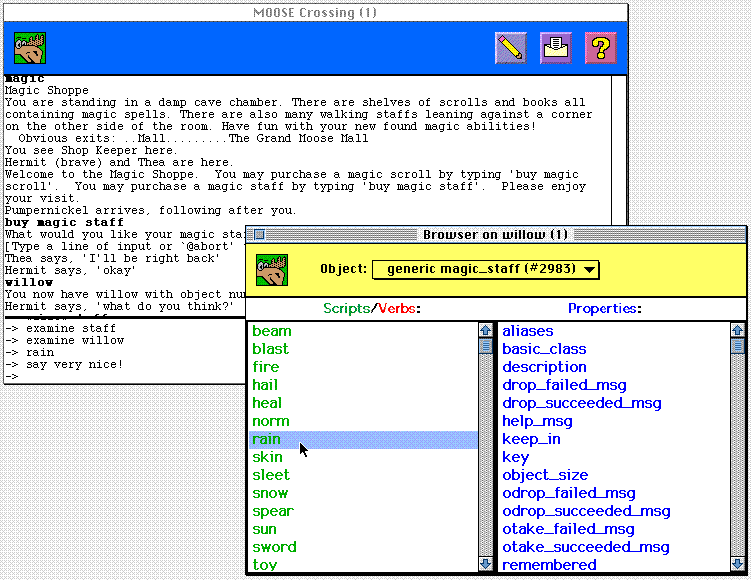
am overcome with gratitude. after hours of searching usenet, ftp indexers, ftp sites, archive.org, discmaster and every archival tool i know of and coming up with zilch, i jusssst found the MacMOOSE software buried in a professor's apache open dir! he worked in the same research group as MacMOOSE (Epistemology & Learning Group @ MIT) and had the foresight to make a tarball of the lab's FTP server before it died years ago
this is the kind of archival once in a million thing - that someone self-archived an incredibly important and obscure piece of software by accident, and left a copy on the web. thank you prof fred g. martin 🙏
this archive of the MIT ELG ftp server is going straight to archive.org.