But AI can’t do your job. It can help you do your job, but that does not mean it is going to save anyone money.
[...]
. The market’s bet on AI is that an AI salesman will visit the CEO of Kaiser and make this pitch: “Look, you fire nine out of 10 of your radiologists, saving $20m a year. You give us $10m a year, and you net $10m a year, and the remaining radiologists’ job will be to oversee the diagnoses the AI makes at superhuman speed – and somehow remain vigilant as they do so, despite the fact that the AI is usually right, except when it’s catastrophically wrong.
“And if the AI misses a tumor, this will be the human radiologist’s fault, because they are the ‘human in the loop’. It’s their signature on the diagnosis.”
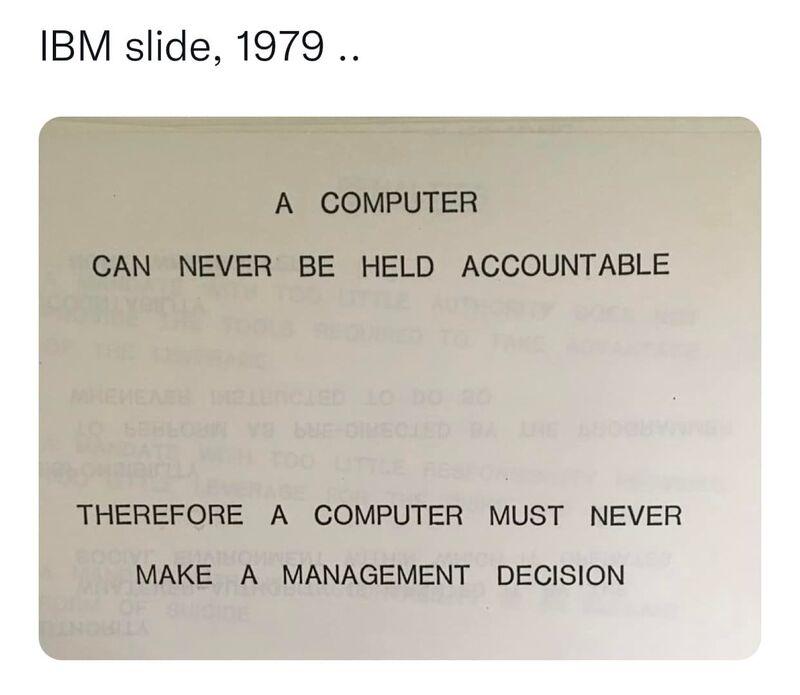
This is a reverse centaur, and it is a specific kind of reverse centaur: it is what Dan Davies calls an “accountability sink”. The radiologist’s job is not really to oversee the AI’s work, it is to take the blame for the AI’s mistakes.
This is another key to understanding – and thus deflating – the AI bubble. The AI can’t do your job, but an AI salesman can convince your boss to fire you and replace you with an AI that can’t do your job. This is key because it helps us build the kinds of coalitions that will be successful in the fight against the AI bubble.

![But AI can’t do your job. It can help you do your job, but that does not mean it is going to save anyone money.
[...]
. The market’s bet on AI is that an AI salesman will visit the CEO of Kaiser and make this pitch: “Look, you fire nine out of 10 of your radiologists, saving $20m a year. You give us $10m a year, and you net $10m a year, and the remaining radiologists’ job will be to oversee the diagnoses the AI makes at superhuman speed – and somehow remain vigilant as they do so, despite the fact that the AI is usually right, except when it’s catastrophically wrong.
“And if the AI misses a tumor, this will be the human radiologist’s fault, because they are the ‘human in the loop’. It’s their signature on the diagnosis.”
This is a reverse centaur, and it is a specific kind of reverse centaur: it is what Dan Davies calls an “accountability sink”. The radiologist’s job is not really to oversee the AI’s work, it is to take the blame for the AI’s mistakes.
This is another key to understanding – and thus deflating – the AI bubble. The AI can’t do your job, but an AI salesman can convince your boss to fire you and replace you with an AI that can’t do your job. This is key because it helps us build the kinds of coalitions that will be successful in the fight against the AI bubble.](https://static.mamot.fr/media_attachments/files/115/921/082/922/740/034/original/d932ee8f0c7bdac3.png)