Discussion
Loading...

Post

Log in
  • About
  • Code of conduct
  • Privacy
  • Users
  • Instances
  • About Bonfire
Jan Wildeboer 😷:krulorange:
@jwildeboer@social.wildeboer.net  ·  activity timestamp 3 days ago

TL;DR Most EV batteries will last longer than the cars they’re in. Battery degradation is at better (meaning: lower) rates than expected. Slow charging is better. Drive EV and don’t worry about your battery.

„Our 2025 analysis of over 22,700 electric vehicles, covering 21 different vehicle models, confirms that overall, modern EV batteries are robust and built to last beyond a typical vehicle’s service life.“
https://www.geotab.com/blog/ev-battery-health/

#GoodNews #EV #Battery

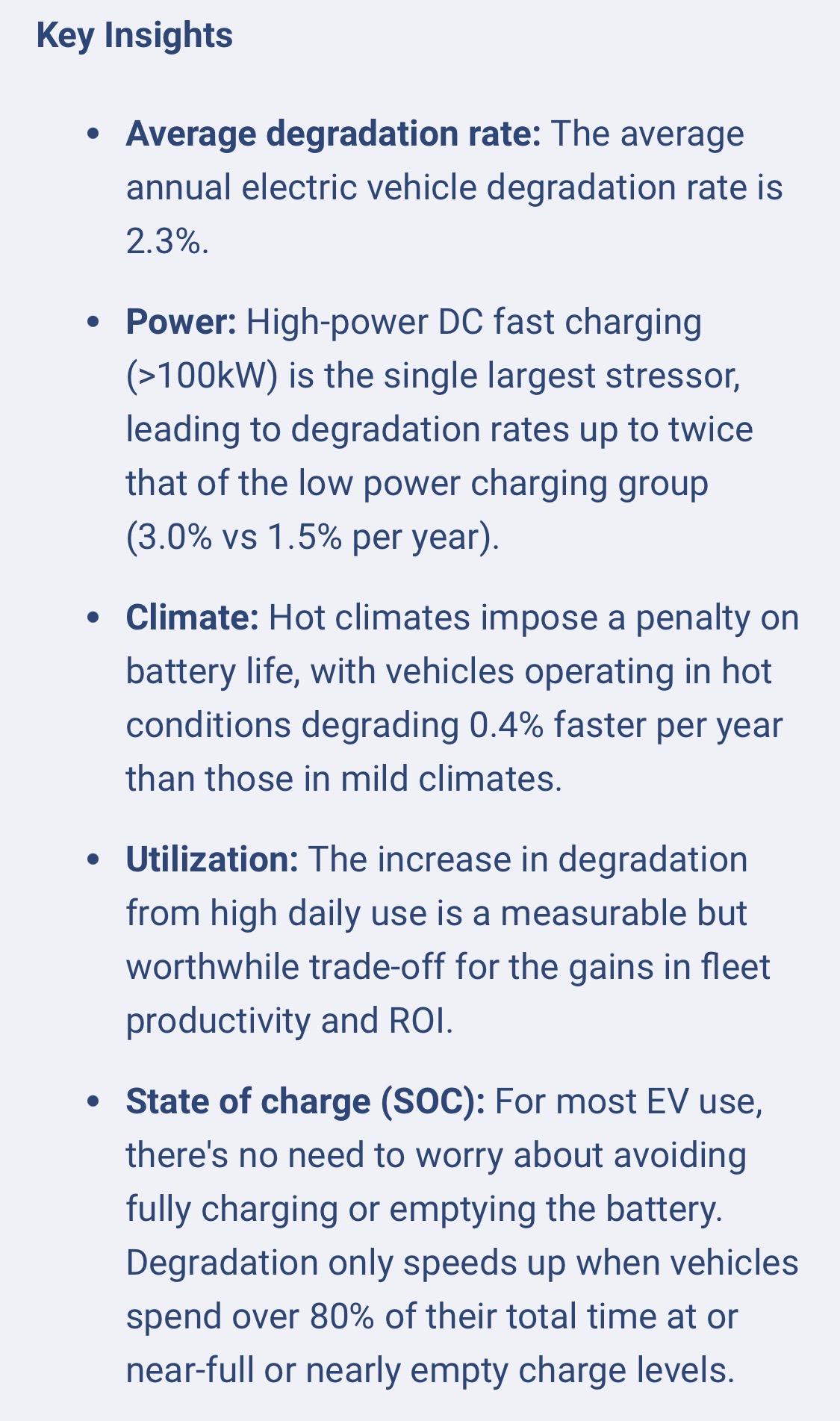
Key Insights

Average degradation rate: The average annual electric vehicle degradation rate is 2.3%. 

Power: High-power DC fast charging (>100kW) is the single largest stressor, leading to degradation rates up to twice that of the low power charging group (3.0% vs 1.5% per year). 

Climate: Hot climates impose a penalty on battery life, with vehicles operating in hot conditions degrading 0.4% faster per year than those in mild climates. 

Utilization: The increase in degradation from high daily use is a measurable but worthwhile trade-off for the gains in fleet productivity and ROI.

State of charge (SOC): For most EV use, there's no need to worry about avoiding fully charging or emptying the battery. Degradation only speeds up when vehicles spend over 80% of their total time at or near-full or nearly empty charge levels.
Key Insights Average degradation rate: The average annual electric vehicle degradation rate is 2.3%. Power: High-power DC fast charging (>100kW) is the single largest stressor, leading to degradation rates up to twice that of the low power charging group (3.0% vs 1.5% per year). Climate: Hot climates impose a penalty on battery life, with vehicles operating in hot conditions degrading 0.4% faster per year than those in mild climates. Utilization: The increase in degradation from high daily use is a measurable but worthwhile trade-off for the gains in fleet productivity and ROI. State of charge (SOC): For most EV use, there's no need to worry about avoiding fully charging or emptying the battery. Degradation only speeds up when vehicles spend over 80% of their total time at or near-full or nearly empty charge levels.
Geotab

EV Battery Health: Key Findings from 22,700 Vehicle Data Analysis | Geotab

Analysis of electric vehicle battery health of 22K+ EVs reveals a 2.3% average battery degradation rate. High-power DC fast charging is the top risk factor.
  • Copy link
  • Flag this post
  • Block
Cassandrich
Cassandrich
@dalias@hachyderm.io replied  ·  activity timestamp 2 days ago

@jwildeboer Atrociously bad quality of cars if true. A car should last 25-40 years at least. No way a battery does.

  • Copy link
  • Flag this comment
  • Block
Jan Wildeboer 😷:krulorange:
@jwildeboer@social.wildeboer.net replied  ·  activity timestamp 2 days ago

@dalias many newer cars manufactured in the past 20+ years will not make it to 25 years due to electronics failing (capacitors and mosfets are typical candidates), regardless of being powered by ICE or EV.

  • Copy link
  • Flag this comment
  • Block
Jan Wildeboer 😷:krulorange:
@jwildeboer@social.wildeboer.net replied  ·  activity timestamp 3 days ago

This also means that buying a used EV is perfectly fine. If the used car is „younger“ than 5-7 years, the battery will be fine for years to come.

„How long do EV batteries last?

The average lifespan of EV batteries will be around 13 years or more based on observed degradation rates.“

  • Copy link
  • Flag this comment
  • Block
David Chisnall (*Now with 50% more sarcasm!*)
@david_chisnall@infosec.exchange replied  ·  activity timestamp 2 days ago

@jwildeboer There are some companies now recycling EV batteries for home storage. For fixed locations, the efficiency Is a bit less important (space and weight are at less if a premium than in a car), but cost remains important.

  • Copy link
  • Flag this comment
  • Block
Zimmie
Zimmie
@bob_zim@infosec.exchange replied  ·  activity timestamp 2 days ago

@david_chisnall @jwildeboer With cars being so expensive to repair, EVs get totaled by insurance pretty readily. With the cells lasting so long, there’s very little demand for used EV batteries. As a result, they tend to be really cheap from junkyards.

I was recently looking up how much a replacement battery pack for a particular hybrid costs. Turns out it’s about $1800 for an 11 kWh pack, but while looking I also found a local wrecker selling a 75 kWh pack from a Mustang Mach-E for about $3k.

  • Copy link
  • Flag this comment
  • Block

bonfire.cafe

A space for Bonfire maintainers and contributors to communicate

bonfire.cafe: About · Code of conduct · Privacy · Users · Instances
Bonfire social · 1.0.1 no JS en
Automatic federation enabled
Log in
  • Explore
  • About
  • Members
  • Code of Conduct