Discussion
Loading...

Post

Log in
  • About
  • Code of conduct
  • Privacy
  • Users
  • Instances
  • About Bonfire
Tim 馃幃
Tim 馃幃
@timixretroplays@digipres.club  路  activity timestamp last week

#Arduino, #maker and #electronics folks should know this exists: it's a USB Power Delivery trigger, a tiny and cheap (AU$6.90 from Core Electronics) board that pulls the full 12V or 20V or whatever, at all the amperage, from a phone charger that supports USB PD. No more screwing around with chunky variable voltage supplies!

I'm pairing one with some stepper drivers that buck input voltage down to 5V for microcontrollers, so this is 100% of a small motor-driven project's power supply right here.
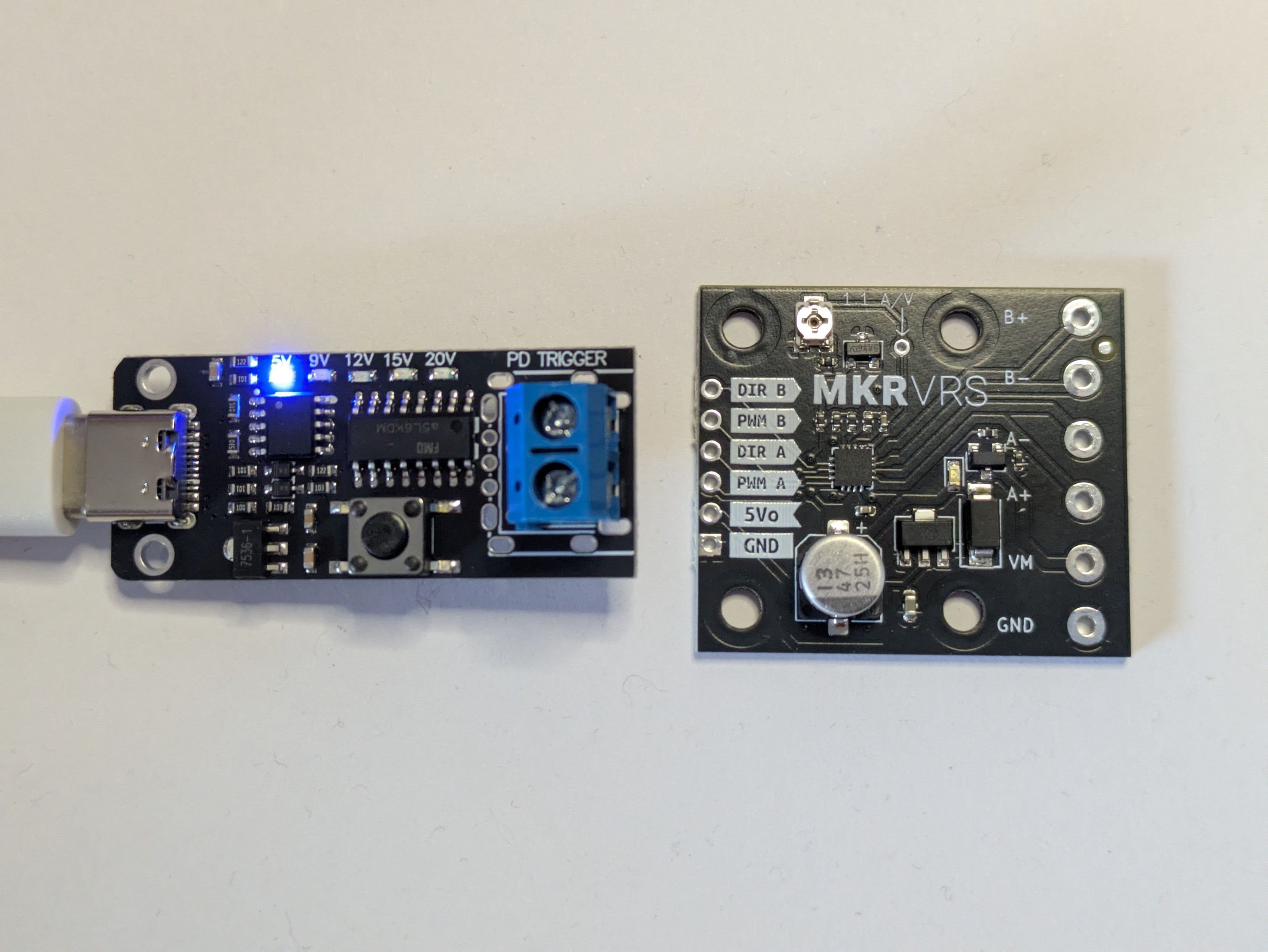

A photo of two small circuit boards on a desk. One is plugged into a USB type C cable and has a bright blue light lit up next to text that says 5V. The board is labeled "PD trigger" and also includes a small button, a microchip, and a large blue screw terminal for attaching wires. The other board is a small square labeled MKRVRS which has a row of six connector pins on each side, intended to power a small stepper motor attached on the right using digital signals from a microcontroller on the pins on the left.
  • Copy link
  • Flag this post
  • Block
Joel Michael
Joel Michael
@jpm@aus.social replied  路  activity timestamp last week

@timixretroplays strangely enough I was reading the CH224 datasheet today, the new CH224Q looks like a very nice upgrade to the previous versions

  • Copy link
  • Flag this comment
  • Block
Tim 馃幃
Tim 馃幃
@timixretroplays@digipres.club replied  路  activity timestamp last week

This one in particular has a simple and neat way to tell you if a particular USB charger supports a particular PD voltage. The light is solid at 5V or 9V, but blinks on 12, 15 or 20V when plugged into the charger I have sitting on my desk. That's actually really good to know since it means I'll have to upgrade to a better charger to prototype this project on my desk - I might've been pretty confused otherwise.

  • Copy link
  • Flag this comment
  • Block
Tim 馃幃
Tim 馃幃
@timixretroplays@digipres.club replied  路  activity timestamp last week

This is also a surprisingly fun way to learn that I do not, in fact, own a USB charger capable of putting out 12V PD. Either that or I don't have a USB cable capable of it? Is that a thing?

  • Copy link
  • Flag this comment
  • Block
Peter Marheine
Peter Marheine
@pmarheine@digipres.club replied  路  activity timestamp last week

@timixretroplays Voltage is unaffected by the cable, only current limit. You can go all the way up to maximum voltage (48V with EPR, 20V otherwise) with any cable, as long as PD works at all with that cable.

For current limits, every cable can do up to 3A. Captive cables (ones permanently connected to the source; a charger with type C plug rather than a receptacle) can use whatever the charger says, otherwise you need an e-marked (with a chip) cable that declares its maximum current up to 5A.

  • Copy link
  • Flag this comment
  • Block
Peter Marheine
Peter Marheine
@pmarheine@digipres.club replied  路  activity timestamp last week

@timixretroplays An example that seems fairly common in my experience is 65W chargers with captive cables that go up to 3.25A.

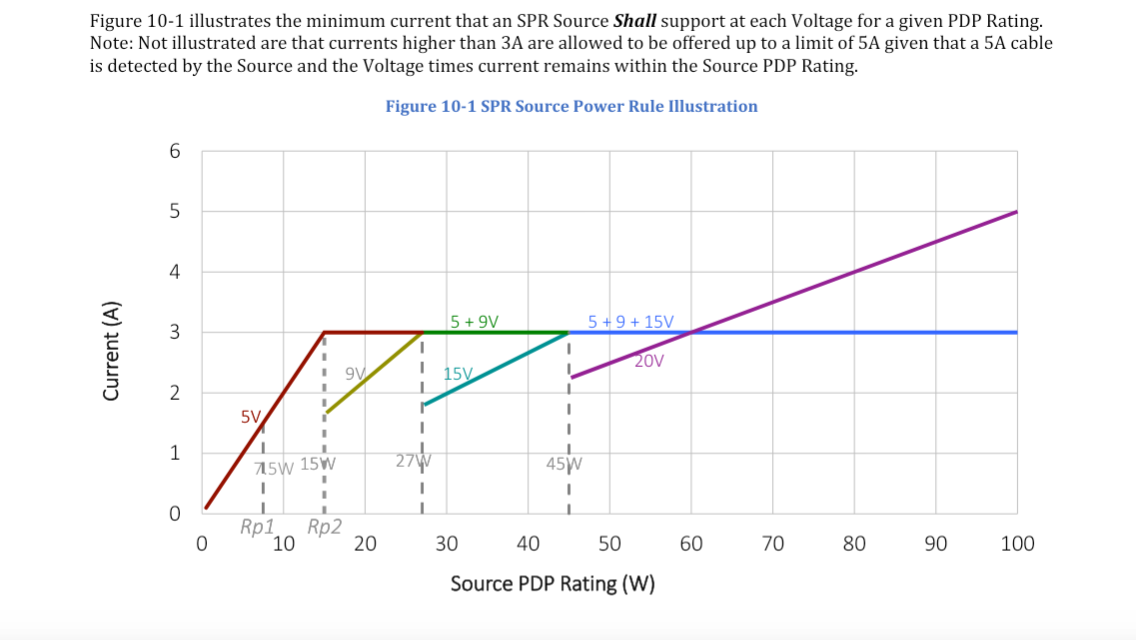
It's also handy to know the "source power rule" which specifies that a source must increase voltage up to the allowed maximum before increasing current beyond 3A. That means every charger rated for more than 45W output must support 20V operation, >27W implies 15V and >15W implies 9V. 12V support is strictly optional at all power levels!

Sorry, no caption provided by author
  • Copy link
  • Flag this comment
  • Block
Joel Michael
Joel Michael
@jpm@aus.social replied  路  activity timestamp last week

@timixretroplays particular care in cable selection is required for 5A operation, if it鈥檚 successfully negotiating higher voltage then at least the CC lines are connected properly

  • Copy link
  • Flag this comment
  • Block

bonfire.cafe

A space for Bonfire maintainers and contributors to communicate

bonfire.cafe: About 路 Code of conduct 路 Privacy 路 Users 路 Instances
Bonfire social 路 1.0.1-beta.35 no JS en
Automatic federation enabled
Log in
  • Explore
  • About
  • Members
  • Code of Conduct