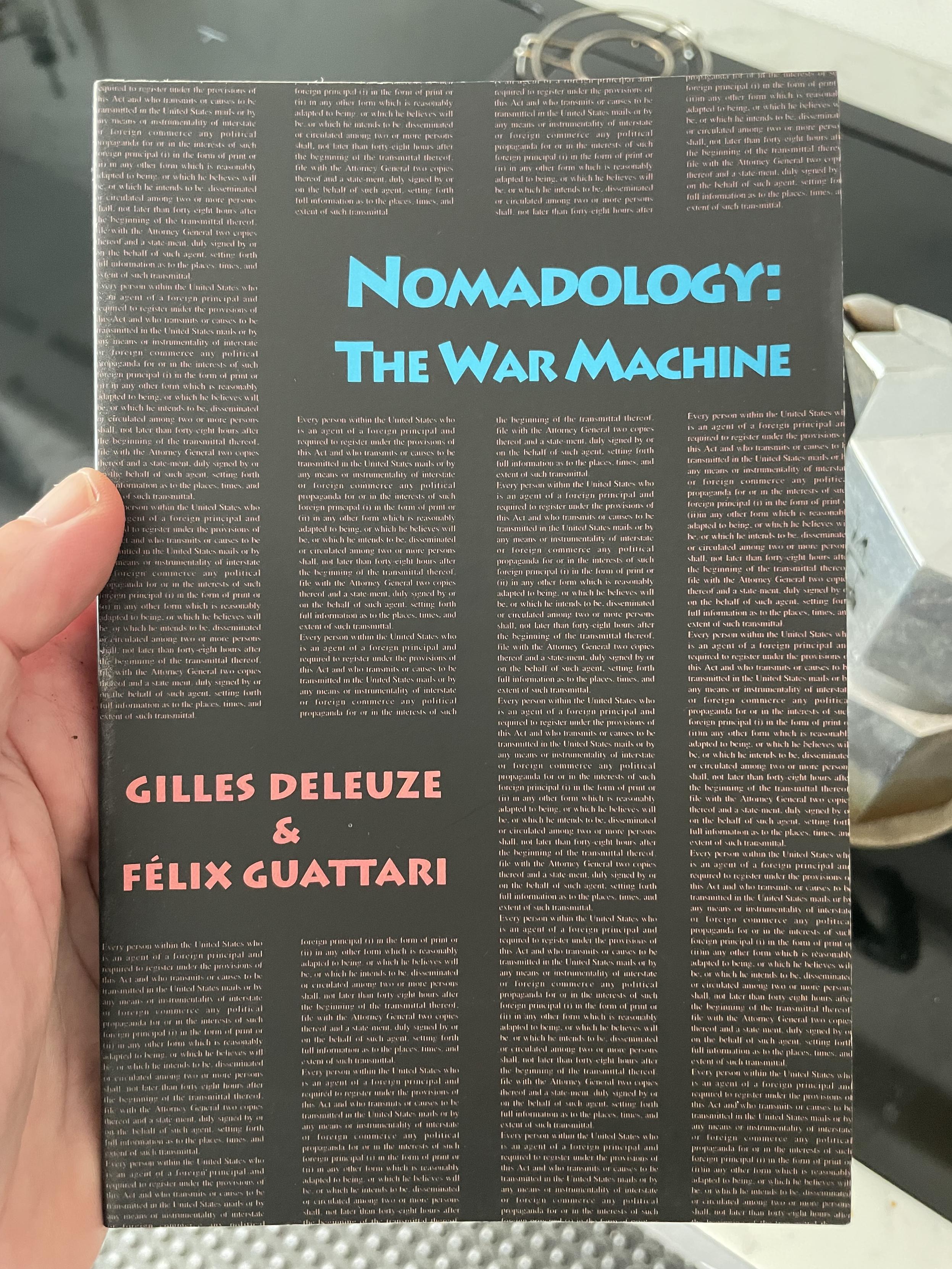
I got this down off the shelf because it’s relevant to one of the things I’m working on, and because – some 39 years after buying it and reading it for the first time – I feel like I’m finally in a position to understand and make use of it. Follow along with me, as I do a reasonably close reading of it here? It ought to be a fair amount of fun. #nomadology #deleuzeandguattari #deleuze #guattari
Post
Replies:
15
with the theme developed most fully by Graeber/Wengrow of a oscillation or seasonal alternation between forms of organization in a given society. You might even describe this idea of opposed but mutually co-constituting tendencies, deriving pulses of sustaining energy from their constant alternation between equilibrium and chaos, as Taoist — but D&G mean for us to understand that this alternation plays out in space, as a map of insides and the outsides they cannot overcode or even comprehend.
The map they draw for us is worth quoting at some length: “Not only is there no universal State, but the outside of States cannot be reduced to ‘foreign policy,’ that is to a set of relations among States. The outside appears simultaneously in two directions: huge worldwide machines branched out over the entire ecumenon at any given moment, which enjoy a large measure of autonomy in relation to the States (for example, commercial organization of the ‘multinational’ type, or industrial complexes,
or even religious formations like Christianity, Islam [...], etc.); but also the local mechanisms of bands, margins, minorities, which continue to affirm the rights of segmentary societies in opposition to the organs of State power...What becomes clear is that bands, no less than worldwide organizations, imply a form irreducible to the State, and that this exteriority necessarily presents itself as that of a diffuse and polymorphous war machine. It is a nomos very different from the ‘law.’”
Well, there’s a lot here to chew on. I think even contemporary normie political science would concur with the idea that “international relations” subtends non-State entities (from the World Bank & the IMF to Save the Children, Oxfam & Greenpeace to Apple, Google & Meta), religious currents like salafist Islam, & stateless peoples like the Palestinians or the Kurds. There’s no argument that the outside of the State is “diffuse and polymorphous.” But does it make sense to think of all that as
observing a single nomos, an overarching or undergirding organizing principle? Do all of these entities & currents, accreting around very different logics of blood, market, belief or conviction, really function as war machines as D&G have described them?
My own personal sense of things is that it’s not really possible to answer in the affirmative, not even in the most simplified, toy model of things. The move D&G make is to define all of that as “what escapes States or stands against States.”
And if that topographical distinction is the bright-line standard to uphold, then yes — all of that can be said to constitute a war machine, in all its heterogeneity and difference: “The State-form, as a form of interiority, has a tendency to reproduce itself, remaining identical to itself across its variations and easily recognizable within the limits of its poles...But the war machine’s form of exteriority is such that it exists only in its own metamorphoses; it exists in an industrial
innovation as well as in a technological invention, in a commercial circuit as well as in a religious creation, in all the flows and currents that only secondarily allow themselves to be appropriated by the State.”
Here D&G encourage us to think all the forms of non-State activity as avatars of a single hugely dynamic & protean tendency, ever new, ever strange, often savage but occasionally generative of great beauty, whose only consistency is that it perpetually escapes the reason of State.
Tomorrow we’ll take up the question of whether this remains so — whether, indeed, Empire can any longer be said to have an outside — and what that implies for epistemology, the way we think the world. See you then!
Oh, sorry: this is me turning back, more like Columbo than Steve Jobs, to raise one last thing for the day. It has to do precisely with this question of the thinkability of the outside, and specifically with the function of #sciencefiction as what D&G might call a “minor” literature. I sure wouldn’t have put it in so many words at the time, but it’s obvious to me now that I grew up relying on SF to furnish me with lines of flight bursting through the containment of what could be thought.
And this took any number of forms, from Hal Clement imagining what intelligent life might look like if it had evolved under brutally high gravity to the ontological instability of Chip Delany’s ever-self-consuming Bellona. All of these worlds were challenges to the frames around language and thought and possibility that consensus normality subjects us to. I know SF can still do that – for all its issues, you’ve no doubt heard me recommend Peter Watts’s “Blindsight” more than once – but I do
worry that market pressures, groupthink and what we might call the involution of the genre as it begins to consume its own past make that less and less likely. I only rarely now come across a piece of science fictional literature that feels like it presents me with an outside to my thought.
No doubt this has a lot to do with me. But I do think something has gone missing from this literature. All too often the books I pick up feel more like a comfort blanket than like the appearance of some
quietly self-replicating logic that will go on to overcode and remake my sense of the world and what is possible within it.
All I want is more fiction like that. I still need it, now perhaps even more than I did when I was 10 or 16 or 21. If science fiction is not a literature of the outside, then it is nothing.
And while we’re on the topic of science fiction as a literature of the outside, it happens to be a fruitful source of metaphors to help explain this conception D&G have of the war machine as everything that “escapes States or stands against States”!
As readers, we perhaps expect this concept of the war machine as it’s presented to us to have one definable form. But that’s just it: it doesn’t, & (as I read things, anyway) its doesn’tness is a big part of what D&G describe as its “multiplicity.”
And not just that, either, but its exteriority — its resistance to conceptualization by State thought. (An unpleasant corollary: perhaps our expectation of a definition is a marker of our own capture by that thought.)
So: multiple, protean, slippery, seeming to lack a clear point of origin, refusing the categories we’ve prepared for it. What else do we know works like that?
Well, consider “the” titular “Alien” – “the” in quotes because, more through sloppiness and lack of attention to canon formation than intent, across the series the three iconic forms of facehugger, chestburster and full-grown xenomorph are eventually revealed to stand amid a bewildering profusion of morphologies. “The” alien, in each film, seems to take cues from whatever species it’s hybridized with, reproducing in any number of ways, but maintains throughout its perfect, unreasoning hostility.