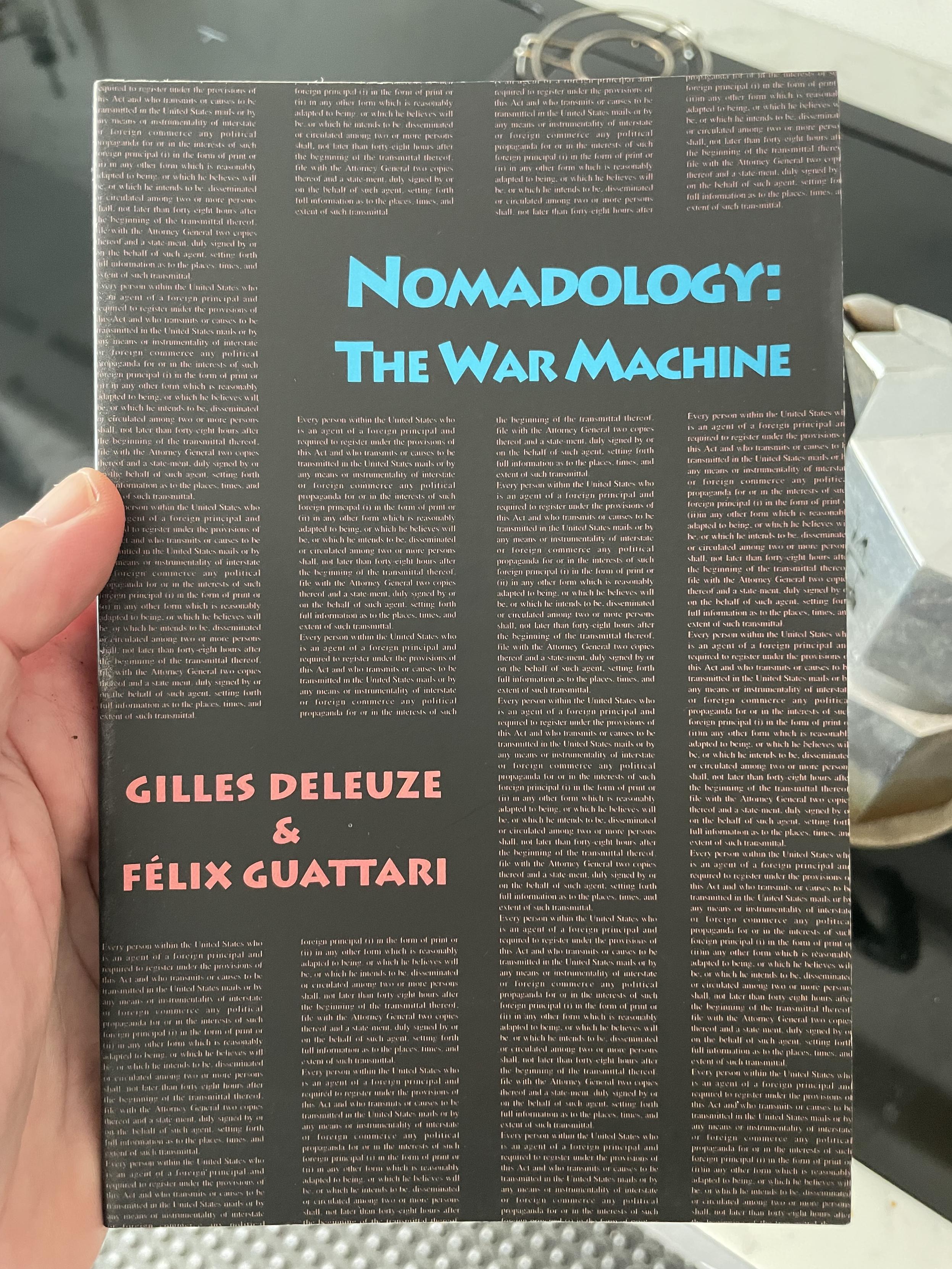
I got this down off the shelf because it’s relevant to one of the things I’m working on, and because – some 39 years after buying it and reading it for the first time – I feel like I’m finally in a position to understand and make use of it. Follow along with me, as I do a reasonably close reading of it here? It ought to be a fair amount of fun. #nomadology #deleuzeandguattari #deleuze #guattari
Post
Replies:
15
the way they chose to structure ATP and the very way in which they define their terms & craft arguments. They’re trying, in other words, to think the rhizome rhizomorphically, and as people of the Book they’re necessarily doing so with only partial and limited success. (If they were fully successful, ATP would have been a hypertext, not any kind of book, and in fact it’s poignant to think of D&G developing the work in a world where collaborative hypertext authoring tools were available to them.)
So, fresh from that detour to fill in the backstory of “the rhizome,” we plunge ever onward.
Recall that we’d begun this second textual division of “Nomadology” with a question — how do groups ward off the logics of the incipient State, either historically or in real time? — and a proposition: that there’s plenty of evidence for the exteriority of the war machine to the State to be found in ethnology, the comparative study of human cultures. And we consider how some of those cultures — street
children of Bogotá, French high society — indeed did call upon mechanisms that, whether consciously or otherwise, did serve to diffuse prestige & prevent power from accumulating in any one individual. There’s a brief and not terribly deep discussion of what these mechanisms look like in the specific case of Bogotá.
But then D&G throw us a curveball, which possibly explains why they don’t develop any particularly elaborate case to defend what they’ve laid out: far from developing over time,
they argue that the State is something that appears in a single stroke. It cannot (they say) be accounted for as an evolutionary tendency. It either appears, or does not, and when it does, it is perfect and complete, all the institutions it will need to call upon already present at birth, like a mammalian stock of oocytes.
I think this account of State formation is, to put it mildly, historically debatable, but it’s the hinge they lean on for their next provocation: if the State either appears
or does not, the question of the relation of the State to non-State societies may not be evolutionary or developmental so much as it is spatial.
This is how they put it: presenting the thesis out of Clastres that “on the one hand, the State arose in a single stroke, fully formed [and] on the other, the counter-State societies used very specific mechanisms to ward it off, to prevent it from arising,” they assert “that these two propositions are valid, but that their interlinkage is flawed.”
And from this it follows that “the State itself has always been in a relation with an outside, and is inconceivable independent of that relationship...the law of the State is not that of All or Nothing...but that of interior and exterior. The State is sovereignty. But sovereignty only reigns over what it is capable of internalizing, of appropriating locally.” And this opens onto a discussion of State topology that has only grown more pointed and more relevant in the years since 1980.
Because what’s being posited here is a kind of dynamic, metastable exchange of energies between State societies and their exteriors, a condition of “coexistence and competition in a perpetual field of interaction” [emphasis in original] that is mutually constitutive. This accords with Scott’s account, in “Against the Grain,” “The Art of Not Being Governed” and elsewhere, of permeability between State societies and the “barbarian” communities on their peripheries, and it even chimes to a degree
with the theme developed most fully by Graeber/Wengrow of a oscillation or seasonal alternation between forms of organization in a given society. You might even describe this idea of opposed but mutually co-constituting tendencies, deriving pulses of sustaining energy from their constant alternation between equilibrium and chaos, as Taoist — but D&G mean for us to understand that this alternation plays out in space, as a map of insides and the outsides they cannot overcode or even comprehend.
The map they draw for us is worth quoting at some length: “Not only is there no universal State, but the outside of States cannot be reduced to ‘foreign policy,’ that is to a set of relations among States. The outside appears simultaneously in two directions: huge worldwide machines branched out over the entire ecumenon at any given moment, which enjoy a large measure of autonomy in relation to the States (for example, commercial organization of the ‘multinational’ type, or industrial complexes,
or even religious formations like Christianity, Islam [...], etc.); but also the local mechanisms of bands, margins, minorities, which continue to affirm the rights of segmentary societies in opposition to the organs of State power...What becomes clear is that bands, no less than worldwide organizations, imply a form irreducible to the State, and that this exteriority necessarily presents itself as that of a diffuse and polymorphous war machine. It is a nomos very different from the ‘law.’”
Well, there’s a lot here to chew on. I think even contemporary normie political science would concur with the idea that “international relations” subtends non-State entities (from the World Bank & the IMF to Save the Children, Oxfam & Greenpeace to Apple, Google & Meta), religious currents like salafist Islam, & stateless peoples like the Palestinians or the Kurds. There’s no argument that the outside of the State is “diffuse and polymorphous.” But does it make sense to think of all that as
observing a single nomos, an overarching or undergirding organizing principle? Do all of these entities & currents, accreting around very different logics of blood, market, belief or conviction, really function as war machines as D&G have described them?
My own personal sense of things is that it’s not really possible to answer in the affirmative, not even in the most simplified, toy model of things. The move D&G make is to define all of that as “what escapes States or stands against States.”
And if that topographical distinction is the bright-line standard to uphold, then yes — all of that can be said to constitute a war machine, in all its heterogeneity and difference: “The State-form, as a form of interiority, has a tendency to reproduce itself, remaining identical to itself across its variations and easily recognizable within the limits of its poles...But the war machine’s form of exteriority is such that it exists only in its own metamorphoses; it exists in an industrial
innovation as well as in a technological invention, in a commercial circuit as well as in a religious creation, in all the flows and currents that only secondarily allow themselves to be appropriated by the State.”
Here D&G encourage us to think all the forms of non-State activity as avatars of a single hugely dynamic & protean tendency, ever new, ever strange, often savage but occasionally generative of great beauty, whose only consistency is that it perpetually escapes the reason of State.
Tomorrow we’ll take up the question of whether this remains so — whether, indeed, Empire can any longer be said to have an outside — and what that implies for epistemology, the way we think the world. See you then!