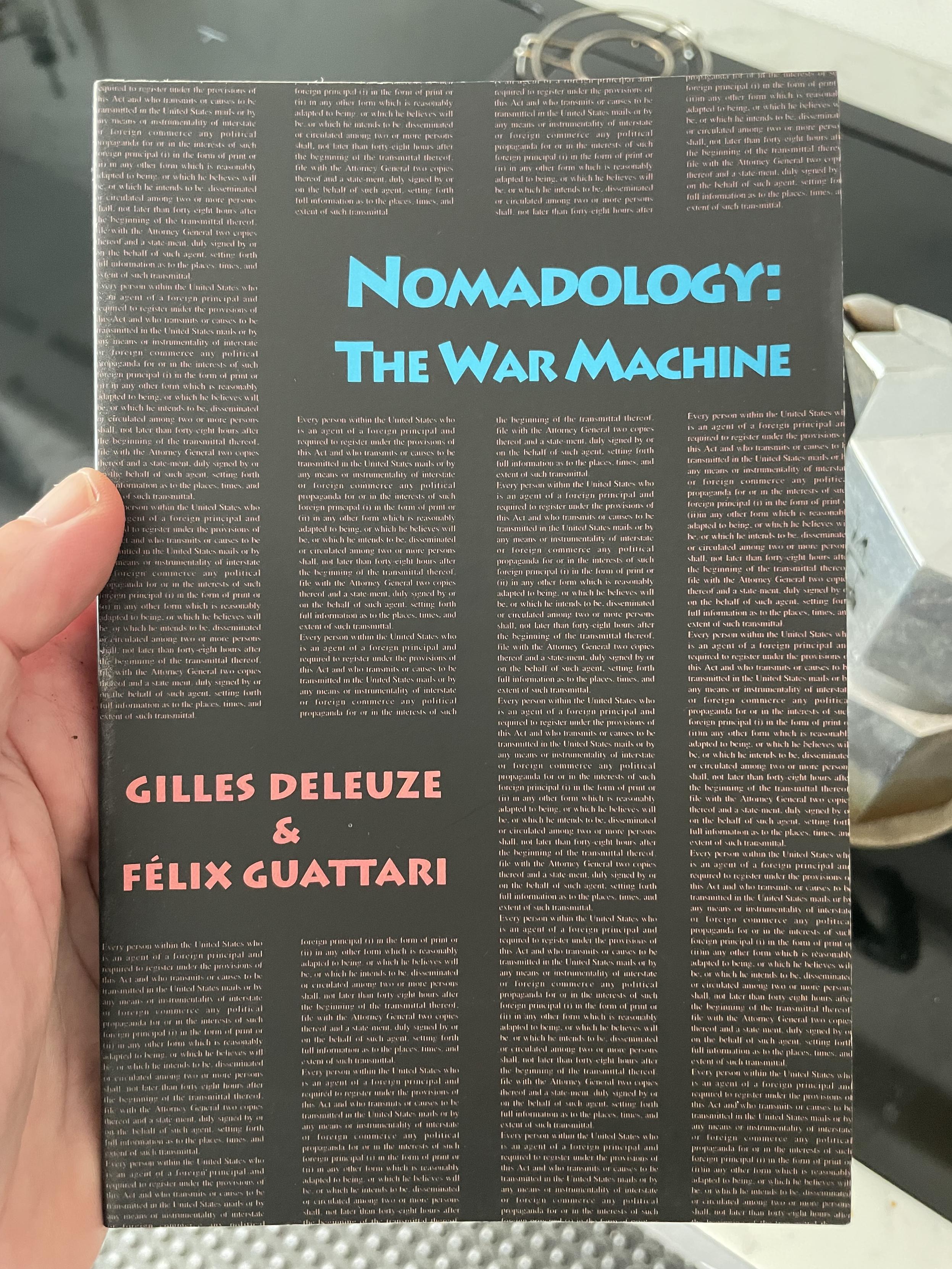
I got this down off the shelf because it’s relevant to one of the things I’m working on, and because – some 39 years after buying it and reading it for the first time – I feel like I’m finally in a position to understand and make use of it. Follow along with me, as I do a reasonably close reading of it here? It ought to be a fair amount of fun. #nomadology #deleuzeandguattari #deleuze #guattari
Post
Replies:
15
So what’s it all about?
They start from a consideration of the Book as bearer of writing & thought, in both its semantics and its physical manifestation. It’s a somewhat difficult passage — murky, at times discursive, slipping between registers — but for me the core of it lies in the announcement that the Book takes “the Tree or Root as an image,” and that “[b]inary logic is the spiritual reality of the root-tree.” The Tree cleaves the world into Above and Below and continuously imposes a
sorting operation that allocates things into one or the other.
Lest we despair at the harshly reductionist logic of such a Book, and the Law that it implies, D&G go on to tell us that there is another model for the Book, and therefore for thought: the “radicle-system, or fascicular root”: a bundle, a multiplicity where the unity of the tap-root shatters into a “supplementary dimension.” But they tend to deprecate this figure as something that “does not really break with dualism.”
What is the third figure for thought, the one that finally does offer a decisive break with binaries, with dualism, with hierarchy and the relentless above-or-below, ahead-or-behind sorting operations it gives rise to? This is the rhizome: a *horizontal* growth of the plant, capable of spreading beneath the Earth and sending up new shoots from each or any of its nodes.
They go on to supply us with a series of things other than plants that they regard as strongly rhizomorphic: the wolf pack,
the swarm, the burrows of ants or rodents “in all of their functions of shelter, supply, movement, evasion, and breakout.” In fact the rhizome “itself assumes very diverse forms, from ramified surface extension in all directions to concretion into bulbs and tubers.”
And the important quality of the rhizome — the thing in which its prescience resided, the reason it became the figure par excellence for the internetworked age and the tag for a thousand lame club nights, tryhard zines, etc. —
is the principle of “connection and heterogeneity” D&G ascribed to it: “any point of a rhizome can be connected to anything other, and must be.” There it is: the reason we’re still reading D&G, the thing that made this willfully obscure body of thought so supremely relevant to a world in which, before the decade was out, the collapse of Soviet-style communism would deprive the left of one of its primary models of organization, in which a mass networked medium would emerge just a few years later.
A rhizome, furthermore, “may be broken, shattered at a given spot, but it will start up again on one of its old lines, or on new lines. You can never get rid of ants because they form an animal rhizome that can rebound time and again even after most of it has been destroyed.”
And now maybe we can begin to see why this figure also suggests the pack, the street gang, the “barbarian” horde or the guerrilla force: in their multiplicity, their resistance to capture or suppression,
their disconcerting ability to “route around failure,” as the engineers and early ideologues of the internet might have it — to disappear from here and pop up again, after some interval, over there. If the State cannot help but organize things as aboves and belows, befores and afters, thises and not thats, the war machine is of the order of the rhizome.
We’ll see where this move takes us tomorrow. (No notes today, other than pointing you at the full ATP itself: https://files.libcom.org/files/A%20Thousand%20Plateaus.pdf)
A final thought for today, though: is it ironic that this Introduction commits the very sort of ordering that D&G tell us belongs to State thought? Was it succumbing to the same error when, a few days back, I described sketching out “a matrix” to keep track of the various dichotomies they lay out before us – interiority v exteriority, mood v affect, unity v multiplicity, root v rhizome and so on?
My answer is that this is a tension D&G struggle with at every turn, and which intimately informs
the way they chose to structure ATP and the very way in which they define their terms & craft arguments. They’re trying, in other words, to think the rhizome rhizomorphically, and as people of the Book they’re necessarily doing so with only partial and limited success. (If they were fully successful, ATP would have been a hypertext, not any kind of book, and in fact it’s poignant to think of D&G developing the work in a world where collaborative hypertext authoring tools were available to them.)
So, fresh from that detour to fill in the backstory of “the rhizome,” we plunge ever onward.
Recall that we’d begun this second textual division of “Nomadology” with a question — how do groups ward off the logics of the incipient State, either historically or in real time? — and a proposition: that there’s plenty of evidence for the exteriority of the war machine to the State to be found in ethnology, the comparative study of human cultures. And we consider how some of those cultures — street
children of Bogotá, French high society — indeed did call upon mechanisms that, whether consciously or otherwise, did serve to diffuse prestige & prevent power from accumulating in any one individual. There’s a brief and not terribly deep discussion of what these mechanisms look like in the specific case of Bogotá.
But then D&G throw us a curveball, which possibly explains why they don’t develop any particularly elaborate case to defend what they’ve laid out: far from developing over time,
they argue that the State is something that appears in a single stroke. It cannot (they say) be accounted for as an evolutionary tendency. It either appears, or does not, and when it does, it is perfect and complete, all the institutions it will need to call upon already present at birth, like a mammalian stock of oocytes.
I think this account of State formation is, to put it mildly, historically debatable, but it’s the hinge they lean on for their next provocation: if the State either appears
or does not, the question of the relation of the State to non-State societies may not be evolutionary or developmental so much as it is spatial.
This is how they put it: presenting the thesis out of Clastres that “on the one hand, the State arose in a single stroke, fully formed [and] on the other, the counter-State societies used very specific mechanisms to ward it off, to prevent it from arising,” they assert “that these two propositions are valid, but that their interlinkage is flawed.”
And from this it follows that “the State itself has always been in a relation with an outside, and is inconceivable independent of that relationship...the law of the State is not that of All or Nothing...but that of interior and exterior. The State is sovereignty. But sovereignty only reigns over what it is capable of internalizing, of appropriating locally.” And this opens onto a discussion of State topology that has only grown more pointed and more relevant in the years since 1980.
Because what’s being posited here is a kind of dynamic, metastable exchange of energies between State societies and their exteriors, a condition of “coexistence and competition in a perpetual field of interaction” [emphasis in original] that is mutually constitutive. This accords with Scott’s account, in “Against the Grain,” “The Art of Not Being Governed” and elsewhere, of permeability between State societies and the “barbarian” communities on their peripheries, and it even chimes to a degree