Advent of Tilings - Day 23.1
Almost at the end we see the light through diamond and hexagon shaped tunnels of an infinite surface, again monohedrally tiled.
#math #geometry #3d #combinatorics #tiling #AdventOfTilings #TilingTuesday
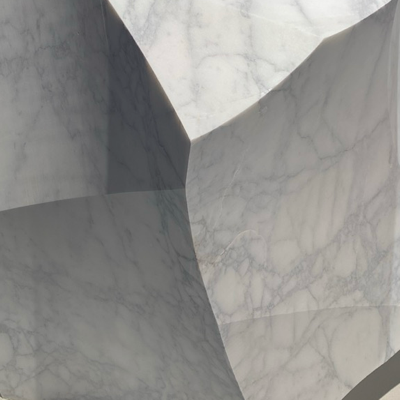
Advent of Tilings - Day 23.1
Almost at the end we see the light through diamond and hexagon shaped tunnels of an infinite surface, again monohedrally tiled.
#math #geometry #3d #combinatorics #tiling #AdventOfTilings #TilingTuesday
Advent of Tilings - Day 18.2
After applying “growth strategy 1” 20 times, adding 20 layers we end up with 22173 tiles.
The number of tiles in the added layers for the first ten steps:
1 + 6 + 20 + 53 + 98 + 161 + 246 + 352 + 474 + 615 + 762 + …
Advent of Tilings - Day 23.1
Almost at the end we see the light through diamond and hexagon shaped tunnels of an infinite surface, again monohedrally tiled.
#math #geometry #3d #combinatorics #tiling #AdventOfTilings #TilingTuesday
Advent of Tilings - Day 22.2
It takes only one rule to get from single tile to cuboid
f₁f₂t₁t₂⁻¹t₁f₁t₁⁻¹
Advent of Tilings - Day 22.1
It is not always easy to find a symmetric tree, but keep it in a pot and you may be surprised by what it grows up to be.
Advent of Tilings - Day 21.2
The looping rules seem to reflect the strictness of the construction:
(f₂t₁t₂)²
(f₁t₁t₁)²
Advent of Tilings - Day 21.1
This tiling grows following a double pyramid shape that would make Djoser proud. Embeddable and monohedral.
Advent of Tilings - Day 20.2
The twist of the structure is accomplished by the rules:
(f₁t₁)² and f₁f₂t₂⁻¹t₁t₂t₂f₂t₂⁻¹ and (f₁f₂t₂⁻¹)³
Advent of Tilings - Day 18.2
After applying “growth strategy 1” 20 times, adding 20 layers we end up with 22173 tiles.
The number of tiles in the added layers for the first ten steps:
1 + 6 + 20 + 53 + 98 + 161 + 246 + 352 + 474 + 615 + 762 + …
Advent of Tilings - Day 18.1
Christmas eve is near. It is time to look to the top of the tree and beyond towards infinity, but how to get there?
Let’s have a look at two different growth strategies, both starting with a single tile and adding layers outwards.
Growth strategy 1: We identify the surface boundary edges and glue a new tile to every open edge, so that with every layer all previous boundary edges become inner edges.
Growth strategy 2: We identify the surface boundary vertices and glue tiles around every boundary vertex, so that with every layer the previous boundary vertices become inner vertices.
How will the boundary differ at about the same number of tiles? Will there be a difference at all?
Let’s have a look at an example of an infinite surface embeddable in euclidian space.
To create the two examples of the same surface with different growth strategy we use the looping rules (f₁t₁)³ and (f₁f₂t₂⁻¹)².
Advent of Tilings - Day 17.2
Zoom in on the boundary of the unwrapped tiling.
Rules are t₂⁸ and (t₂⁻¹t₁)³ and (f₁t₁)²
Advent of Tilings - Day 17.1
A heftier caliber construction of 2304 tiles forming a genus 289 surface, intended for a sturdier branch. This would also have been a worthy contribution to #TilingTuesday which unfortunately was forgotten.
Advent of Tilings - Day 16.1
Light enough for the mid-tree branches. Another best effort immersion of an intricate finite surface tiling of genus 169 that is made up of 1344 tiles.
Advent of Tilings - Day 15.2
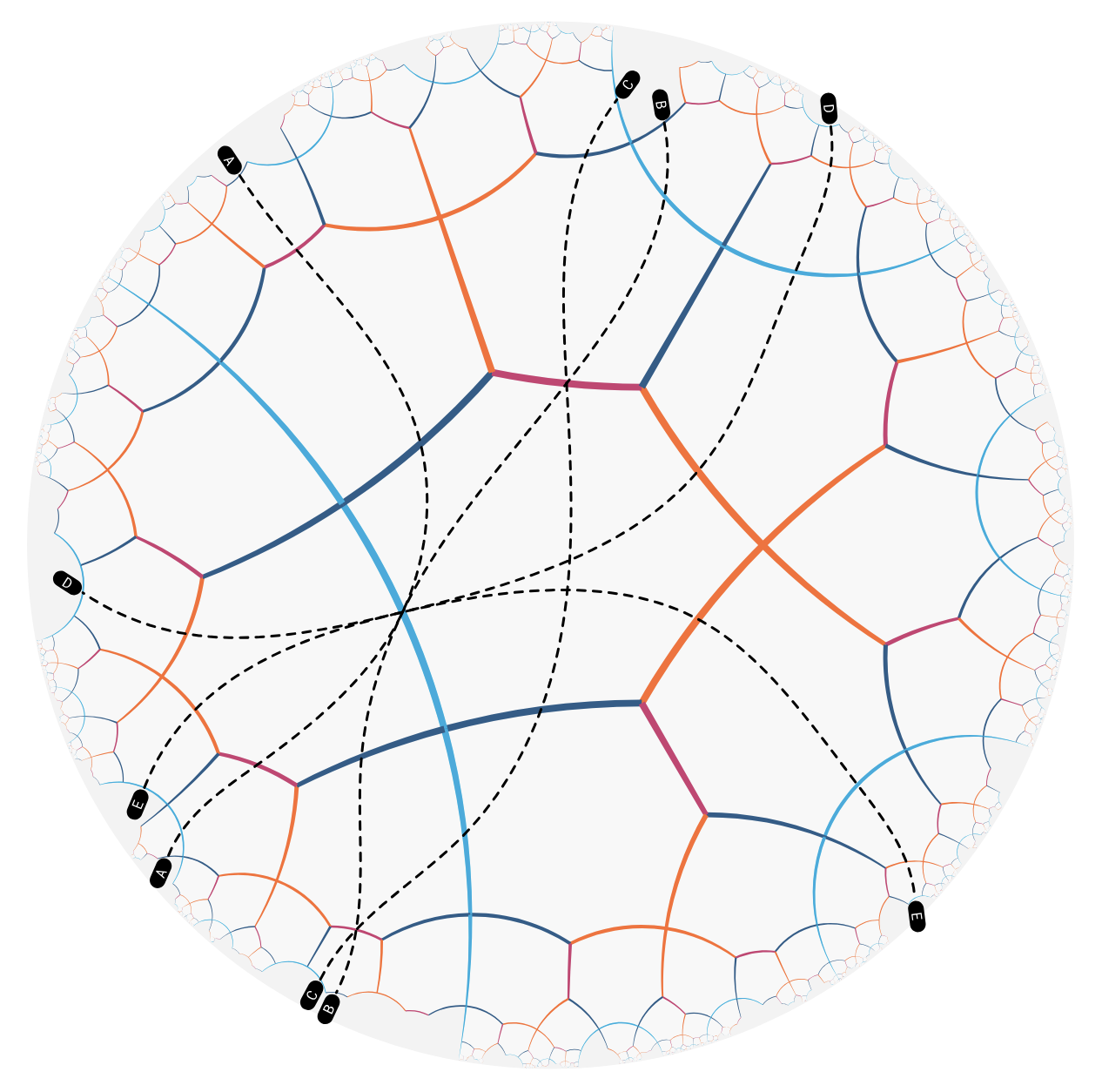
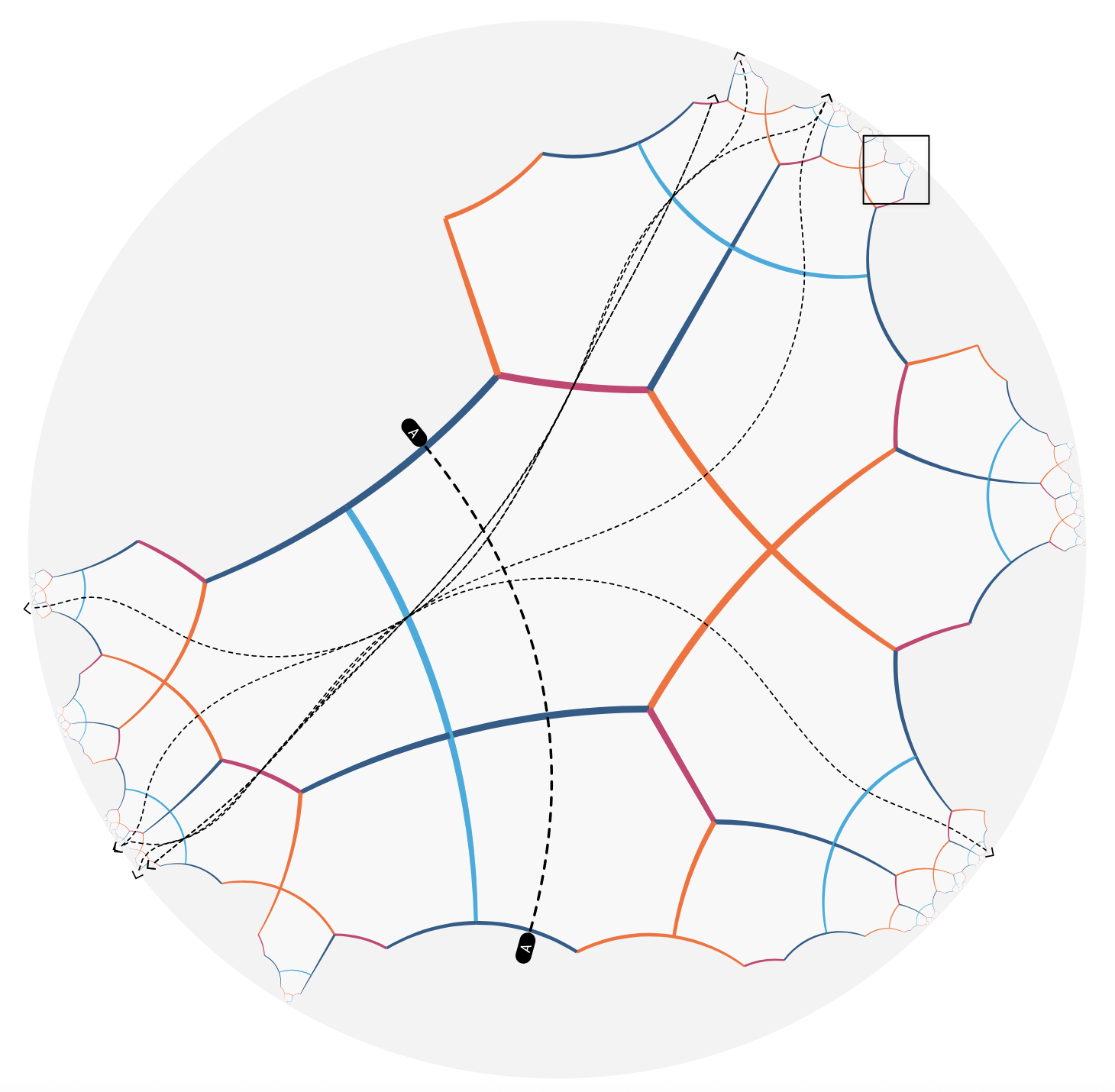
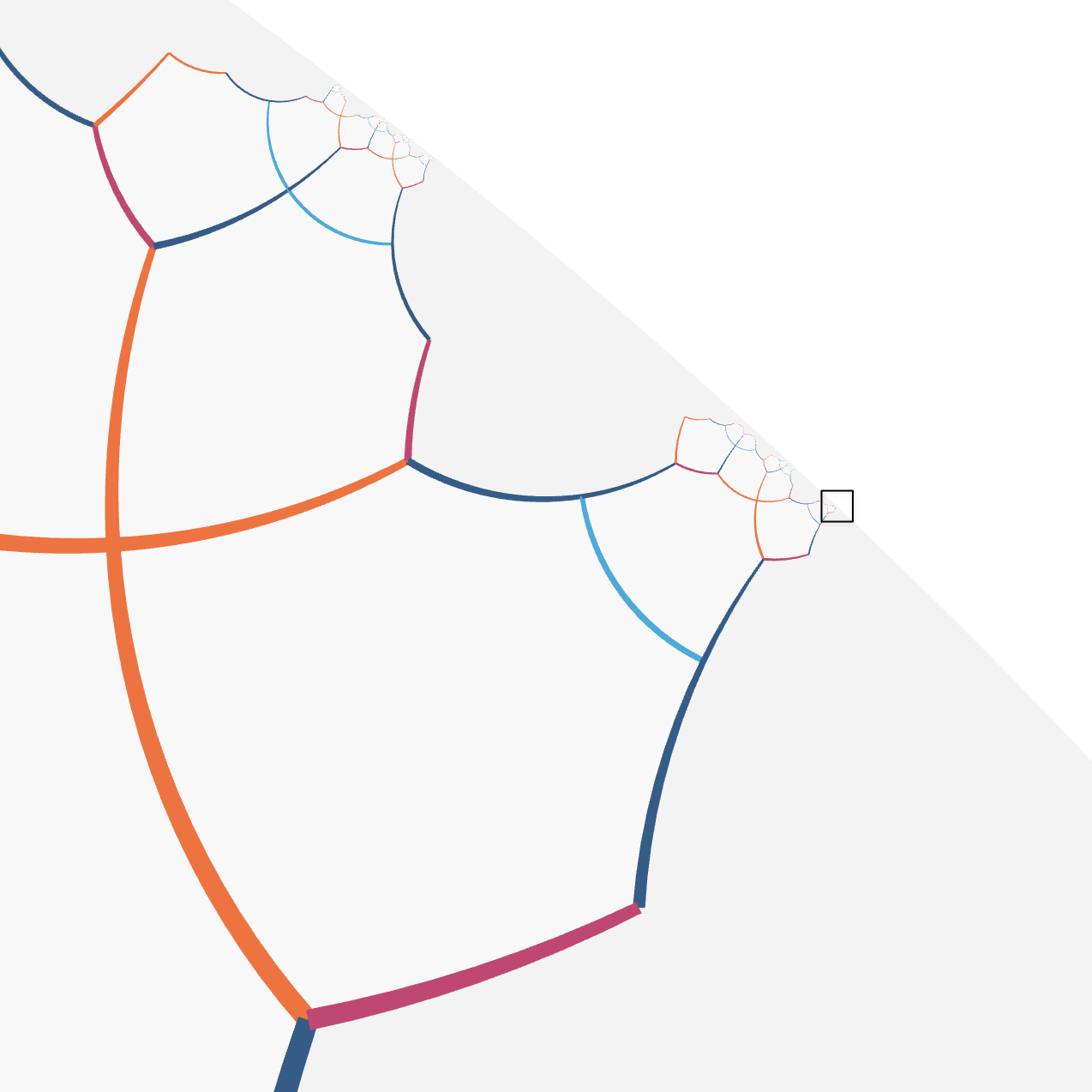
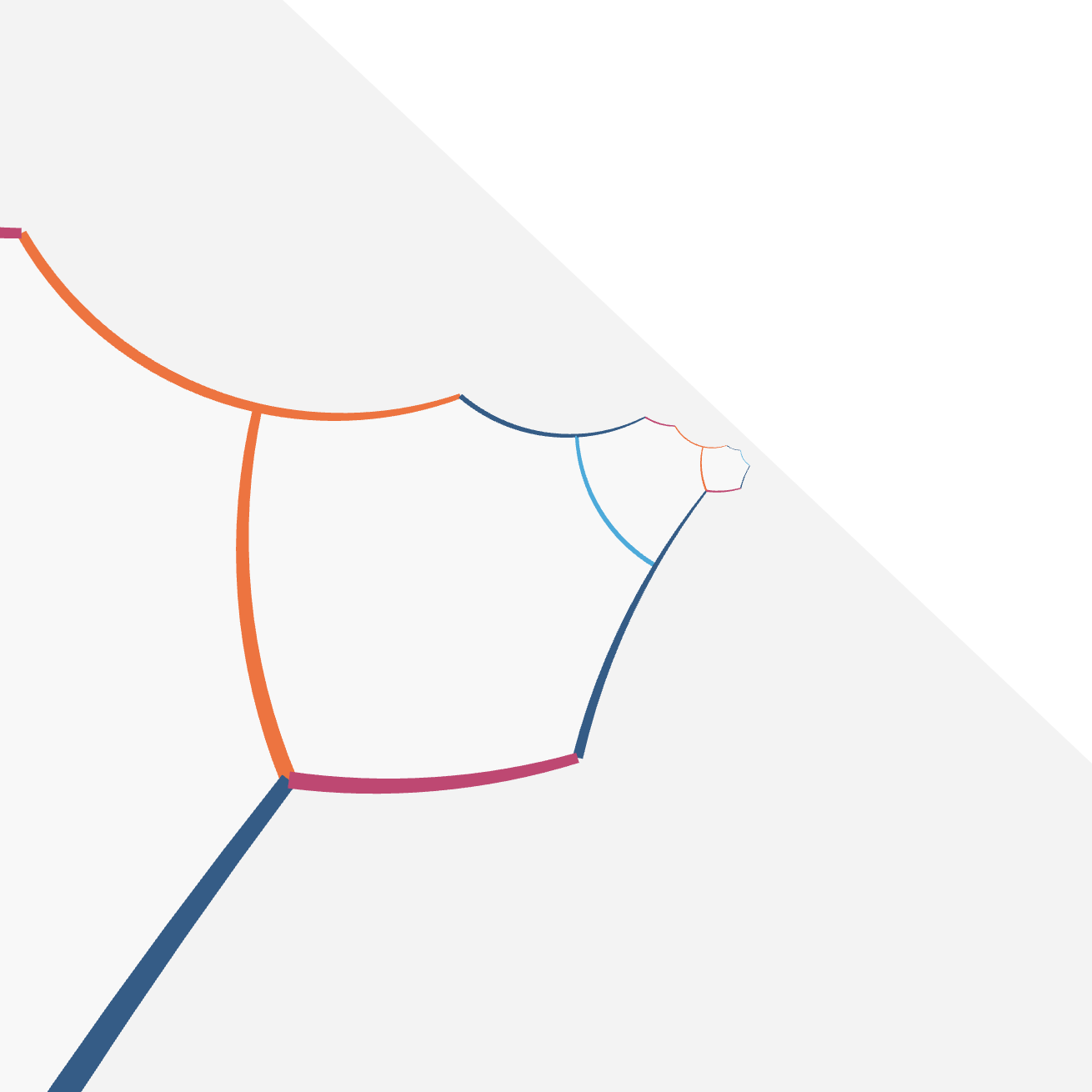
The unfolded hexagonal tile in the Poincaré plane with zoom in.
Gluing rules are
t₂²
(f₁f₂f₁f₂f₁t₁)²