Discussion
Loading...

#Tag

Log in
  • About
  • Code of conduct
  • Privacy
  • Users
  • Instances
  • About Bonfire
Jenniferplusplus boosted
MikeDunnAuthor
MikeDunnAuthor
@MikeDunnAuthor@kolektiva.social  ·  activity timestamp 3 weeks ago

Today in Labor History January 18, 1943: The start of the Warsaw Ghetto Uprising. In the summer of 1942, over a quarter million Jews were deported from the ghetto to Treblinka and murdered. In response, the remaining Jews began building bunkers and smuggling weapons and explosives into the ghetto. On January 18, 1943, when the Nazis began their second deportation of the Jews, the armed insurgency began. They fought with whatever they could smuggle into the ghetto: handguns, gasoline bottles and a few other weapons. They inflicted enough casualties on the Nazis that the deportation was halted within a few days. Only 5,000 Jews were removed, instead of the 8,000 planned. They knew from the start that the uprising was doomed. Most of the Jewish fighters did not expect to survive. Rather, they saw their resistance as a battle for their honor and a protest against the world's silence. Marek Edelman, one of the few survivors, said their inspiration to fight was "not to allow the Germans alone to pick the time and place of our deaths."

#workingclass #LaborHistory #holocaust #genocide #nazis #worldwartwo #uprising #warsaw #jews #antisemitism #ghetto #resistance #fascism #antifascism

Jewish women and children, arms in the air, forcibly removed from a bunker by Nazi soldiers during the Warsaw Ghetto Uprising. By Unknown author (Franz Konrad confessed to taking some of the photographs, the rest was probably taken by photographers from Propaganda Kompanie nr 689.[1][2]) - Image:Warsaw-Ghetto-Josef-Bloesche-HRedit.jpg uploaded by United States Holocaust MuseumThis is a retouched picture, which means that it has been digitally altered from its original version. Modifications: Restored version of Image:Stroop Report - Warsaw Ghetto Uprising 06.jpg with artifacts and scratches removed, levels adjusted, and image sharpened.., Public Domain, https://commons.wikimedia.org/w/index.php?curid=17223940
  • Copy link
  • Flag this post
  • Block
MikeDunnAuthor
MikeDunnAuthor
@MikeDunnAuthor@kolektiva.social  ·  activity timestamp 3 weeks ago

Today in Labor History January 18, 1943: The start of the Warsaw Ghetto Uprising. In the summer of 1942, over a quarter million Jews were deported from the ghetto to Treblinka and murdered. In response, the remaining Jews began building bunkers and smuggling weapons and explosives into the ghetto. On January 18, 1943, when the Nazis began their second deportation of the Jews, the armed insurgency began. They fought with whatever they could smuggle into the ghetto: handguns, gasoline bottles and a few other weapons. They inflicted enough casualties on the Nazis that the deportation was halted within a few days. Only 5,000 Jews were removed, instead of the 8,000 planned. They knew from the start that the uprising was doomed. Most of the Jewish fighters did not expect to survive. Rather, they saw their resistance as a battle for their honor and a protest against the world's silence. Marek Edelman, one of the few survivors, said their inspiration to fight was "not to allow the Germans alone to pick the time and place of our deaths."

#workingclass #LaborHistory #holocaust #genocide #nazis #worldwartwo #uprising #warsaw #jews #antisemitism #ghetto #resistance #fascism #antifascism

Jewish women and children, arms in the air, forcibly removed from a bunker by Nazi soldiers during the Warsaw Ghetto Uprising. By Unknown author (Franz Konrad confessed to taking some of the photographs, the rest was probably taken by photographers from Propaganda Kompanie nr 689.[1][2]) - Image:Warsaw-Ghetto-Josef-Bloesche-HRedit.jpg uploaded by United States Holocaust MuseumThis is a retouched picture, which means that it has been digitally altered from its original version. Modifications: Restored version of Image:Stroop Report - Warsaw Ghetto Uprising 06.jpg with artifacts and scratches removed, levels adjusted, and image sharpened.., Public Domain, https://commons.wikimedia.org/w/index.php?curid=17223940
  • Copy link
  • Flag this post
  • Block
Agaric Tech Collective boosted
MikeDunnAuthor
MikeDunnAuthor
@MikeDunnAuthor@kolektiva.social  ·  activity timestamp 5 months ago

Today in Labor History September 16, 1945: 43,000 oil workers went on strike in 20 states. During WWII, most of the major unions collaborated with the U.S. war effort by enforcing labor “discipline” and preventing strikes. In exchange, the U.S. government supported closed shop policies under which employers at unionized companies agreed to hire only union members. While the closed shop gave unions more power within a particular company, the no-strike policy made that power virtually meaningless. When the war ended, inflation soared and veterans flooded the labor market. As a result, frustrated workers began a series of wildcat strikes. Many grew into national, union-supported strikes. In November 1945, 225,000 UAW members went on strike. In January 1946, 174,000 electric workers struck. That same month, 750,000 steel workers joined them. Then, in April, the coal strike began. 250,000 railroad workers struck in May. In total, 4.3 million workers went on strike. It was the closest the U.S. came to a national General Strike in the 20th century. And in December 1946, Oakland, California did have a General Strike, the last in U.S. history. Overall, it was the largest strike wave in U.S. history. In 1947, Congress responded to the strike wave by enacting the Taft-Hartley Act, restricting the powers and activities of labor unions and banning the General Strike. The act is still in force today and one the main reasons there hasn’t been a General Strike in the U.S. since 1945.

#workingclass #LaborHistory#GeneralStrike #oakland #oilworkers #union #strike #strikewave #worldwartwo #tafthartley #uaw #coal #railroads #inflation #steel #wildcat

AFL union rally, Madison Square Garden, New York City, 1947, with large sign that reads: Mr. President, Veto the Taft-Hartley slave labor bill.
  • Copy link
  • Flag this post
  • Block
MikeDunnAuthor
MikeDunnAuthor
@MikeDunnAuthor@kolektiva.social  ·  activity timestamp 5 months ago

Today in Labor History September 16, 1945: 43,000 oil workers went on strike in 20 states. During WWII, most of the major unions collaborated with the U.S. war effort by enforcing labor “discipline” and preventing strikes. In exchange, the U.S. government supported closed shop policies under which employers at unionized companies agreed to hire only union members. While the closed shop gave unions more power within a particular company, the no-strike policy made that power virtually meaningless. When the war ended, inflation soared and veterans flooded the labor market. As a result, frustrated workers began a series of wildcat strikes. Many grew into national, union-supported strikes. In November 1945, 225,000 UAW members went on strike. In January 1946, 174,000 electric workers struck. That same month, 750,000 steel workers joined them. Then, in April, the coal strike began. 250,000 railroad workers struck in May. In total, 4.3 million workers went on strike. It was the closest the U.S. came to a national General Strike in the 20th century. And in December 1946, Oakland, California did have a General Strike, the last in U.S. history. Overall, it was the largest strike wave in U.S. history. In 1947, Congress responded to the strike wave by enacting the Taft-Hartley Act, restricting the powers and activities of labor unions and banning the General Strike. The act is still in force today and one the main reasons there hasn’t been a General Strike in the U.S. since 1945.

#workingclass #LaborHistory#GeneralStrike #oakland #oilworkers #union #strike #strikewave #worldwartwo #tafthartley #uaw #coal #railroads #inflation #steel #wildcat

AFL union rally, Madison Square Garden, New York City, 1947, with large sign that reads: Mr. President, Veto the Taft-Hartley slave labor bill.
  • Copy link
  • Flag this post
  • Block
Aral Balkan boosted
Fifi Schwarz 🖤🇪🇺 🍉✊🏿🌈🌍
@fifischwarz@waag.social  ·  activity timestamp last year

‘People who do not know what others in a group actually think often decide that it is safer to go along with what appear to be the dominant norms in order not to stand out.’
#DeZinVanHetBoek #TheEssenceOfTheBook

#BoekPerWeek 8/52 ★★★★☆

Must read. Here's why in 🇬🇧 🇺🇲
https://www.goodreads.com/review/show/6214923141

En hier in 🇳🇱
https://verzameldezinnen.nl/2025/02/08/erbij-staan-en-ernaar-kijken-boekbespreking/

#Boeken @boeken
#Bookstodon @bookstodon
#Geschiedenis#History
#TweedeWereldoorlog
#WWII#WorldWarTwo #Holocaust

Boekomslag Mary Fulbrook - Bystander Society. Conformity and complicity in Nazi Germany and the Holocaust
  • Copy link
  • Flag this post
  • Block
STOP OCCUPATION 🍉 S. Costa boosted
MikeDunnAuthor
MikeDunnAuthor
@MikeDunnAuthor@kolektiva.social  ·  activity timestamp 7 months ago

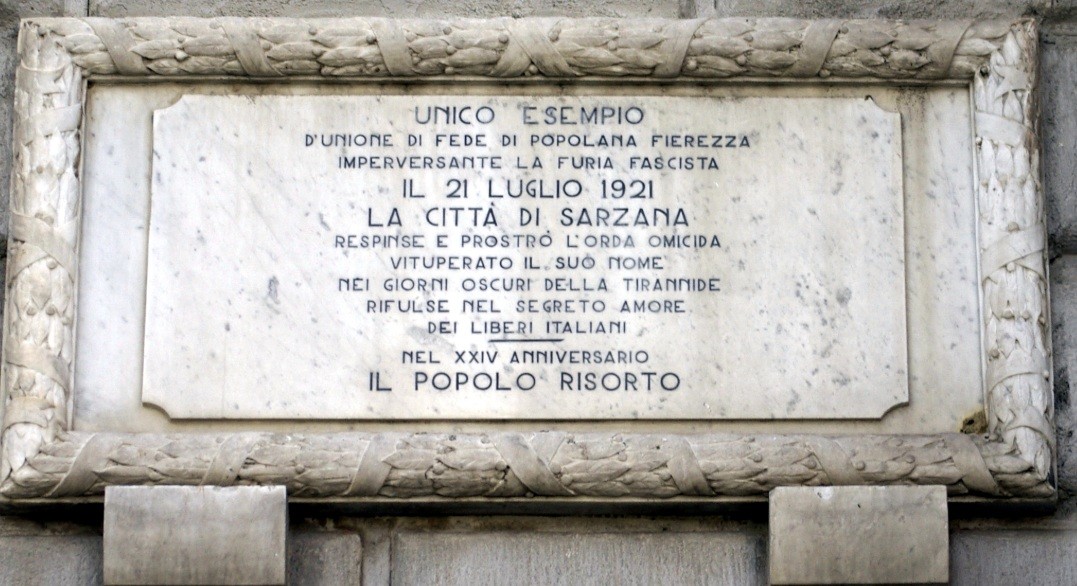
Today in Labor History July 21, 1921: Hundreds of antifascist activists chased off 600 fascists in Sarzana, Italy, who were trying to free several a fascist squad from prison, after they opened fire. Led by the anti-fascist Arditi del Popolo, the people chased the fascists into the neighboring hills, killing 18 of them. Sarzana continued to be a center of partisan resistance to fascism during World War Two.

#workingclass #LaborHistory #fascism #antifa #antifascism #italy #prison #worldwartwo

Plaque in Sarzana, Italy, commemorating the battle in which antifascists drove off and killed fascists in 1921
  • Copy link
  • Flag this post
  • Block
MikeDunnAuthor
MikeDunnAuthor
@MikeDunnAuthor@kolektiva.social  ·  activity timestamp 7 months ago

Today in Labor History July 21, 1921: Hundreds of antifascist activists chased off 600 fascists in Sarzana, Italy, who were trying to free several a fascist squad from prison, after they opened fire. Led by the anti-fascist Arditi del Popolo, the people chased the fascists into the neighboring hills, killing 18 of them. Sarzana continued to be a center of partisan resistance to fascism during World War Two.

#workingclass #LaborHistory #fascism #antifa #antifascism #italy #prison #worldwartwo

Plaque in Sarzana, Italy, commemorating the battle in which antifascists drove off and killed fascists in 1921
  • Copy link
  • Flag this post
  • Block

bonfire.cafe

A space for Bonfire maintainers and contributors to communicate

bonfire.cafe: About · Code of conduct · Privacy · Users · Instances
Bonfire social · 1.0.2-alpha.22 no JS en
Automatic federation enabled
Log in
  • Explore
  • About
  • Members
  • Code of Conduct