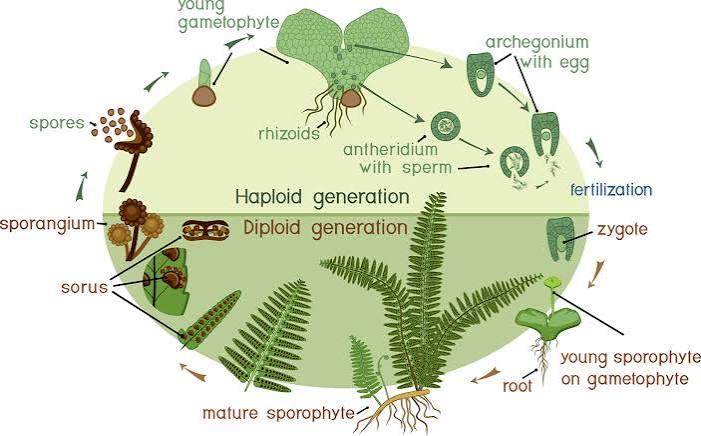
Ferns live a double life, alternating between two completely separate plants each generation. The one you'd recognize as a fern - the leafy thing with fronds - is called the 'sporophyte'. Its cells are 'diploid', meaning they carry two copies of every chromosome, one from each parent, just like your own cells do.
On the undersides of its fronds, the sporophyte produces spores, and it makes them through a special kind of cell division that halves the chromosome count. So while the sporophyte itself is diploid, its spores are 'haploid': they carry just a single copy of each chromosome.
Here's where ferns diverge from the animals we're used to: those haploid spores don't grow into new leafy ferns! Instead, each spore grows into a tiny, separate plant - often a green heart-shaped flap just a few millimeters across - called a 'gametophyte'.
Being haploid, this has only one copy of each chromosome, and it's this modest little plant, not the showy frond, that produces the eggs and sperm. When a sperm swimming through a film of water reaches an egg and fertilizes it, the two haploid cells combine their single chromosome sets into one cell with a double set: a diploid cell again! That grows into a new leafy sporophyte, and the cycle begins again.
So a fern is really two alternating plants: a big diploid sporophyte that makes spores, and a small haploid gametophyte that makes eggs and sperm.
Ferns can spread quickly because they produce vast numbers of spores, which can be blown by the wind for enormous distances. Then, when a lone spore grows into a little gametophyte, this can fertilize itself!
(2/2)