
Wow some terrible reporting about Google's latest horrible ideas about how to distort information access in the name of "convenience" (or something):
https://techcrunch.com/2026/05/19/google-search-as-you-know-it-is-over/
A short thread
🧵>>
Wow some terrible reporting about Google's latest horrible ideas about how to distort information access in the name of "convenience" (or something):
https://techcrunch.com/2026/05/19/google-search-as-you-know-it-is-over/
A short thread
🧵>>
@emilymbender
Good thing they block adblockers then aye?
@emilymbender These companies desperately want to stop us from finding & enjoying each other's content. Walled gardens of social media & mega platforms weren't enough, now the search directories will be the ultimate walled garden.
All built on stealing the work of everyone who's ever published anything online.
Why would anyone create anything anymore? I already feel my own desire to blog is waning.
@emilymbender My bigger worry is if they start ensloppifying scholar.google.com. Zotero Connector eats it right up. Semantic Scholar isn't a patch on it for grabbing bibliographic records and tracking references, I have seen noticeable distortion in its results. Their pipeline is somewhat ML driven but they do use LLM summaries. This is expected given the origins of the service. Provenance is everything.
@emilymbender Six alternatives to Google Search hosted in Europe
https://european-alternatives.eu/alternative-to/google-search
I usually use Qwant and I'm very happy
@emilymbender I want my printed encyclopedia back...
@emilymbender so… search is now Google Wave but with robots.
@emilymbender I saw someone toot about that Tuesday afternoon, and my reaction to the article was, "So TechCrunch is rewriting Google press releases?" Not a critical thought expressed in the article. IIRC, no quotes from anyone at all, positive or negative. Just a list of supposedly useful features and enhancements.
Feh.
@emilymbender The good news: nobody needs #google. I've blocked all their MTAs, and resisted using their apps for quite some time. No problems so far.
@emilymbender 2.5 billion users a month they claim.
Having an AI summary forced into every search doesn't make the searcher a user of the tech. How many people simply ignore the summary?
@emilymbender yeah, even for someone who is pro-tech and interested in AI developments, this @TechCrunch piece read like a press release. It was journalistically extremely weak to the point I felt dumber for reading it.
@emilymbender i'm fucking weepi ng
Information-gathering agents are an evolution of Google
i have never observed google demonstrate any behavior that struck me as evidence of them gathering any form of information
Links will become an afterthought
that reminds me how they own the w3c and use it to ensure no one who has ever created a webpage will ever be able to show it to anyone without exposing them to the most openly broken cryptography i've ever seem
There’s little time left for publishers to adapt.
openly gloating
which will eventually be free
that's right. we will all be free. that's a cryptographic guarantee
@hipsterelectron @emilymbender Seems more like we are free to give everything to Google for free and not get any traffic in return. 🤔
5 years ago (2021) Google researchers Metzler et al put out a preprint talking about how LLMs would change information access ("Rethinking Search"). It was full of TERRIBLE ideas, and Chirag Shah and I wrote a reply ("Situating Search"):
https://dl.acm.org/doi/10.1145/3498366.3505816
>>
@emilymbender The point that their search product was already, to use the vernacular, crap, at this point, must have been lost on them, and Sundar Pichai in particular is responsible for this, as Ed Zitron has neatly elaborated upon elsewhere.
We followed a couple of years later with further arguments about, inter alia, protecting the information ecosystem:
https://dl.acm.org/doi/10.1145/3649468
While Nora Lindemann was writing about similar ideas:
https://link.springer.com/article/10.1007/s00146-024-01944-w
>>
@emilymbender i want you to know your repeated scientific deconstruction of google's ideological warfare under the guise of a search interface has enabled me to extrapolate at great length how the entire formalisms of automata theory have been constructed to exclude any investigation that could ever produce a paper with more than 1% performance improvement over their state of the art. parsing and formal languages has been dead for several decades.
google calls it a "parser confusion vulnerability" when python maintainers use features of the zip file format in their own published releases that make it impossible for specifically google to insert a cryptograpic backdoor onto their users' machines (because google owns pypi), while at the same time the python METADATA file format actively right now supports an "ambiguity' intentionally invisible to human reviewers but instructs the standard packaging software to download and execute code that won't show up in the output.
just as you said:
We revisit foundational work related to information behavior, information seeking, information retrieval, information filtering, and information access to resurface what we know about these fundamental questions and what may be missing.
i very recently realized these questions can be quantified in the field of operating system design, in a really drastic sense that led me to switch my research focus because i'm confident i can convince people every computer should work this way.
just this weekend i realized (quite by mistake) that a fact i'd known since 2019, when google made mozila and twitter lay off their teams of scientists who had just publicly demonstrated that google chrome and bazel products were neither "fast" nor "correct", in ways that are easily and obviously quantifiable, also represented a shocking and obvious failure in the entire theory of operating system design. not just that computers are slow and fail to protect the user, but how demonstrate a thrilling counterexample
which is to say, after an intensive literature review (including "standards" for "portable" behavior that were neither), i'm confident i've identified a novel property for computer security which results from a computer performance property that i could already prove 12 ways from sunday. and i now know how to construct a system that achieves both.
i found a dissertation from the single person who tried something pretty close https://circumstances.run/@hipsterelectron/116602585443289491 but otherwise i have performed sufficient literature review to be confident i can express this result in a way that will convince any convince anyone familiar with the field that there's a whole other field they'd been missing this whole time.
and it will run on a computer or phone, to protect people from harm. it demonstrates how the temporal and spatial structure of computer memory in response to user input can be described as a correctness property of the operating system. like i did to google's bazel, it will defeat them in their own terms
thank you
But all the academic papers in the world showing why something is a bad idea won't stop companies from doing it, if it's profitable and/or fits into their quasi-religious beliefs that "AI" is the future, alas.
So let's look at what Google is up to now, or at least says they are, via TechCrunch as stenographer:
>>
@emilymbender Sometimes it feels like these people are trying to create a world from science fiction stories. For example, in Star Trek when they ask the computer something and it just gives them the answer. They don't understand that plenty of science fiction has no basis in reality and/or are terrible for how our brains actually work (like you've pointed out).
That or they are just greedy bastards that are looking to exploit anyone and everyone for a profit.
@emilymbender I'll see you that and raise you: https://www.asc.upenn.edu/news-events/news/largest-quantitative-synthesis-date-reveals-what-predicts-human-behavior-and-how-change-it Secondary reference from the APNIC blog about why IPv6 uptake has failed, which, ironically, is a part of the Internet relatively free from unwanted LLM scraper incursion, so far. The neat Hilbert curve based heat maps for IPv4 address spaces do not map so neatly to IPv6 because of the massively increased address space.
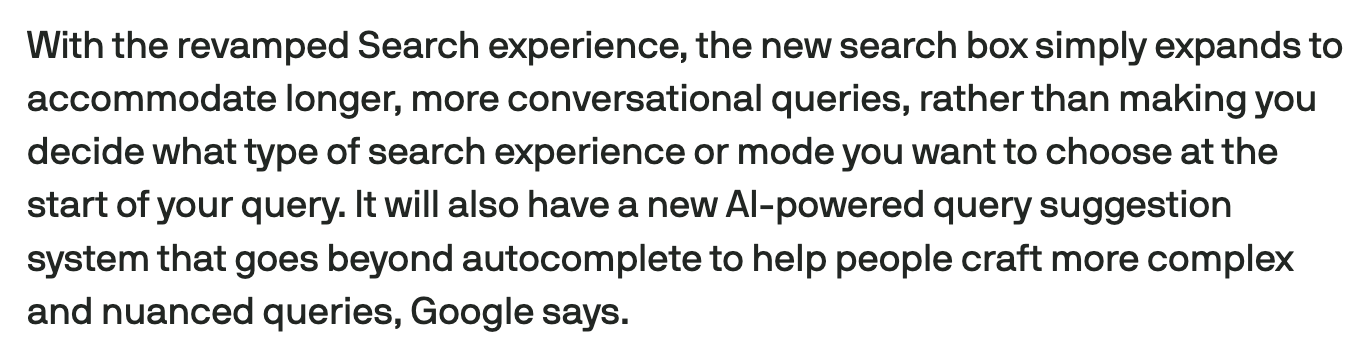
Not satisfied to cut people off from the important sense-making of looking at information in its context and finding and navigating different perspectives (what "AI overviews" do), Google also wants to tell you what to search for:
>>
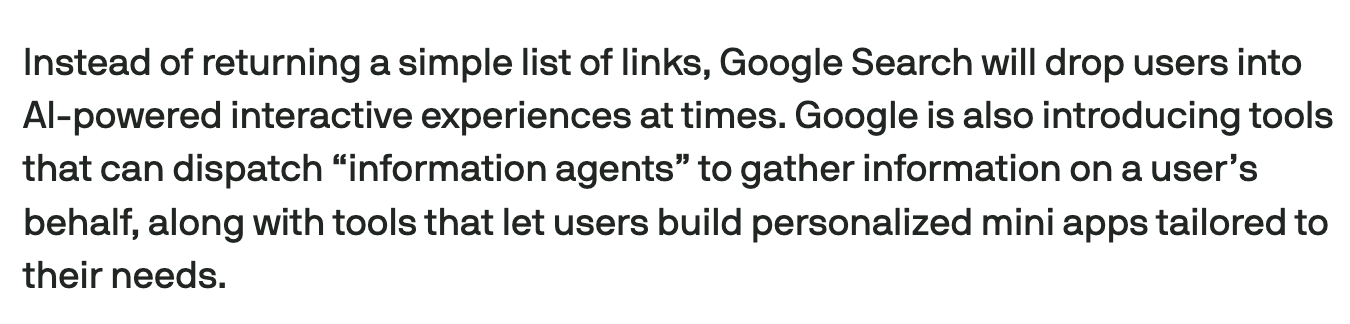
How infantilizing --- you thought you were looking to find something that someone else wrote on the web. But woah! Now you've been "dropped into" an "interactive experience". Yeah, Google can just fuck right off with that.
>>
Look, I hate pointy-clicky interfaces as much as the next Gen-Xer (let me use the keyboard, dammit) but it is so weird to reduce the important, and importantly effortful, work of navigating the information ecosystem to the apparent drudgery of clicking on links that are (*shudder*) blue!!!
>>
Here is where it really starts to show that this journalist is just lightly paraphrasing a press release. "Links will become an afterthought," will they? What is your evidence for that confident statement about the future?
>>
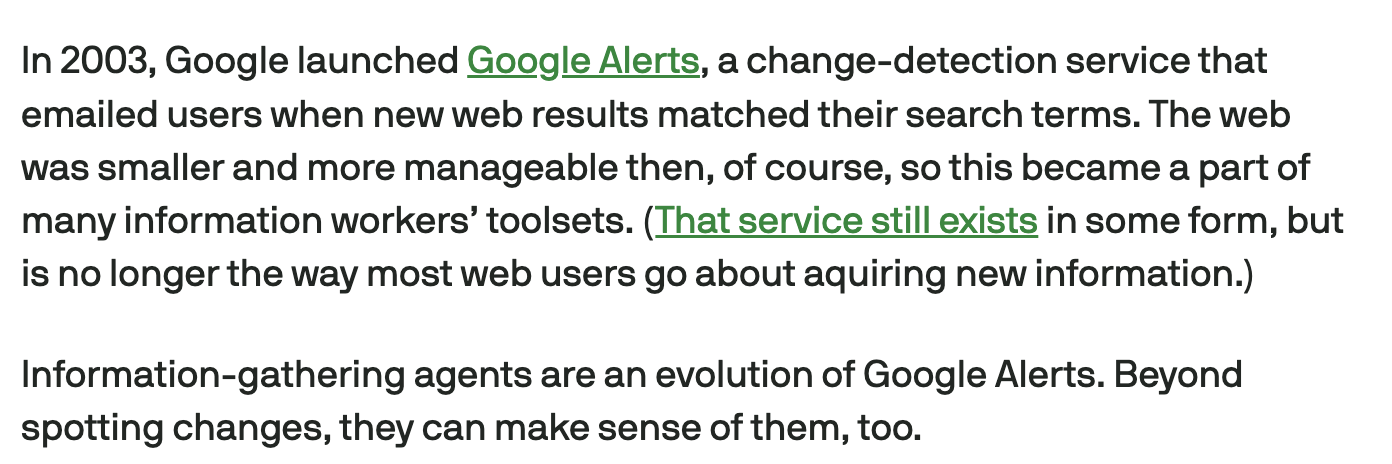
Spot the magical thinking here. No, the "AI" isn't making sense of anything. It's making papier-mache of the input, and preventing the use from doing the sense-making.
Also, is that the Pokemon sense of "evolution"?
>>
To expand just a little bit: the point of a Google Alert was to gain access to things that people were saying about a topic that you were tracking, which you otherwise might not turn up. And every (blue, even!) link that you clicked on brought you to a web page you could examine to get a sense of who was writing, in what context, and why.
>>
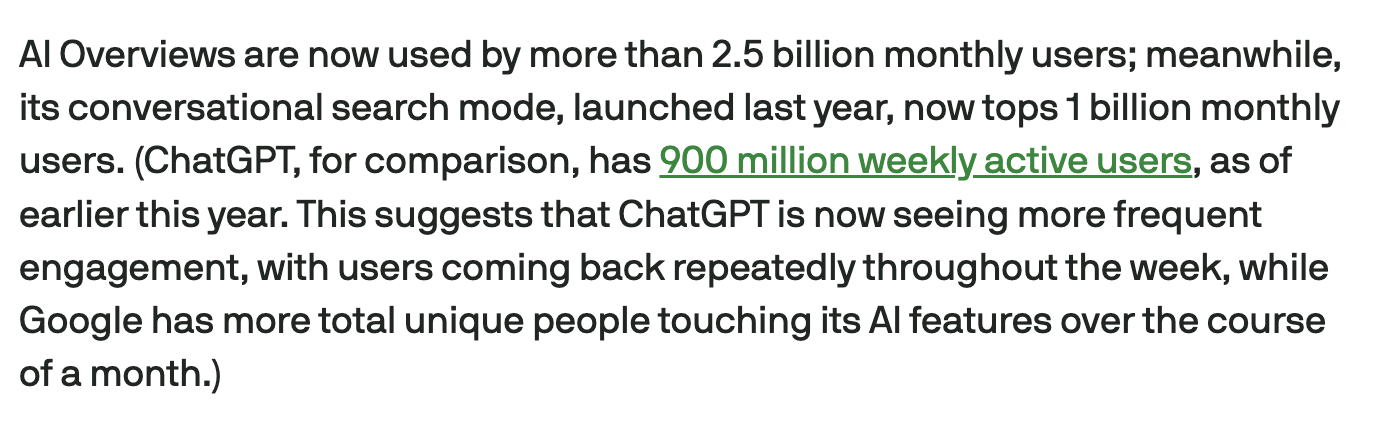
More stenography here. Google starting shoving the "AI Overviews" into query results as an opt-out situation. That is, you have to take action to have them not pop up. I don't doubt they are *shown to* 2.5 billion monthly users, but that doesn't mean they are used by as many or desired by them.
>>
@emilymbender Priority is on maximising usage. Sure, they lose money on every user, but they will make it up on scale.


Install bonfire.cafe
Get the full app experience