

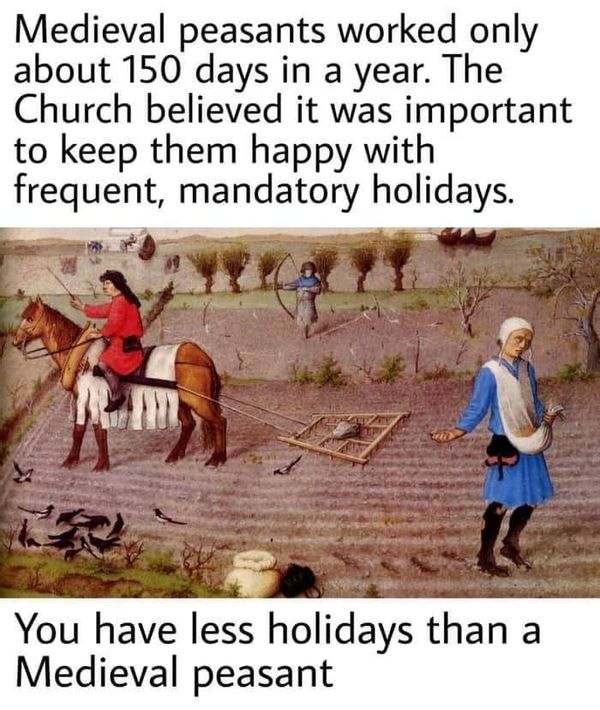
Does anyone have a pointer to an open access academic reference for the number of days worked in a year by peasants in medieval Europe?
Post
Replies:
9


@alberto_cottica I quite enjoyed this multi-part series about the labor dynamics of medieval peasants:
https://acoup.blog/category/collections/the-peasant/
Technically it's a blog series, but it was written by an academic historian and goes quite in depth (as far as I can see from my non-historian perspective). I'm sure your answer is in there, maybe even with a citation.



@alberto_cottica no, but they ALSO had to work on their own little patch of land to feed their family. ALSO a lot of the work would have been agricultural and could not be done year round
@Tho99 I found this: https://doi.org/10.1093/ej/uez017 .
Figure 4 is striking.
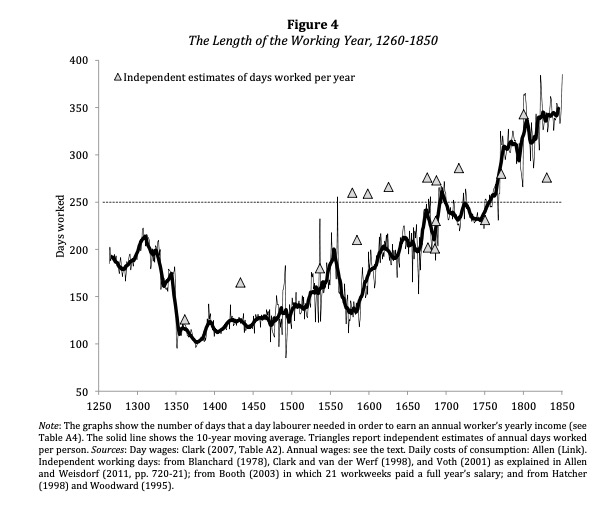
Unreal Wages? Real Income and Economic Growth in England, 1260–1850
@alberto_cottica whatever a medieval or early modern yearly salary was supposed to mean 😊
@Tho99 not salary, though. What is bring graphed is yearly days of work.


@alberto_cottica My understanding is, after the harvest they were not feasting either, they were fixing house and equipment (carts etc), trying to keep alive any chicken/goat/cow if they had any, and churning out for the year ahead the expendables like bast shoes which run out like crazy https://en.wikipedia.org/wiki/Bast_shoe
That alone was a lot of work. "Serfdom and colonial rule REALLY sucks" is the idea which Ukrainian school spends a lot of time teaching to all ages. I barely got it and I'm thankful.
@autkin no doubt. In a similar fashion, housemaking, childcare etc. are not counted in working hours today – and gives rise to an underestimation of wage gender gaps, because that care work falls disproportionately on women.


@alberto_cottica
So that would be a three day week.
Thank goodness we have computers and AI to take away the unnecessary work.