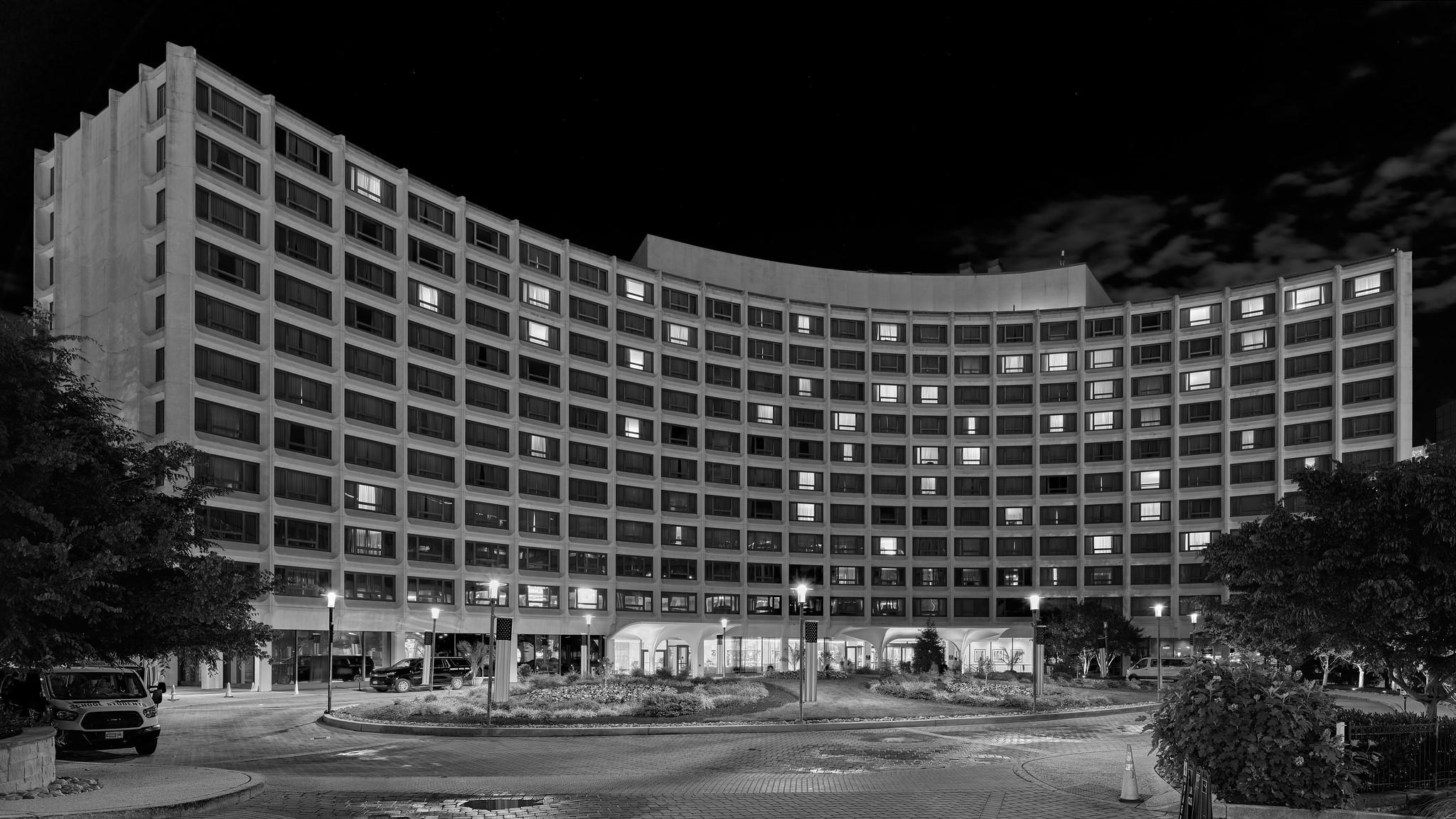

Washington ("Hinckley") Hilton, Washington, DC, 2023.
All the pixels, none of the gunfire, at https://www.flickr.com/photos/mattblaze/53007102796
Post
Washington ("Hinckley") Hilton, Washington, DC, 2023.
All the pixels, none of the gunfire, at https://www.flickr.com/photos/mattblaze/53007102796
This is a fairly conventional architectural composition, emphasizing the curved facade. To get a high resolution capture of the wide structure, this was made as a stitched composite of two captures with the Rodenstock 32mm/4.0 HR Digaron-W lens. The Phase One back was shifted left and right by about 12mm.
By using shift movements at a fixed perspective, the two captures can be stitched directly together into a panorama without needing to transform the frame geometry (as you would with panning).
The result here is about 170MP in 16:9 format, which is sufficient for very large prints that retain a great deal of detail (I've printed this at 6 feet wide).
Mid-Century Modernist architecture, and Brutalism in particular, is easy to dismiss as being superficially lifeless and uninteresting, but at its best (and with the right eye) these buildings can be seen as sculptures in the landscape. I don't always appreciate them, but they're often more interesting than they first seem.
@mattblaze I feel like you buried the lede — could you describe how the 6’ print happened? (unless it was inkjet, but I’m hoping for some wild processing equipment like a cross between a darkroom and a car wash)
Thanks in advance 🙏
@jacquiharper I use one of the Canon roll paper photo printers. It's the largest thing in my house.
The Washington Hilton, completed 1965, was designed by architect William Tabler. It's notable not only for its distinctive exterior, but also for the prominent events hosted there. The hotel is or has been home to the White House Correspondents Association Dinner, the National Prayer Breakfast, the Shmoocon conference, and the assassination attempts on Reagan and Trump, among many other things.
It has extensive back-of-house facilities and security features to accommodate high profile VIPs.
Based on the style and period, you might guess this was a minor work of Eero Saarinen's (it shares many design elements with his arirport terminals of the same era). But, in fact, the architect was the less well known William Tabler, who had many commissions from Hilton. This was one of Tabler's most distinctive hotels, I think.


Install bonfire.cafe
Get the full app experience