
@corpsmoderne @deneb @mastodonmigration There is no software that removes the satellites from your eyeballs. This is a huge problem.
Post
Replies:
29




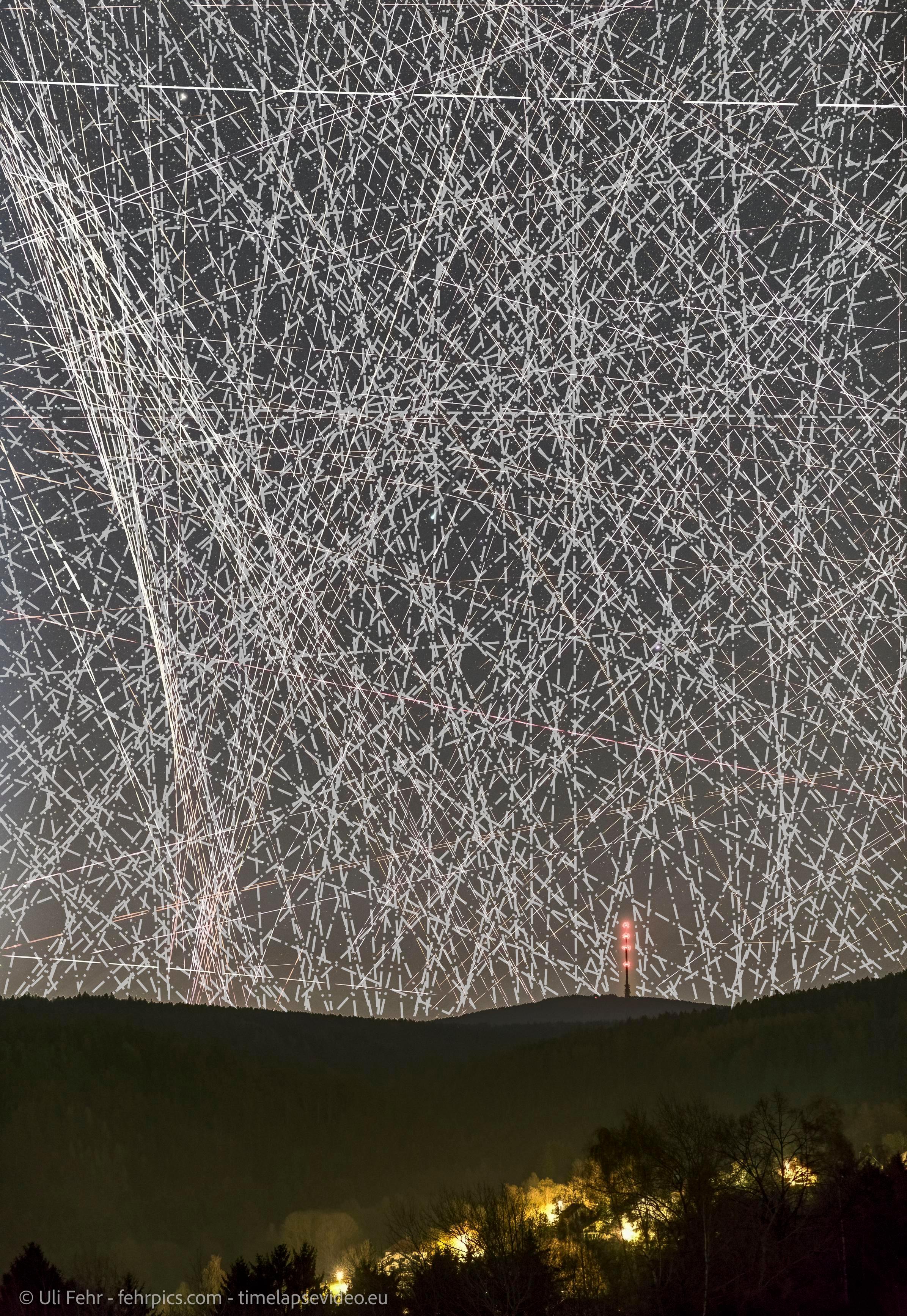
@mastodonmigration @RalphBassfeld @sundogplanets Software can remove the trails. And this is a multiple exposure image.


@mastodonmigration @sundogplanets
Great photo!
I’m guessing it’s about 40 stacked images, each with an exposure time of about 15 seconds and a 1-second interval between exposures—that explains the streaks from the satellite trails. So the total exposure time is about 10 minutes. Is that right?
What I don’t understand is why the trails appear in parallel bundles—how does that happen?



@mastodonmigration @sundogplanets
Irgendwie...
Ich beobachte ja auch öfter den Himmel.
Aber eine Satellitenspur quer durchs Bild mit der gleichen Farbe und Helligkeit kommt mir irgendwie sehr gephotoshopt vor.
Da oben ist inzwischen wirklich zu viel los - danke Elon - aber schneeweiß, mit gleicher Helligkeit vom oberen Bildrand bis zum Horizont - oder umgekehrt - kann ich mir nicht vorstellen.
Aber vielleicht sollte ich mir den Begleittext zum APoD mal genau durchlesen bevor ich meckere. 🫣

@mastodonmigration @sundogplanets Oh, what a tangled web we weave.

@mastodonmigration @sundogplanets@mastodon.social
And this is how it looks like after psychopath musk lift up 1 mio of his satellites.

@diametraldaneben @mastodonmigration Somehow, if China sent Starlink satellites into each other air-hockey style to some end of theirs, I would never gripe about it.

This does not solve the problem. In fact such collisions are a serious concern (called Kessler Syndrome) because the debris does not come down, it just creates more space junk.
@mastodonmigration @diametraldaneben That rubicon has passed. It will be junk one way or another.

@mastodonmigration @sundogplanets that has to be a sunset/sunrise phenomenon. If it was the middle of the night the sun would be behind the Earth and the satellites would be in shadow unless they're really low on the horizon
@Cattail @mastodonmigration From some latitudes, from some times of night. https://iopscience.iop.org/article/10.3847/1538-3881/ac341b/pdf

@mastodonmigration @sundogplanets Why do the satellites blink?
@Qybat @mastodonmigration That's probably the reset time between several second-long exposures that were added together.


@mastodonmigration @sundogplanets I can find the comet. But that is not the point - this is major level pollution of our skies.
Something that is more and more of a problem, because there are so few places left where you can get a decent view of the sky because of ground pollution, and are accessible, so that amateurs and kids and families can actually see the sky as it really is, and get excited about astronomy.
But even these places are now being polluted by LEO satellites.

@mastodonmigration @ichwillechtnurlesen @sundogplanets Looks like a sewing pattern. But I found the comet.

@mastodonmigration @sundogplanets @Susticle That's what I meant the other day ...


@mastodonmigration @sundogplanets for an instant, I thought the post would be about mansplaining
@leonardof @mastodonmigration SpaceX: mansplaining the night sky since 2019


@mastodonmigration I can find the comet, but that doesn't ameliorate the fact that these bastards have filled our near orbit with shit. @sundogplanets


@mastodonmigration @sundogplanets ok don't get me wrong: satellites pollution is a big problem and people should be made aware of it.
But as an astrophotographer I know that the software we use are very good at removing them, usually without rejecting the whole frame.
This picture has been processed specifically to emphasize the problem, which is a tidy bit misleading even if for a good cause.
Amateur astronomy is not the problem with swarms of satellites.
Will still share it.


@corpsmoderne @mastodonmigration @sundogplanets
As a scientist who did process data from various professional telescopes, I know that you can hide these trails and still make "nice" pictures. But I also know that by doing so you degrade the signal, and when what you are looking for is at the detection limit (it usually is, otherwise you would not waste precious telescope time on it), it can introduce artifacts or hide valuable info.
@deneb @mastodonmigration @sundogplanets oh 100% . I was strictly speaking about amateur astronomy, I'm sure it's a very different problem in professional astronomy. But the picture above belong to the amateur kind of photography.
@corpsmoderne @deneb @mastodonmigration There is no software that removes the satellites from your eyeballs. This is a huge problem.

@sundogplanets When you can't even stare up at the night sky without being reminded of the liberties billionaires take with our world, something is very wrong.


@mastodonmigration @sundogplanets it's deeply cynical that one of the major culprits calls itself "Space Exploration Technologies Corporation"

@mastodonmigration That's really something else seeing it like this, and not in a good way. 😡
@PamelaBarroway @sundogplanets
Yes. It is really stunning. We are blinding ourselves.


@mastodonmigration @PamelaBarroway One (Nazi) billionaire, ruining an entire planet's view so he can have more money than God. What a awful shitlord.