

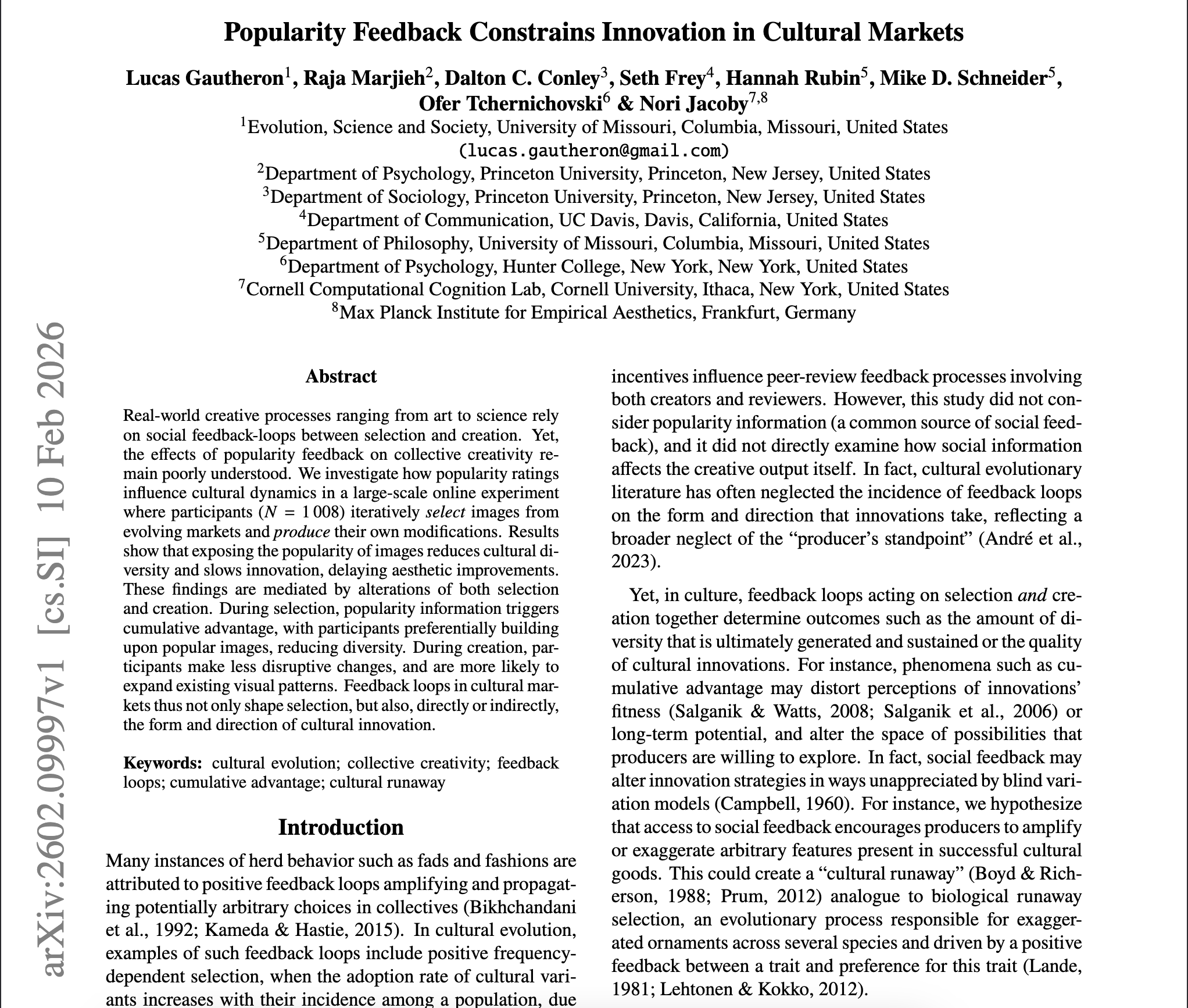
What are the implications for #ActivityPub user interface design?
18
Replies
30
Boosts

… that maybe showing “like” counts and other “engagement” stats isn’t a good thing.
It’s counterintuitive for software designers trained on surfacing as much data as possible, but it’s probably true.


Interesting paper, thanks. I just made an analogy to how road networks evolve over time, and what that means for the #social environment. This against the backdrop of my long blog article about #ActivityPub fediverse #evolution.
https://social.coop/@smallcircles/116429792361242801
Social experience design examines the #SocioCultural ecosystem that emerges by the #technology landscape and is determined by the shape of our #tech that it must grown on. Think like organic moss, that is able to take a foothold in the nooks and crannies of slick aluminium roofs. #SocialWeb is a forest.
An observation is that we generally severely underestimate the impact of "adding an extra online channel, so now we can be social remotely". This way of perceiving social totally misses how everything is different online, and at the same time that many things should / can be very similar to how we do offline #SocialNetworking for ages. Increasing social bandwidth on the wire.
https://coding.social/blog/reimagine-social/#personal-social-networking

@strypey just mentions Conway's Law, and how it shapes and affects all that we do. The driving force is #Emergence, which over time also shaped modern global #society as it stands today.
Question for grassroots environments that are able to healthily evolve and naturally grow into long-term sustainable ecosystems - in case of the #fediverse able to support diverse and vibrant online culture, where people cocreate and participate in a value-based collaborative economy - is how #ActivityPub based enabling #technology can be designed to foster the right social dynamics that influence this emergence.
Or else we get US road network, emerged by the lobbying powers of Big Oil. Corporate capture in case of #fedi. Or traffic chaos and road jams, stifling #innovation.
My #SX blog addresses how @EUCommission #funding (via the great @nlnet ) encourages - in traffic terms - creation of infra building blocks. But not road vision, policies, enforcement. Lacks socio-cultural care.
@benpate @bengo @strypey @EUCommission @nlnet
When it comes to Conway's Law then, what do we have today in terms of alternative #SocialNetworking environment, here on #ActivityPub fediverse?
If I squint my eyes so the details become vague, I see more or less a copy/paste of existing #SocialMedia that we are all familiar with, and as #BigTech forces it through our throat. BUT! Decentralized.. a great achievement. We can now build our own roads, instead of being forced to take the highway.
The observation that we "copy/pasted" may or may not be an indicator of the risk that Conway's Law does its work. I leave that as part of my call-for-reflection. Same holds for the risk of corporate capture, who can quickly pave over with asphalt any 'desire path' that became popular, and perhaps make it a toll road.
More interesting it gets when it comes to #ethics: dealing with tech externalities. See: https://social.coop/@smallcircles/116316524763055082
And #sustainability: Go from #FOSS to Sustainable open social systems.
@smallcircles @benpate @strypey @EUCommission @nlnet good reflection. If things here look copy pasted from the corporate captured web, it might be because the same people keep making the same limiting decisions with their cronies all the way since https://en.wikipedia.org/wiki/OpenSocial
Big believer in Conways Law and also moreso
https://en.wikipedia.org/wiki/Matthew_effect
https://en.wikipedia.org/wiki/Planck%27s_principle
“the future lies with the youth”
Good point Ben. And there’s a delicate balance of giving people something good and unique vs. something they’re familiar with and will use
Remember, nobody can force you to use the Fediverse, so our tools have to meet people where they are.
It’s like weaning an addict off of cigarettes, or sugar.
@benpate @smallcircles @strypey @EUCommission @nlnet I’ve been using this website for almost a decade and the way it does the fediverse protocols has changed a great amount over that time. There no informed consent when the “instance” invisibly changes how it does “fediverse”. These cloud oriented platforms on the fediverse effectively force people to use new “fediverse” all the time.
@benpate @smallcircles @strypey @EUCommission @nlnet People do need to take responsibility for which kind of fediverse they use by interacting with the fediverse not through a web page served by a platform, but through clients that aren’t served by web platforms. Choose the code you run. Beware networks that “give” you opaque behavior that changes without your informed consent because https://en.wikipedia.org/wiki/Moral_hazard
@benpate @smallcircles @strypey @EUCommission @nlnet
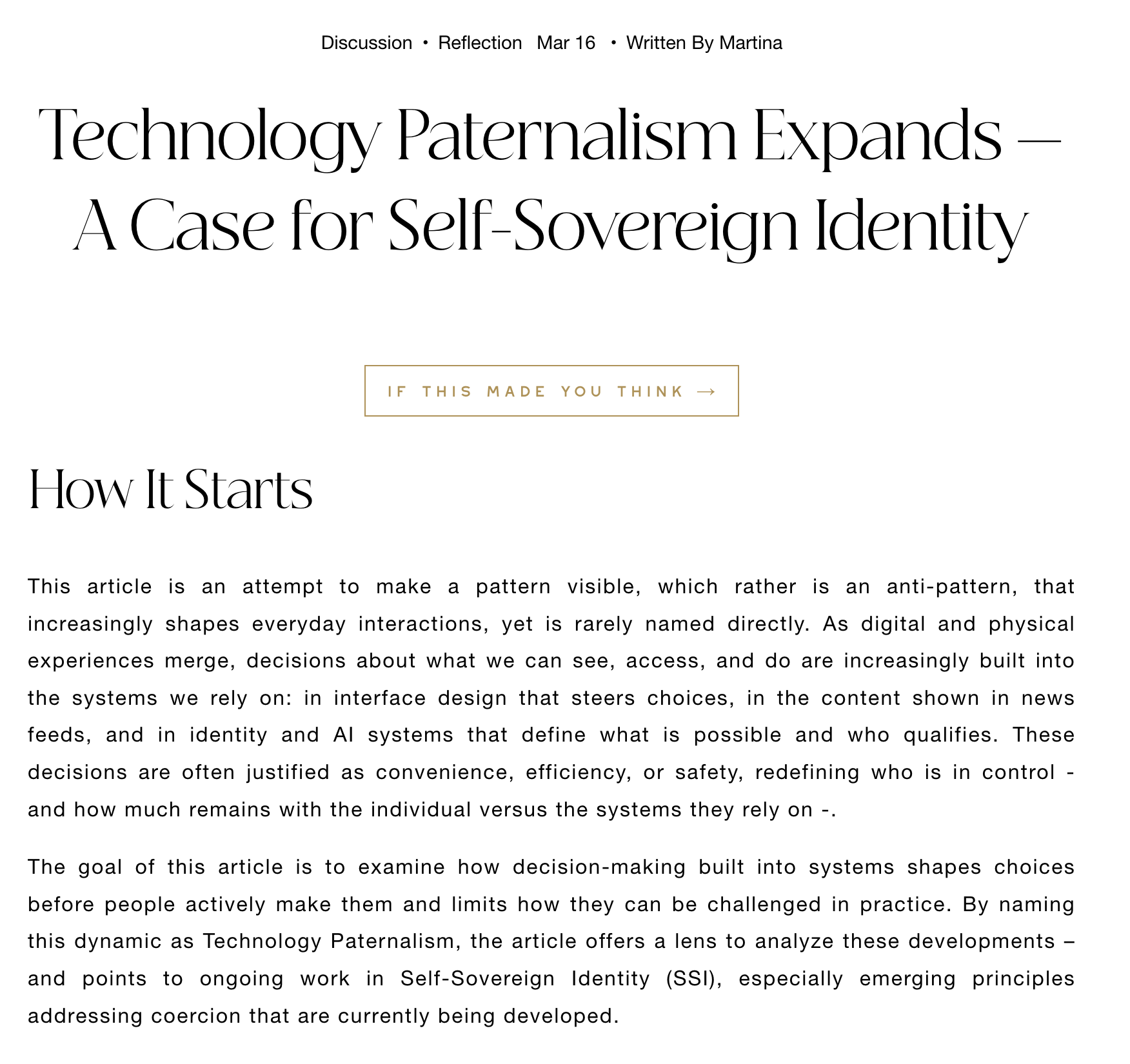
Here's another writeup that names a related phenomenon, "technology paternalism"
https://www.kosmaconnect.net/interactionblog/technologypaternalism



(1/?)
I don't disagree with anything you say here @bengo, but I do want to sound a note of caution.
I've been involved in co-design processes for building a new kind of app from scratch (eg Loomio), or (re)designing a website from first principles. I've learned the hard way that although the scaffolding provided by UX design can be "paternalism", a thoughtful design can make the difference between usable and unusable, for most people.
@strypey @benpate @smallcircles @EUCommission @nlnet
Absolutely. I didn't mean to imply co-design is overly paternalistic. I meant to imply professional philanthropy, standards work, open source, governance, and devtools/security software sales often is, for better or worse.
Paternalism in general isn't always a problem, but as with all things, there can be too much of it.
Things become overly paternalistic by unfairly exploiting structural privilege at the expense of everyone else.
@bengo
> Things become overly paternalistic by unfairly exploiting structural privilege at the expense of everyone else
Right. So we could name the problem more accurately as power inequality, or corporatism, or somesuch. I don't want to get too hung up on terminology, but I can't help thinking "paternalism" is an unhelpful word here. It reminds me of the attitudes of Command Line Warriors who think providing graphical interfaces is "paternalism".
@strypey @benpate @smallcircles @EUCommission @nlnet providing GUI is not paternalism but it can and has at times been done in a paternalistic way, at least according to some. It’s ok and normal folks don’t always agree where the line is.
@bengo @strypey @benpate @EUCommission @nlnet
Thanks, Ben. Highly interesting article, that I should really bring to social coding note-taking forum as subject for closer study.
The article mentions "dark patterns" which years ago I suggested to IETF the more inclusive term "deception patterns" for. From there "deceptive design" became a known term. But deception implies intent. Though I don't know if I would adopt the word paternalism in SX methodology, even as anti-pattern name, it is related to a deep insight that drives SX applied research..
Namely the observation that we, humankind, *severely* underestimate what it means to be "social" online. Bit like: "After the telephone, with the internet we now have an extra line to connect remotely via text".
While what we're actually doing and with tech people firmly in the lead, is building completely societies, and with hardly ANY rules at that. It's the Wild West.
And furthermore that we're mostly fully myopic to how all this works.
@bengo @strypey @benpate @EUCommission @nlnet
Online is an extension to our life offline, thus we're building OUR society as a Wild West now. And it shows.
SX adopts the concept of a peopleverse to imagine the seemless integration of online and offline worlds, on the basis of unobtrusive, humane and harmonious technology that serves people in their daily needs and day-to-day activities. It is merely a concept, to help direct thinking.
The intrinsic values of Humanity and Freedom are building blocks and toolkit of SX. And philosophical underpinning is required, to help offer people to make a mindset shift. SX, I sometimes say "adds the missing social layers to the techstack", but SX's call to "Reimagine social" is much more than that.
The way we build tech and 'dump' it in society is UTTERLY weird, and unresponsible. And all-pervasive. The norm.
Introducing the mindset shift, constitutes a wicked problem. One that SX focuses on solving, using itself as the approach. Self servicing.
RE: https://social.coop/@smallcircles/116433817412456814
@bengo @strypey @benpate @EUCommission @nlnet
In the blog post I'm writing now the Paradox of Emergence is introduced. The huge problem in tackling wicked problems is to make clear the role of the individual in it, how they contribute in making it worse or better. And also makes it incredibly hard to motivate people to come along on the adventure quest towards the solution.
Because the holistic solution is the "Golden Dragon" that sits entirely in emergent space, as Potential only, until many people collectively give it wings, and it materializes.
How can you convince people to Invest in a magic dragon that doesn't exist yet? Take Climate Change. Wicked problem, yet the solution is simple, and starts like:
"If we all did our part, gave our 2 cent, then.."
The paradox is that you people don't see the value of their investment based on the promised vision of the outcome. While in hindsight, after the wicked problem was solved it is often painfully obvious, simple solution.
RE: https://social.coop/@smallcircles/116433817412456814
@bengo @strypey @benpate @EUCommission @nlnet
I mention in my blog post "Grassroots fediverse evolution" the underpinning philosophy to SX is a simple life philosophy based on basic universal wisdoms and truths, called innercircles, that's on my Hobby track for 11 years now.
I recently dubbed them Urgent platitutes, and made it a SX concept. They are thought provokers. Wisdoms we all know, yet overlook and trample upon in our rushed daily life's rat race. Innercircles tagline is:
> "Simple solutions still exist"
Eternal teaser: https://innercircles.community
ANY wicked problem has a simple solution if you know the emergent forces that are at play. And any knowledge, wisdom, common sense, and life experience we need to do that already exists.
The ONLY thing remaining then, to solve the big problems of our time, is to get people to fall in line together to forge the path to the solution.
That of course is *extremely* hard, and where SX innercircles philosophy gets truly fascinating.
@bengo @strypey @benpate @EUCommission @nlnet
Tangential.
As an aside to the discussion, I just found a weird quirk in mastodon or AP protocol (distinction unclear) that the toot above contains a quote post that isn't in the toot's text. It was at the start, when I pasted in the URL of the post to quote, but I deleted it again. However, the quote remained, and now it no longer removable when editing.
On with my musings. And bring subject matter back to paternalism in tech, I hope.. 😅