Discussion
Loading...

Post

Log in
  • About
  • Code of conduct
  • Privacy
  • Users
  • Instances
  • About Bonfire
Abhijit Menon-Sen
Abhijit Menon-Sen
@amenonsen@flipping.rocks  ·  activity timestamp 2 weeks ago

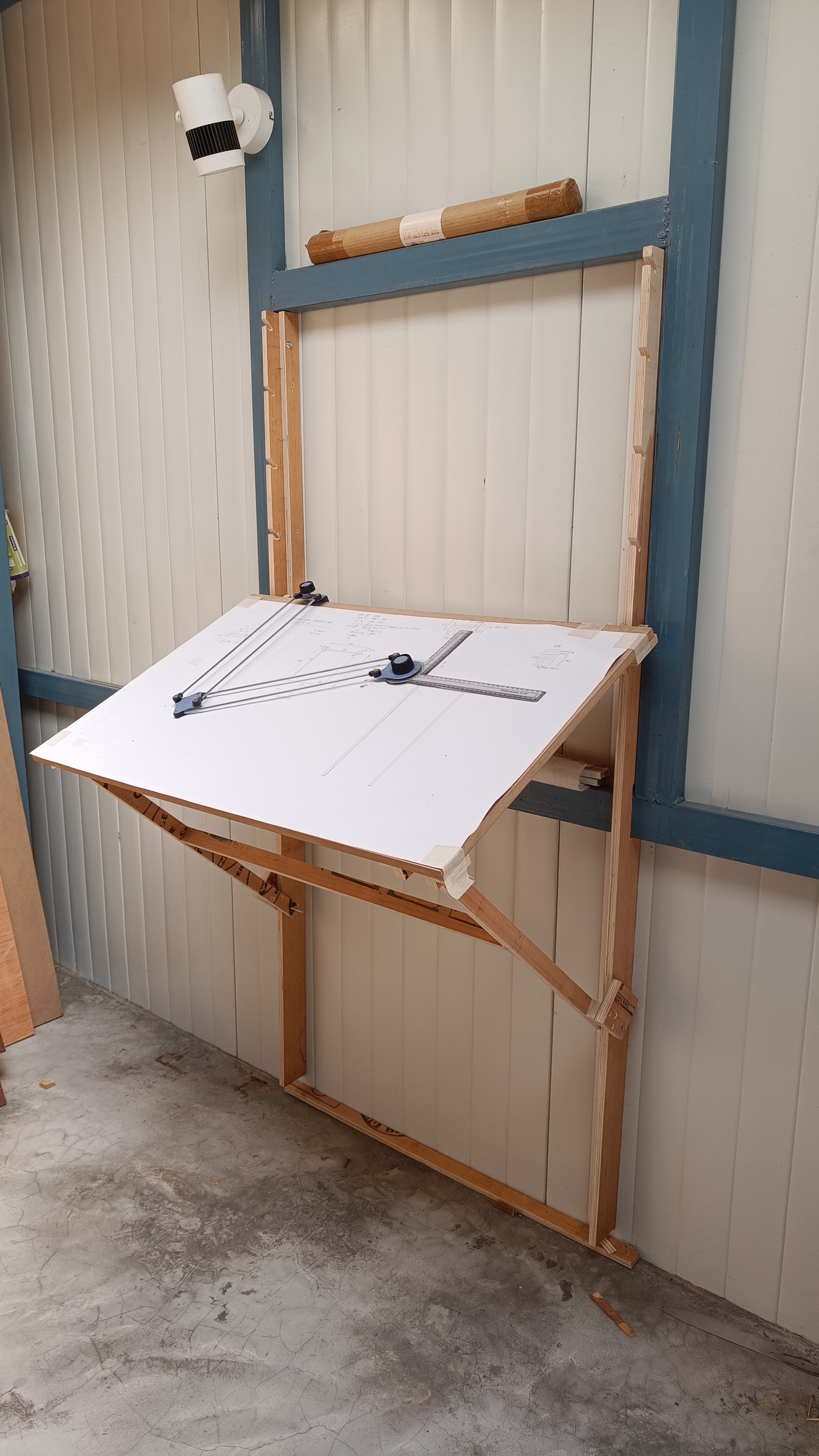
I made an adjustable A1 drafting table for my workshop. It's ugly, but it does work as intended: I can keep it in this position to draw on, and then move it up so that it hangs flat against the wall, which makes it easier to read the plans while executing them.

#woodworking

Photo of a drafting table inside a workshop. Two vertical plywood strips with slots at various heights are screwed to a steel frame on the white wall inside the workshop, extending down to just above the floor, and a flat A1-sized piece of MDF is mounted across them. The "table" has bolts across the top that fit into the slots on the frame, and can thus be placed into any slot as required; and there are pivoting "legs" from the bottom edge of the table that fit into the slots lower down. So depending on which slots you use, the table can be nearly horizontal or slightly slanted (as in the photo), or completely vertical. The plywood is cheap and brown and worn in spots, not finished nicely.

Near the upper left corner of the board is attached a "mini drafter": a thin steel-tube parallelogram arrangement with an L-shaped ruler that can pivot to draw parallel lines at any desired angle anywhere on the board.

Photo of a drafting table inside a workshop. Two vertical plywood strips with slots at various heights are screwed to a steel frame on the white wall inside the workshop, extending down to just above the floor, and a flat A1-sized piece of MDF is mounted across them. The "table" has bolts across the top that fit into the slots on the frame, and can thus be placed into any slot as required; and there are pivoting "legs" from the bottom edge of the table that fit into the slots lower down. So depending on which slots you use, the table can be nearly horizontal or slightly slanted (as in the photo), or completely vertical. The plywood is cheap and brown and worn in spots, not finished nicely. Near the upper left corner of the board is attached a "mini drafter": a thin steel-tube parallelogram arrangement with an L-shaped ruler that can pivot to draw parallel lines at any desired angle anywhere on the board.
  • Copy link
  • Flag this post
  • Block

bonfire.cafe

A space for Bonfire maintainers and contributors to communicate

bonfire.cafe: About · Code of conduct · Privacy · Users · Instances
Bonfire social · 1.0.2-alpha.34 no JS en
Automatic federation enabled
Log in
Instance logo
  • Explore
  • About
  • Members
  • Code of Conduct