Discussion
Loading...

Post

Log in
  • About
  • Code of conduct
  • Privacy
  • Users
  • Instances
  • About Bonfire
Mehrad :kde: :emacs: :rstats:
@Mehrad@fosstodon.org  ·  activity timestamp 3 days ago

What is the best way to cite this WHO's cancer statistics page?

https://gco.iarc.who.int/today/en/dataviz/bars?mode=cancer&group_populations=1&populations=900

I tried archiving it with Archive.org Wayback Machine, but the resulting URL does not open:

https://web.archive.org/web/20250530025223/https://gco.iarc.who.int/today/en/dataviz/bars?mode=cancer&group_populations=1&populations=900

#Academia #AcademicChatter @academicchatter

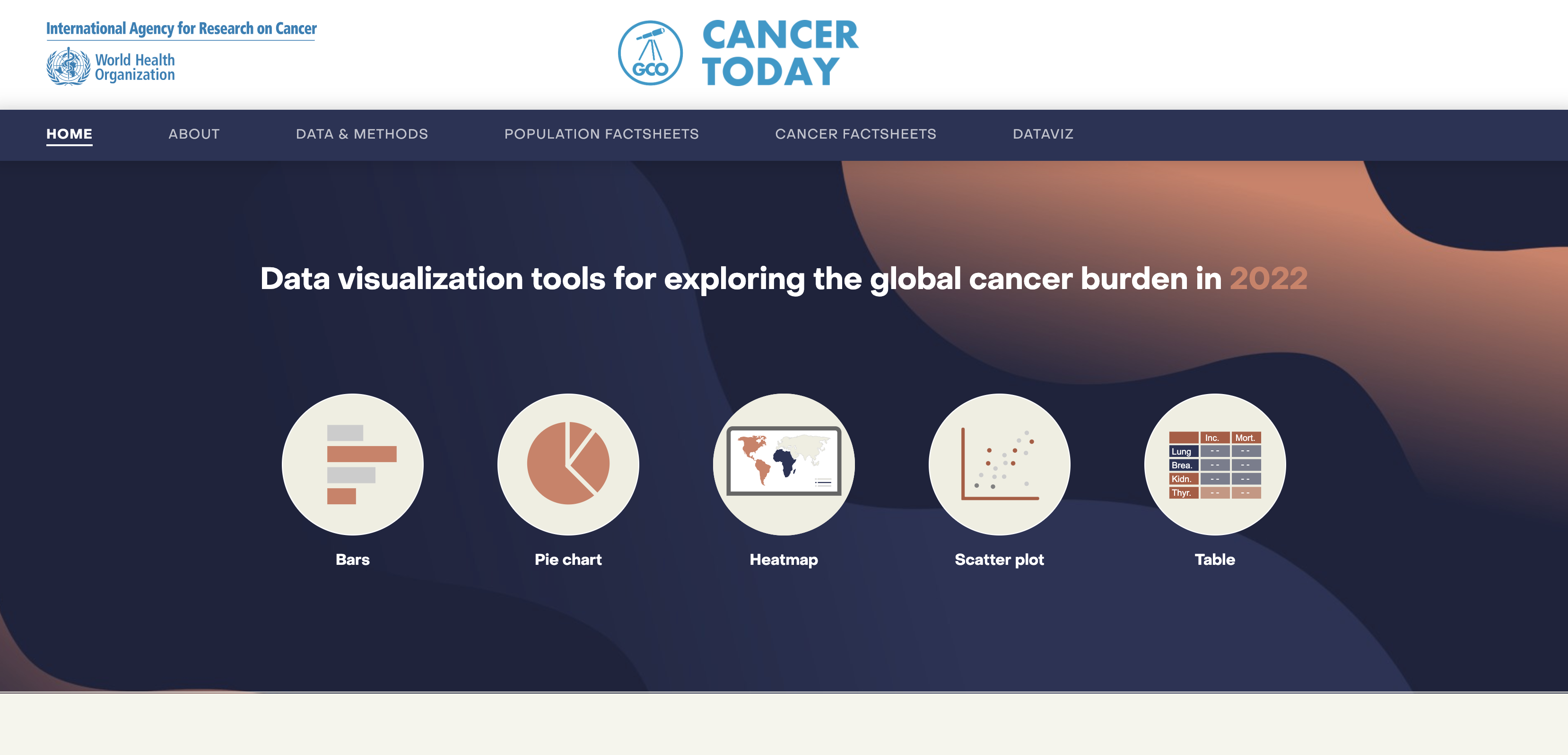
Cancer Today

CANCER TODAY enables a comprehensive assessment of the cancer burden worldwide in 2022, based on the GLOBOCAN estimates of incidence, mortality and prevalence for year 2022 in 185 countries or territories for 36 cancer types by sex and age group.
  • Copy link
  • Flag this post
  • Block
devSJR :python: :rstats:
@devSJR@fosstodon.org replied  ·  activity timestamp 2 days ago

@Mehrad @academicchatter Your link https://web.archive.org/web/20250530025223/https://gco.iarc.who.int/today/en/dataviz/bars?mode=cancer&group_populations=1&populations=900 works for me.

  • Copy link
  • Flag this comment
  • Block
Boud
Boud
@boud@framapiaf.org replied  ·  activity timestamp 2 days ago

@devSJR @Mehrad

Seems OK for me too. I find that often a new Wayback archive, after it's "saved" and has an archived URL, needs a few to a dozen or so hours before it becomes available in a practical sense. I assume that this is related to the huge amount of data and users and the way that Wayback is designed for long-term robustness.

  • Copy link
  • Flag this comment
  • Block
Mehrad :kde: :emacs: :rstats:
@Mehrad@fosstodon.org replied  ·  activity timestamp yesterday

@boud
@devSJR Really? When you openned the link, did you immediately see the horizontal barplot?

  • Copy link
  • Flag this comment
  • Block
devSJR :python: :rstats:
@devSJR@fosstodon.org replied  ·  activity timestamp 21 hours ago

@Mehrad Sorry, I misunderstood it when you said the URL does not load. The bar graph shows up only, when I replicated the settings. But it does not show up immediately.

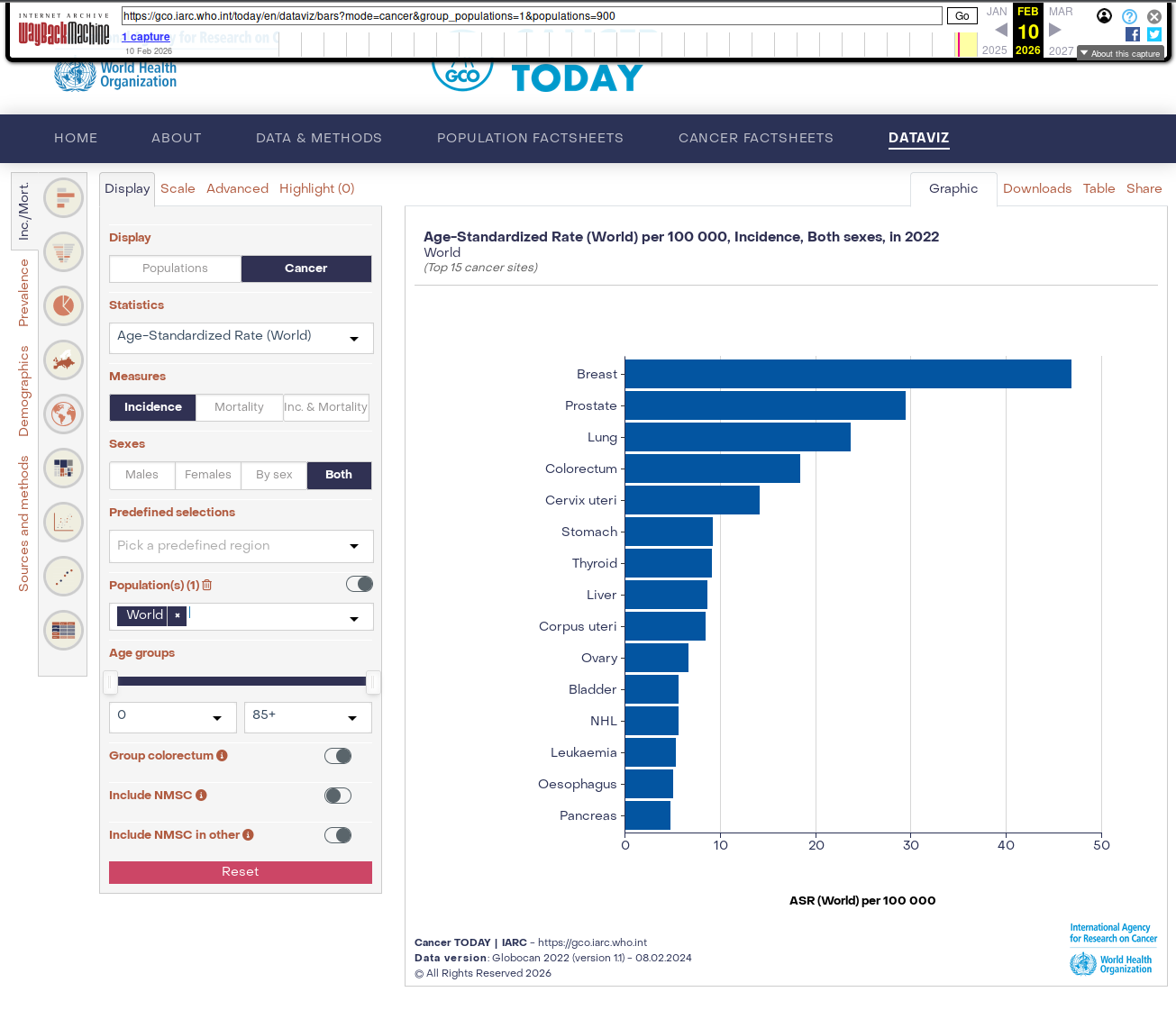
The screenshot from the WHO International Agency for Research on Cancer (IARC) data visualization tool, showing a bar chart titled "Age-Standardized Rate (World) per 100 000, Incidence, Both sexes, In 2022." 

URL is from  https://web.archive.org/. The chart displays the top 15 cancer sites by incidence rate worldwide for the year 2022.

Left side: Control panel with various options to customize the display (incl. selecting populations (e.g., World), statistics (Age-Standardized Rate), measures (Incidence), and sexes (Both)) and toggles for specific conditions like "Group colorectum".

Right side: Horizontal bar chart 
- x-axis Age-Standardized Rate (ASR) per 100,000 people, 
- y-axis lists different types of cancers, starting from Breast cancer at the top, followed by Prostate, Lung, Colorectum, Cervix uteri, Stomach, Thyroid, Liver, Corpus uteri, Ovary, Bladder, NHL (Non-Hodgkin Lymphoma), Leukaemia, Oesophagus, and Pancreas. The chart shows that Breast cancer has the highest incidence rate, followed by Prostate and Lung cancers.

Bottom of chart: Note mentioning "Cancer TODAY | IARC" with link https://gco.iarc.who.int. 

Additional UI elements include navigation tabs at the top (e.g., HOME, ABOUT, DATAVIZ), and options for sharing or downloading the graphic on the right side of the image. The interface also includes date pickers and other controls for navigating or filtering data.

The screenshot from the WHO International Agency for Research on Cancer (IARC) data visualization tool, showing a bar chart titled "Age-Standardized Rate (World) per 100 000, Incidence, Both sexes, In 2022." URL is from https://web.archive.org/. The chart displays the top 15 cancer sites by incidence rate worldwide for the year 2022. Left side: Control panel with various options to customize the display (incl. selecting populations (e.g., World), statistics (Age-Standardized Rate), measures (Incidence), and sexes (Both)) and toggles for specific conditions like "Group colorectum". Right side: Horizontal bar chart - x-axis Age-Standardized Rate (ASR) per 100,000 people, - y-axis lists different types of cancers, starting from Breast cancer at the top, followed by Prostate, Lung, Colorectum, Cervix uteri, Stomach, Thyroid, Liver, Corpus uteri, Ovary, Bladder, NHL (Non-Hodgkin Lymphoma), Leukaemia, Oesophagus, and Pancreas. The chart shows that Breast cancer has the highest incidence rate, followed by Prostate and Lung cancers. Bottom of chart: Note mentioning "Cancer TODAY | IARC" with link https://gco.iarc.who.int. Additional UI elements include navigation tabs at the top (e.g., HOME, ABOUT, DATAVIZ), and options for sharing or downloading the graphic on the right side of the image. The interface also includes date pickers and other controls for navigating or filtering data.
  • Copy link
  • Flag this comment
  • Block
Boud
Boud
@boud@framapiaf.org replied  ·  activity timestamp 18 hours ago

@devSJR @Mehrad

Clarify: For me, the "Age-Standardized Rate (World) per 100 000, ..." horizontal bar graph does *not* show up at the Wayback URL; it does show up at the archive.today URL [3].

My guess: after successively allowing more and more 3rd party sites (like cloudflare), who.int does some redirects to https://gco.iarc.who.int/today/en. Archive.today is generally better at getting through nasty javascript stuff, and protects the user from re-running them.

[3] https://archive.today/2026.02.12-103337/https://gco.iarc.who.int/today/en/dataviz/bars?mode=cancer&group_populations=1&populations=900

Cancer Today

CANCER TODAY enables a comprehensive assessment of the cancer burden worldwide in 2022, based on the GLOBOCAN estimates of incidence, mortality and prevalence for year 2022 in 185 countries or territories for 36 cancer types by sex and age group.
  • Copy link
  • Flag this comment
  • Block

bonfire.cafe

A space for Bonfire maintainers and contributors to communicate

bonfire.cafe: About · Code of conduct · Privacy · Users · Instances
Bonfire social · 1.0.2-alpha.27 no JS en
Automatic federation enabled
Log in
  • Explore
  • About
  • Members
  • Code of Conduct