

We'll see how I feel in the morning, but for now i seem to have convinced myself to actually read that fuckin anthropic paper
Discussion
Loading...
I just
I'm not actually in the habit of reading academic research papers like this. Is it normal to begin these things by confidently asserting your priors as fact, unsupported by anything in the study?
I suppose I should do the same, because there's no way it's not going to inform my read on this


@jenniferplusplus it's not a great lit review/paper in terms of connecting to broader literature; that is however typical for software research (not for more empirical fields like psychology imho)


@jenniferplusplus no, usually academic studies have a null hypothesis of "the effect we're trying to study does not exist" and are required to provide evidence sufficient to reject that hypothesis
"AI" is not actually a technology, in the way people would commonly understand that term.
If you're feeling extremely generous, you could say that AI is a marketing term for a loose and shifting bundle of technologies that have specific useful applications.
I am not feeling so generous.
AI is a technocratic political project for the purpose of industrializing knowledge work. The details of how it works are a distant secondary concern to the effect it has, which is to enclose and capture all knowledge work and make it dependent on capital.


@jenniferplusplus ai is also an #enshittification multiplyer @doctorrow


@jenniferplusplus "The details of how [the AI industry works] are a distant secondary concern to the effect it has, which is to enclose and capture all knowledge work and make it dependent on capital."
Tax, anyone?



@jenniferplusplus
bookmarked for future reference, boosting is not enough



@jenniferplusplus How about not just capital, but also permission?
Imagine a world in which "AI" is actually successful: it is widely, maybe even largely universally, adopted, and it actually works to deliver on its promises. (I *said* "imagine"! Bear with me.) In such a world, what happens to someone (person, company, country, whatever slicing you want to look at) who is *denied access to* this technology for whatever reason?
The power held by those in control of allowing access to that tech…
@mkj Yeah, same thing. You can't use industrial machines without the permission of the owner.
So, back to the paper.
"How AI Impacts Skill Formation"
https://arxiv.org/abs/2601.20245
The very first sentence of the abstract:
> AI assistance produces significant productivity gains across professional domains, particularly for novice workers.
1. The evidence for this is mixed, and the effect is small.
2. That's not even the purpose of this study. The design of the study doesn't support drawing conclusions in this area.
Of course, the authors will repeat this claim frequently. Which brings us back to MY priors, which is that this is largely a political document.


@jenniferplusplus oh gods I need to read this.
@hrefna Im finding it frustrating, mainly

@jenniferplusplus It's less a claim and more an intentionally-unsubstantiated background premise which the supposed research will treat as an assumed truth.
@dalias Honestly, yes. I suspect the purpose of this paper is to reinforce that production is a correct and necessary factor to consider when making decisions about AI.
And secondarily, I suspect it's establishing justification for blaming workers for undesirable outcomes; it's our fault for choosing to learn badly.
And now for a short break
I have eaten. I may be _slightly_ less cranky.
Ok! The results section! For the paper "How AI Impacts Skill Formation"
> we design a coding task and evaluation around a relatively new asynchronous Python library and conduct randomized experiments to understand the impact
of AI assistance on task completion time and skill development
...
Task completion time. Right. So, unless the difference is large enough that it could change whether or not people can learn things at all in a given practice or instructional period, I don't know why we're concerned with task completion time.
Well, I mean, I have a theory. It's because "AI makes you more productive" is the central justification behind the political project, and this is largely a political document.
![[ade]](https://cdn.masto.host/kdesocial/accounts/avatars/114/406/102/412/128/422/original/80826cd9f3ebd519.png "[ade]")

@jenniferplusplus you have inspired me to read it as well (over beer and pizza) and .. yeah, what she said. I think i gave up before the results section. i did feel that the prep-work to calibrate the experiment (e.g the local item dependence in the quiz) was pretty well done, but i will defer to any sociologist who says otherwise.
Why is all the so-called productivity in the paper at all?
> We find that using AI assistance to complete
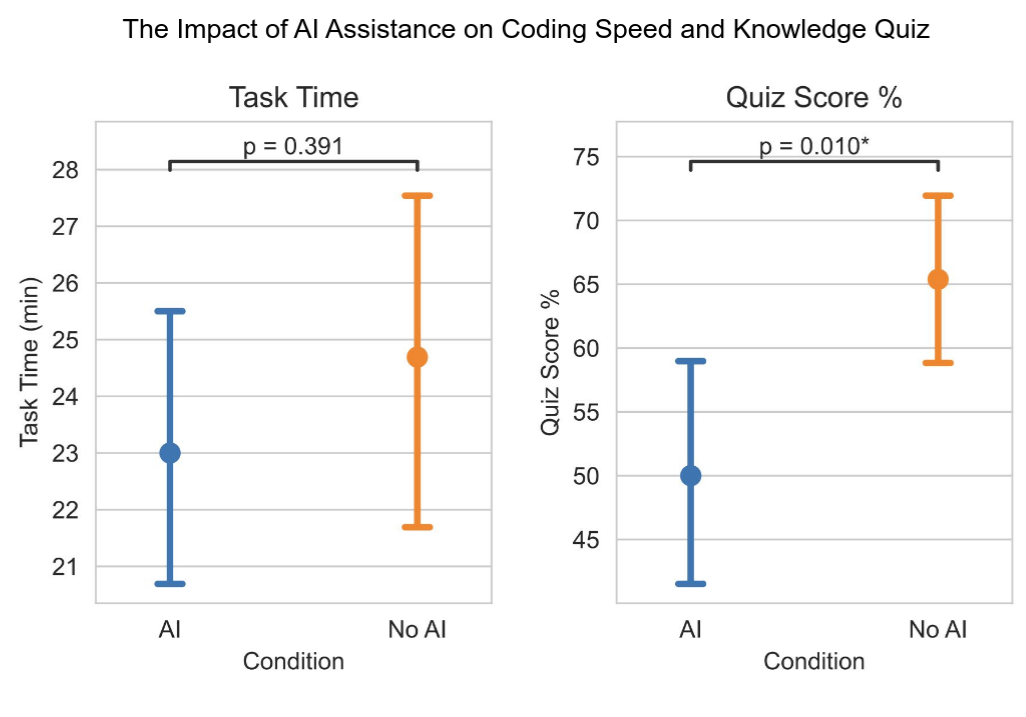
tasks that involve this new library resulted in a reduction in the evaluation score by 17% or two grade
points (Cohen’s d = 0.738, p = 0.010). Meanwhile, we did not find a statistically significant acceleration in
completion time with AI assistance.
I mean, that's an enormous effect. I'm very interested in the methods section, now.
> Through an in-depth qualitative analysis where we watch the screen recordings of every participant in our
main study, we explain the lack of AI productivity improvement through the additional time some participants
invested in interacting with the AI assistant.
...
Is this about learning, or is it about productivity!? God.
> We attribute the gains in skill development of the control group to the process of encountering and subsequently resolving errors independently
Hm. Learning with instruction is generally more effective than learning through struggle. A surface level read would suggest that the stochastic chatbot actually has a counter-instructional effect. But again, we'll see what the methods actually are.
Edit: I should say, doing things with feedback from an instructor generally has better learning outcomes than doing things in isolation. I phrased that badly.
4+ more replies (not shown)
They reference these figures a lot, so I'll make sure to include them here.
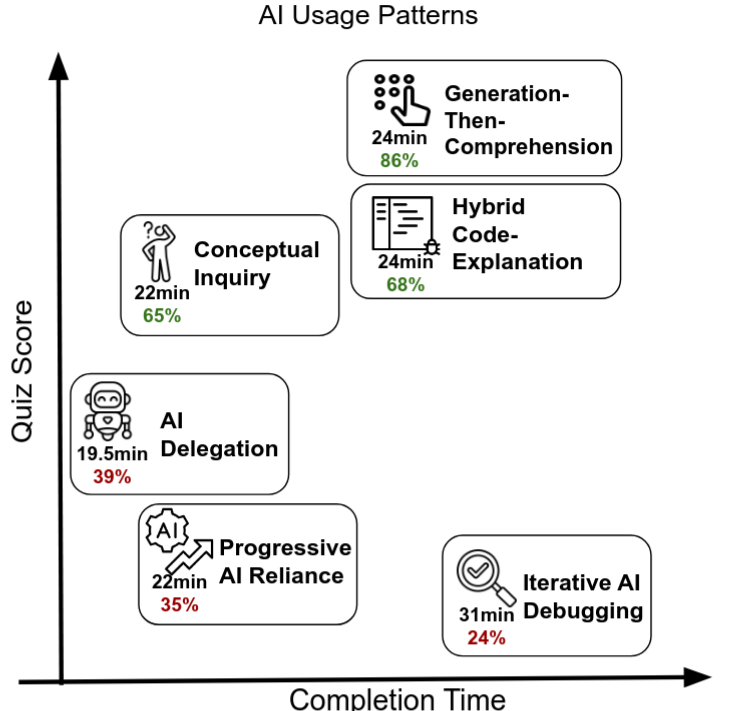
> Figure 1: Overview of results: (Left) We find a significant decrease in library-specific skills (conceptual
understanding, code reading, and debugging) among workers using AI assistance for completing tasks with a
new python library. (Right) We categorize AI usage patterns and found three high skill development patterns
where participants stay cognitively engaged when using AI assistance
2 media
> As AI development progresses, the problem of supervising more and more capable AI systems becomes more difficult if humans have weaker abilities to understand code [Bowman et al., 2022]. When complex software tasks require human-AI collaboration,
humans still need to understand the basic concepts of code development even if their software skills are
complementary to the strengths of AI [Wang et al., 2020].
Right, sure. Except, there is actually a third option. But it's one that seems inconceivable to the authors. That is to not use AI in this context. I'm not even necessarily arguing* that's better. But if this is supposed to be sincere scholarship, how is that not even under consideration?
*well, I am arguing that, in the context of AI as a political project. If you had similar programs that were developed and deployed in a way that empowers people, rather than disempowers them, this would be a very different conversation. Of course, I would also argue that very same political project is why it's inconceivable to the authors, soooo
And then we switch back to background context. We get a 11 sentences of AI = productivity. Then 3 sentences on "cognitive offloading". 4 sentences on skill retention. And 4 on "over reliance". So, fully 50% of the background section of the "AI Impacts on Skill Formation" paper is about productivity.
Chapter 3. Framework.
Finally.
Paraphrasing a little: "the learning by doing" philosphy connects completing real world tasks with learning new concepts and developing new skills. Experiental learning has also been explored to mimic solving real world problems. We focus on settings where workers must acquire new skills to complete tasks. We seek to understand both the impact of AI on productivity
and skill formation. We ask whether AI assistance presents a tradeoff between immediate productivity and longer-term skill development or if AI assistance presents a shortcut to enhance both.
Right. There it is again: productivity. Even within this framing, there are at least 3 more possibilities. That AI does not actually increase productivity; that AI has no effect at all; or that AI improves learning only. I think it's very telling that the authors don't even conceive of these options. Particularly the last one.
But I'm becoming more and more convinced that the framing of productivity as an essential factor to measure and judge by is itself the whole purpose of this paper. And, specifically, productivity as defined by production output. But maybe I'm getting ahead of myself.
And now we have actual research questions! It feels like it shouldn't take this long to get these, but w/e
1. Does AI assistance improve task completion productivity when new skills are required?
2. How does using AI assistance affect the development of these new skills?
We'll learn how the authors propose to answer these questions in the next chapter: Methods.
But first, there is a 6 year old in here demanding I play minecraft, and I'd rather do that.
To be continued... probbaly
Chapter 4. Methods.
Let's go
First, the task. It's uh. It's basically a shitty whiteboard coding interview. The assignment is to build a couple of demo projects for an async python library. One is a non-blocking ticker. The other is some I/O ("record retrieval", not clear if this is the local filesystem or what, but probably the local fs) with handling for missing files.
Both are implemented in a literal white board coding interview tool. The test group gets an AI chatbot button, and encouragement to use it. The control group doesn't.
/sigh
I just. Come on. If you were serious about this, it would be pocket change to do an actual study

Found it! n=52. wtf. I reiterate: 20 billion dollars, just for this current funding round, and they only managed to do this study with 52 people.
But anyway, let's return to the methods themselves. They start with the design of the evaluation component, so I will too. It's organized around 4 evaluative practices they say are common in CS education. That seems fine, but their explanation for why these things are relevant is weird.
1. Debugging. According to them "this skill is curcial for detecting when AI-generated code is incorrect and understanding why it fails.
Maybe their definition is more expansive than it seems here? But it's been my experience, professionally, that this is just not the case. The only even sort-of reliable mechanism for detecting and understanding the shit behavior of slop code is extensive validation suites.
2. Code Reading. "This skill enables humans to understand and verify AI-written code before deployment."
Again, not in my professional experience. It's just too voluminous and bland. And no one has time for that shit, even if they can make themselves do it. Plus, I haven't found anyone who can properly review slop code, because we can't operate without the assumptions of comprehension, intention, and good faith that simply do not hold in that case.

@jenniferplusplus I like the fact that their own research doesn't fit their lazy claim you reference, and they spend a lot of time trying to work out how the claim can be true, even though their own evidence is against it (and more in line with the mixed evidence in the literature, as you say).

@jenniferplusplus No it is not. That kind of thing is left to the realm of "self-publishing". Was this thing peer reviewed?
@seanwbruno It is not. https://arxiv.org/abs/2601.20245
@jenniferplusplus You have entirely more stamina than I have. I just read the first sentence of the abstract and emitted a guffaw and exclaimed, out loud for the spouse to hear, "Citation needed!".
