
Not sure why this dross, dated Dec 1, seems to be circulating now (and why it didn't cross my feed a month ago), but wow what a terrible essay.
https://bigthink.com/the-present/the-rise-of-ai-denialism/
A few comments, in a short 🧵>>
Discussion
Not sure why this dross, dated Dec 1, seems to be circulating now (and why it didn't cross my feed a month ago), but wow what a terrible essay.
https://bigthink.com/the-present/the-rise-of-ai-denialism/
A few comments, in a short 🧵>>
@emilymbender "Big Think" as the name of an AI shill outlet is just a bit too on the nose, sorry. The showrunners are really getting lazy.
I am so glad someone took this article to task.
Thank you.
Is that essay actually AI written?
It has that form-over-substance feel...?
@emilymbender I don’t trust an opinion piece that doesn’t acknowledge and address the weaknesses in its premise. It means the writer is in no way thinking critically.
@emilymbender had to stop reading when I got here, admittedly not very far.
“the very scary possibility that we humans may soon lose cognitive supremacy to artificial systems”
My internal screaming would not let me continue.
@emilymbender It's weird to celebrate something so breathlessly while claiming that it has thrown a nation into stages of grief.
Like ... we don't have to do this. Why opt into something that immediately causes us to grieve
@emilymbender incredibly weak article, reads almost like religious document. Kinda indicative of AI zealots.
@emilymbender Thank you! What do you think about the part, that "It is very likely that AI systems will soon be able to “read you” more accurately than any person could."
People tell these systems everything.
@kaffeeringe On the one hand, "emotion recognition" is misframed from the start --- the "best" one could hope to do is to match how a person (ideally from the same cultural background) observing the subject would understand a facial expression.
On the other hand, companies will try anything to take advantage of emotionally vulnerable people.
>>
@kaffeeringe I think it was in the book _Careless People_ that I read about Facebook specifically targeting ads to teen girls who had just deleted a selfie, preying on hypothesized (and probably often right) moments of low self-esteem.
@emilymbender Thank you. I read the article when it was published. And I disagreed with most of it. This part seemed to have a point. But you are right: it's not real reading of people but again mimicking and 50 shades of sycophancy.
@emilymbender Big Think, they say?
First, it displays a certain kind of intellectual laziness of a type I've seen before: Arguing against "pundits", "influencers" and "voices", without naming a single person whose specific arguments the author is arguing against.
>>
@emilymbender "someone has said something about something. You know who and what it was, right?"
@emilymbender
In other words, it's a perfect example of #EveryAccusationIsAConfession 😂 which is typical of all the AI Tech Bros - accuse the others of being "lazy" because you yourself can't come up with a valid argument for your own pro-AI position. i.e. resort to ad hominems to hide your own lack of a valid argument 🙄
"By any objective measure, AI continues to improve at a stunning pace."
No one ever said "The iphone is improving all the time any moment now everyone will want one"
I mean... WHEN will we get there? This "it's getting better" line is a huge tell for me.
I do think there is a danger of just hoping AI goes away, it won't. We will need regulations and to think about its place.
When you bring that up this kind of guys says "nooo no... it will get better. Please no!"
@futurebird @emilymbender I don't understand what you're talking about.
ChatGPT has 800M weekly active users. It is one of the fastest growing products in history.
https://openai.com/index/1-million-businesses-putting-ai-to-work/
The company has revenue around $10B/year.
The product works for people. They use it and benefit from it. It's not "any day now". It's now.
This allows Rosenberg to caricature the position he is refuting while making it hard for the reader to dispel the caricature, since the original is not pointed to.
>>
@emilymbender another aspect of this is it allows him to position the "origin" of the strawman argument he is constructing as a reaction to the apparent quality of the system outputs instead of the fundamental ethical, environmental, and commercial criticisms of LLMs in general.
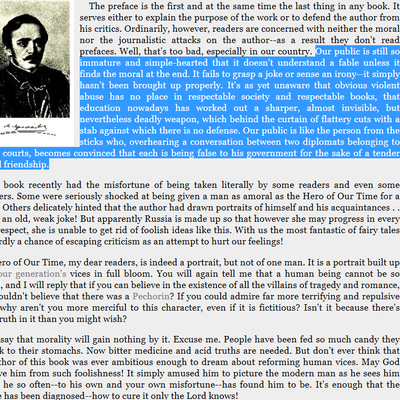
Second, he cites Ayn fucking Rand with (apparently) a straight face.
>>
@emilymbender well there’s a red flag
@emilymbender Good grief 🤦♂️
@emilymbender I was trying to see his perspective until that happened. Then I laughed at him and myself and turned off my phone. 🤣
@emilymbender That's a 1950 First of May parade in Moscow of red flags.
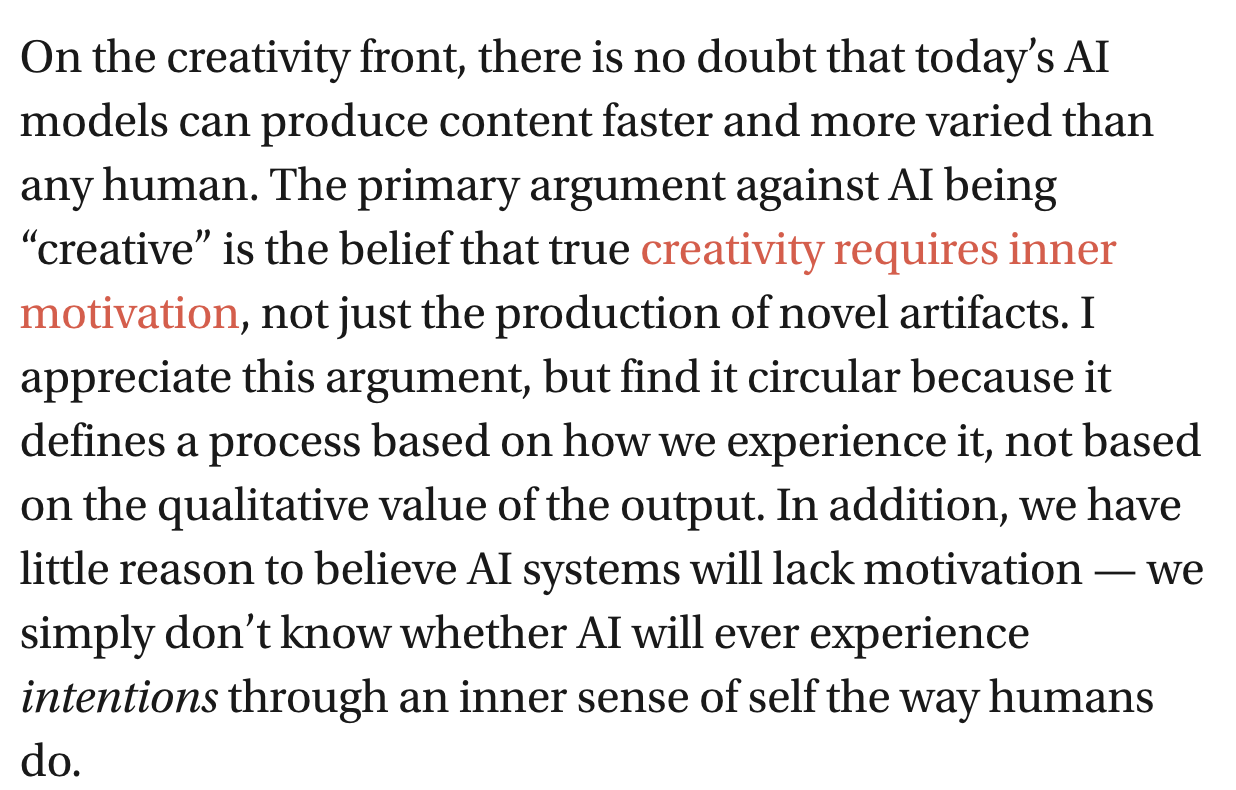
He also conflates the form of language (and art) with the actual thing: "produce content" as if output for which no one has accountability (and which represents no one's communicate intent) has any value in the world.
>>
Experience is central -- no art has any "qualitative value" without experience. Now, people can attribute meaning to synthetic images, but that is also an experience. But as UW's Gabriel Solis once put it so well: writing, art, performance -- these are ways of being human *together*.
>>
The words, the pixels, the sound waves aren't the art. The art is in the experience of the artist and the audience, together.
>>
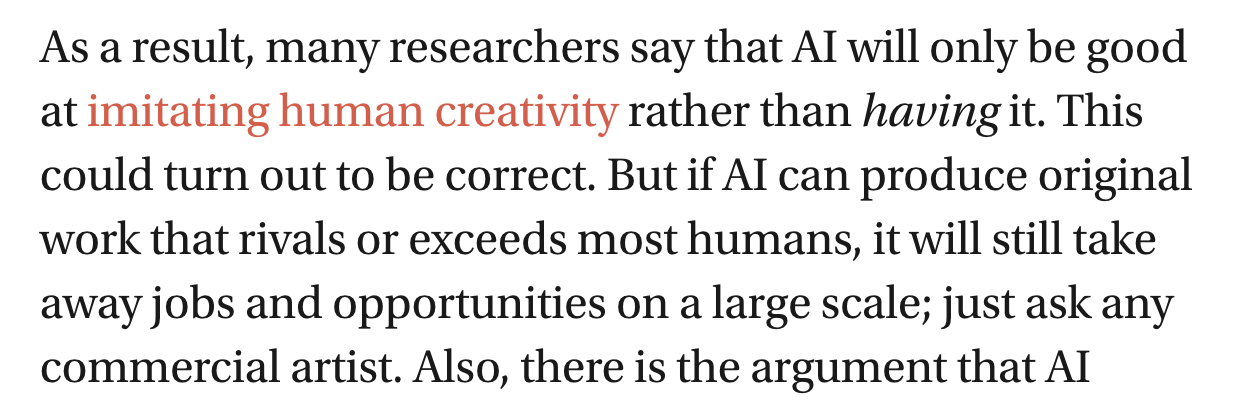
Meanwhile, Rosenberg also consistently displaces accountability: "AI" hasn't done anything. Companies have amassed large collections of stolen art and used them to produce systems with which they and others can create synthetic images.
>>
Other companies, who would have previously hired artists, are taking advantage of cheaply produced synthetic images which are only cheap because they are based on stolen art + heavily subsidized by venture capitalists sustaining this bubble.
>>
And also unwittingly subsidized by ordinary people paying higher electricity prices when data centers move in:
>>
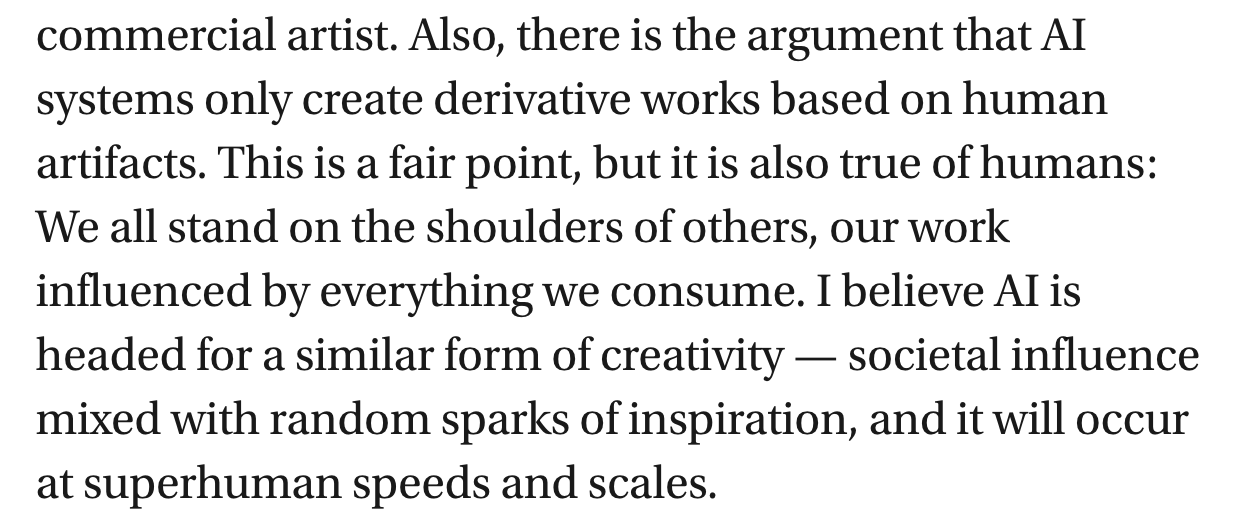
Meanwhile, note the logical leaps here: People creating art based on their experience of others' art is not equivalent to what happens with the large image models munging pixels together. And what is the evidence that "AI" systems will have "sparks of inspiration"?
>>
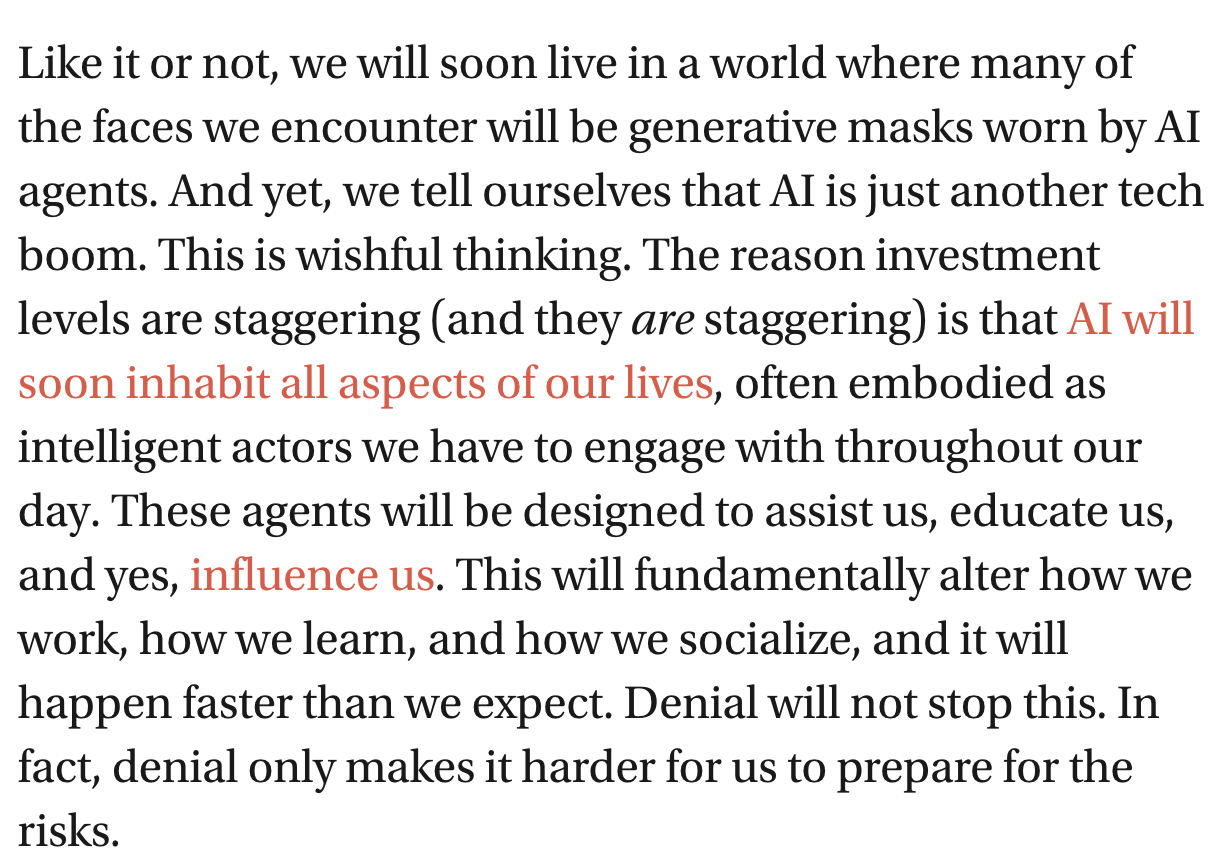
And finally, this argument about "denial" is really an argument for defeatism (in everyone else, Rosenberg seems to be welcoming the future he paints).
>>
@emilymbender
It's sad that the author does this blend of silliness while raising some important points at the same time, but I guess that's how the AI hype works. The risks of AI being applied to so many aspects of our lives, the manipulation possibilities, and the 'identity crisis' (against which I have my own arguments) are mentioned, but then it feels like he's humanizing AI and obfuscating the companies, as the public has been brainwashed to do for decades... Apparently he's an advocate for regulation, so why promote this stereotyped thinking (well, he's a CEO, nvm...)? The whole article is very misleading in this sense. If he's worried about the huge amount of behavioral data that can be gathered for profit, why not mention who's doing the gathering and profiting? Also, I personally find it funny when men feel hurt by cognitive skills being better in software. Like, yeah, bro, calculators have beaten us at arithmetic a long time ago, and most of us are glad they did. You could have gotten over that by now. The fake antagonism of humans against machines is so tiresome. Thanks for this interesting thread

Install bonfire.cafe
Get the full app experience