Discussion
Loading...

Post

Log in
  • About
  • Code of conduct
  • Privacy
  • Users
  • Instances
  • About Bonfire
Mikko Tuomi
Mikko Tuomi
@mustapipa@scicomm.xyz  ·  activity timestamp 3 days ago

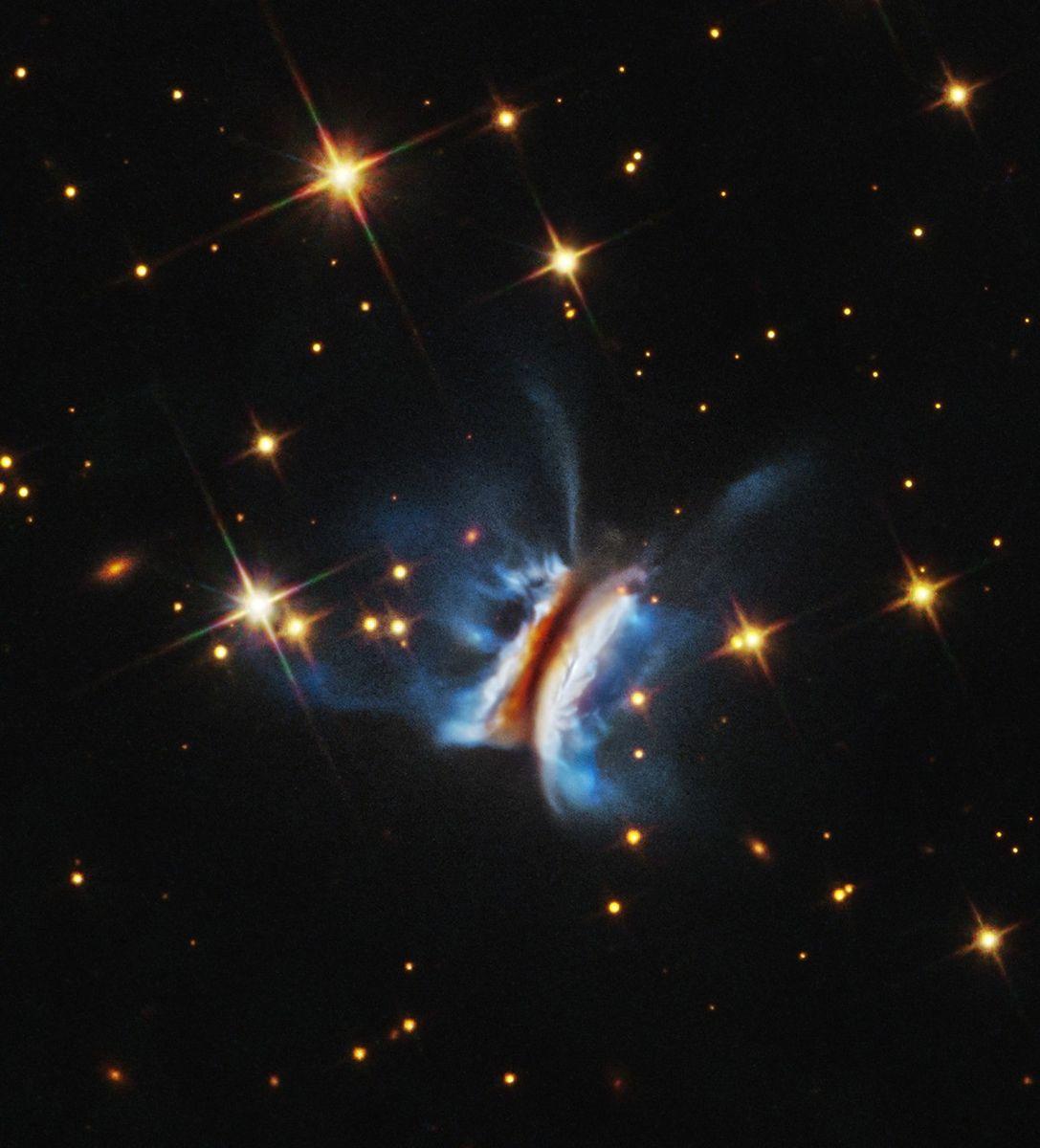
Astronomers have imaged the largest protoplanetary #disk ever observed around a young #star.

For the first time in visible light, images obtained with #Hubble have revealed the disk is unexpectedly chaotic and turbulent, with wisps of material stretching much farther above and below the disk than seen in any similar system.

#Planet nurseries can be much more active and chaotic than expected.

We’re seeing this disk nearly edge-on and its wispy upper layers and asymmetric features are especially striking. Images from both Hubble and #JWST have revealed similar structures in other disks, but IRAS 23077+6707 provides us with an exceptional perspective — allowing us to trace its substructures in visible light at an unprecedented level of detail.

This makes the system a unique, new laboratory for studying planet formation and the environments where it happens.

#astronomy
https://science.nasa.gov/missions/hubble/nasas-hubble-reveals-largest-found-chaotic-birthplace-of-planets/
NASA Science

NASA’s Hubble Reveals Largest Found Chaotic Birthplace of Planets

Astronomers using Hubble imaged the largest protoplanetary disk ever observed circling a young star. The disk is nicknamed “Dracula’s Chivito.”
This Hubble Space Telescope image shows the largest planet-forming disk ever observed around a young star. It spans nearly 400 billion miles — 40 times the diameter of our solar system. Tilted nearly edge-on as seen from Earth, the dark, dusty disk resembles a hamburger. Hubble reveals it to be unusually chaotic, with bright wisps of material extending far above and below the disk—more than seen in any similar circumstellar disk. Cataloged as IRAS 23077+6707, the system is located approximately 1,000 light-years from Earth. The discovery marks a new milestone for Hubble and offers fresh insight into planet formation in extreme environments across the galaxy.
  • Copy link
  • Flag this post
  • Block

bonfire.cafe

A space for Bonfire maintainers and contributors to communicate

bonfire.cafe: About · Code of conduct · Privacy · Users · Instances
Bonfire social · 1.0.1-alpha.40 no JS en
Automatic federation enabled
Log in
  • Explore
  • About
  • Members
  • Code of Conduct