Discussion
Loading...

Post

Log in
  • About
  • Code of conduct
  • Privacy
  • Users
  • Instances
  • About Bonfire
earthling
earthling
@appassionato@mastodon.social  ·  activity timestamp 3 months ago

Marine Microbiology: Ecology & Applications: Fourth Edition by Colin Munn et al, 2026

The fourth edition of this bestselling text has been rigorously updated to reflect major new discoveries and concepts since 2019. This new edition reflects important new findings in marine microbiology revealed by development of high-throughput sequencing, meta-omics, and single-cell technologies, and the ability to analyse and interpret large datasets.

#books
#nonfiction
#MarineMicrobiology
#oceans

Furthermore, it presents major new insights into topics such as the physiology of planktonic microbes and their role in ocean processes; the impacts of rising CO2 levels and climate change on the microbial community structure and ocean processes; the evolution of viruses, organelles, and eukaryotic life; interactions of microbes with plastic pollution; and emerging diseases of marine life and their control. All chapters have been significantly expanded, with full colour diagrams, illustrations, and boxes to aid students’ interest and understanding. Novel pedagogy is designed to encourage students to explore current high-profile research topics. This is the only textbook addressing such a broad range of topics in the specific area of marine microbiology, now a core topic within broader marine science degrees.

‘Deep diving into a sea of microbes and their infinite impacts on human life, Professor Munn once again gifts us with the most authoritative textbook in the field, inspiring the next generation of marine microbiologists’. 
Dr Bruno Francesco Rodrigues de Oliveira, 
Assistant Professor, Fluminense Federal University, Brazil
Furthermore, it presents major new insights into topics such as the physiology of planktonic microbes and their role in ocean processes; the impacts of rising CO2 levels and climate change on the microbial community structure and ocean processes; the evolution of viruses, organelles, and eukaryotic life; interactions of microbes with plastic pollution; and emerging diseases of marine life and their control. All chapters have been significantly expanded, with full colour diagrams, illustrations, and boxes to aid students’ interest and understanding. Novel pedagogy is designed to encourage students to explore current high-profile research topics. This is the only textbook addressing such a broad range of topics in the specific area of marine microbiology, now a core topic within broader marine science degrees. ‘Deep diving into a sea of microbes and their infinite impacts on human life, Professor Munn once again gifts us with the most authoritative textbook in the field, inspiring the next generation of marine microbiologists’. Dr Bruno Francesco Rodrigues de Oliveira, Assistant Professor, Fluminense Federal University, Brazil
  • Copy link
  • Flag this post
  • Block
earthling
earthling
@appassionato@mastodon.social replied  ·  activity timestamp 3 months ago

"When we think of the #ocean, we might think of whales, waves, dolphins, fish, the smell of the sea, its blue colour, and its vastness; most of us would not look out at the sea and think of marine microbes, nor did marine scientists for over a century. They sailed the seas and strenuously dragged plankton nets through the ocean’s pelagic zone to capture what they judged would represent the marine biota.
1/

Farooq Azam, 2011

  • Copy link
  • Flag this comment
  • Block
earthling
earthling
@appassionato@mastodon.social replied  ·  activity timestamp 3 months ago

2/
"But they were unaware that the great majority of the #biota, perhaps 99%, easily streamed through the holes of their nets; the holes were simply too big to capture these microbes. Even when membrane flters and microscopy were used, and they revealed great diversity of #microplankton and #nanoplankton, most #microbes evaded detection. The view of the pelagic web of life that emerged and became entrenched for a century was then based on a tiny fraction of marine biota."

Farooq Azam, 2011

  • Copy link
  • Flag this comment
  • Block
earthling
earthling
@appassionato@mastodon.social replied  ·  activity timestamp 3 months ago

3/
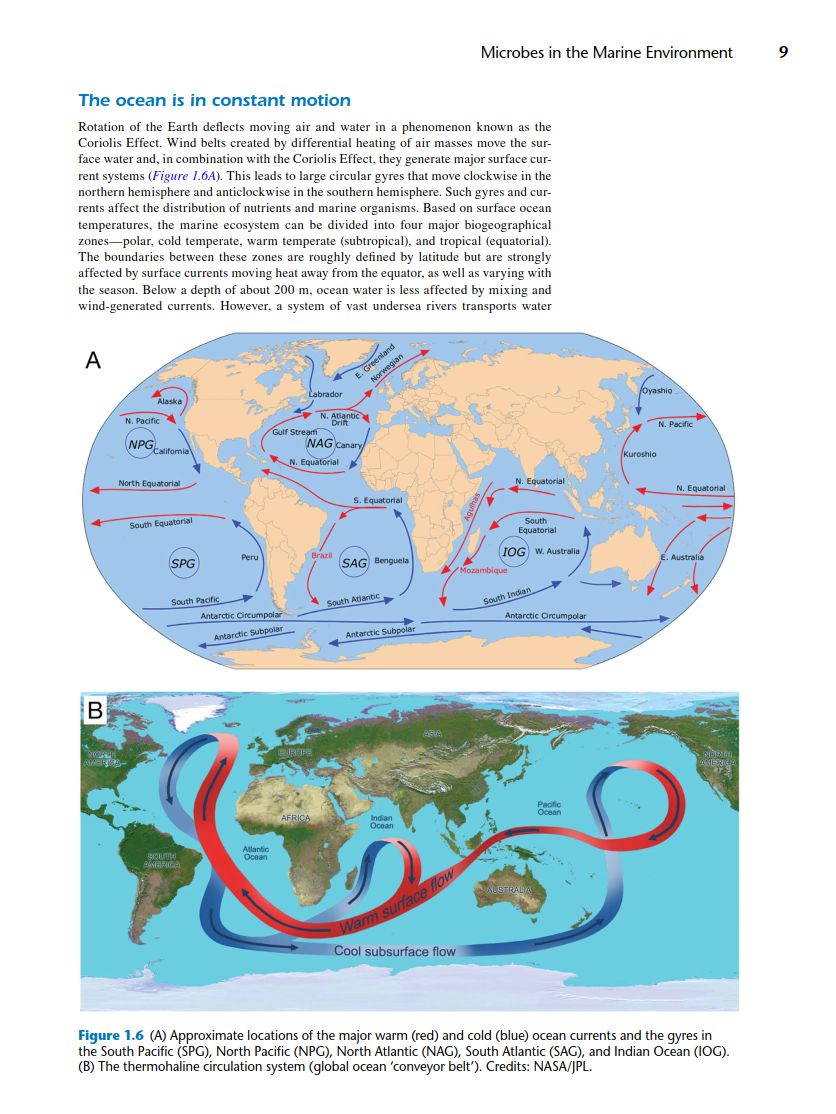
Oceans in motion

#OceanCurrents
#oceans

Ocean currents.
Ocean currents.
Ocean currents.
  • Copy link
  • Flag this comment
  • Block

bonfire.cafe

A space for Bonfire maintainers and contributors to communicate

bonfire.cafe: About · Code of conduct · Privacy · Users · Instances
Bonfire social · 1.0.2-alpha.7 no JS en
Automatic federation enabled
Log in
  • Explore
  • About
  • Members
  • Code of Conduct