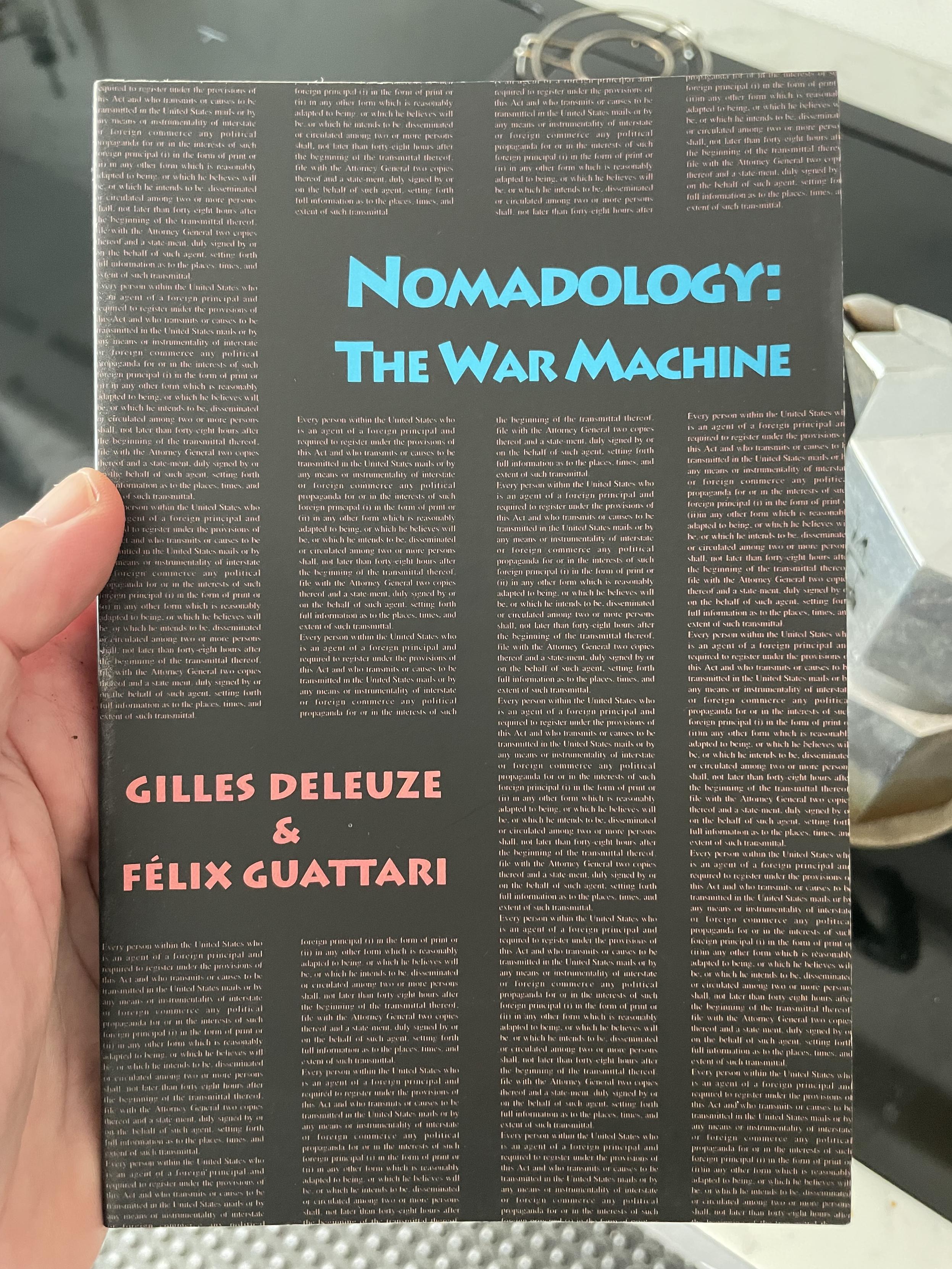
I got this down off the shelf because it’s relevant to one of the things I’m working on, and because – some 39 years after buying it and reading it for the first time – I feel like I’m finally in a position to understand and make use of it. Follow along with me, as I do a reasonably close reading of it here? It ought to be a fair amount of fun. #nomadology #deleuzeandguattari #deleuze #guattari
Post
Replies:
15
Hopefully, you can grasp something of that contrast, even in the first moments of encounter with these two rulesets & the spaces and relations they enfold & call into being. For D&G, chess pieces “have an internal nature and intrinsic properties, from which their movements, situations and confrontations derive.” Knight, bishop & pawn, in other words – and note the mapping of roles from the courtly history of Europe – move differently across the board, and exert differing pressures across space.
It is also the case that the board constrains their movement – most interestingly in the case of the knight, whose characteristic L-shaped movement pattern makes it a metaphor for the indirect application of influence. This, indeed, is why the knight is the symbol of military psychological operations, or PSYOP:
https://www.psywarrior.com/PschologicalOperationsBranch.html
But go…ahh, go! In go the anonymous pieces are “elements of a nonsubjectified machine assemblage [cough] with no intrinsic properties, but only situational ones.” Played on the board, they establish the conditions of “life,” or disrupt the opponent’s ability to do so. A placed stone radiates influence across the entire space of play, an influence conditioned by the pattern already established. The player of go develops a sense for the properties of shape and the board as a field of potential.
D&G’s gloss: “In Go, it is a question of arraying oneself in an open space, of holding space, of maintaining the possibility of springing up at any point…the ‘smooth’ space of Go, as against the ‘striated’ space of chess…The difference is that chess codes and decodes space, while Go proceeds altogether differently territorializing or deterritorializing it (make the outside a territory in space; consolidate that territory by the construction of a second, adjacent territory; deterritorialize…
the enemy by shattering his territory from within; deterritorialize oneself by renouncing, by going elsewhere…).” These terms – deterritorialization, reterritorialization, smoothness, striation – are utterly foundational for an understanding of D&G, and lie at the heart of the dismay and shock Eyal Weizman produced, when he famously revealed that “the IDF has been reading Deleuze”: https://www.radicalphilosophyarchive.com/issue-files/rp136_article1_walkingthroughwalls_weizman.pdf
Typically, though, their definition of these terms is subtle, idiosyncratic to their usage, and (most infuriatingly of all, for the reader of “Nomadology” as a standalone, $12-in-1986 text) not offered here. We’ll have to move on further to see if we can’t grasp what the relationship of “territory” to “milieu” might be, and how the establishment, abandonment or effacement of territory might function as tactics of a war machine that means to maintain its exteriority from an apparatus of State.
But what’s vital for me here is that, even this early in the going – and remember, we’re on page 4! – D&G have furnished the reader with a template or, better yet, a grammar of action for all those who would want to counter logics of state, gleaned from their sustained consideration of multiple traditions and idioms. If “the philosophers have only interpreted the world in various ways [but] the point…is to change it,” here is where that change begins.
It may not always pay to take it too literally, but don’t be mistaken: as the baleful example of the IDF makes explicit, “Nomadology” is a *manual for praxis*.
But why are we talking about games, then, games and priests and Hindu gods? “The problem is that the exteriority of the war machine in relation to the State apparatus is everywhere apparent, but remains difficult to conceptualize.” This is why D&G’s definition of something like “the war machine” proceeds inductively, by an accretion of examples, comparisons, parables or analogies.
After awhile, they trust that a sufficiently robust (if necessarily fuzzy-edged) space of overlap will appear in the implicit Venn diagram they’re drawing between concepts. As a writer I might prefer to (and my editor would insist that I) define my terms upfront, but that’s not their method here. And it works, too — provided only that you stick with it.
It does run the risk, however, that the reader will not quite grasp all the facets and connotations of what they’re laying down, which is why
they occasionally wind up having to undertake what are essentially backfill operations. And this is the case here: “It is not enough to affirm that the war machine is external to the apparatus,” as most of us who’ve been following their argument this far would no doubt be able to do without quibble. “It is necessary to reach the point of conceiving the war machine as itself a pure form of exteriority, whereas the State apparatus constitutes the form of interiority we habitually take as a model,
or according to which we are in the habit of thinking.” There’s two things we might want to pay attention to about this attempt to shore up the reader’s comprehension of these terms. The first is that, pretty clearly, “interiority” and “exteriority” carry some valence here beyond the everyday sense of the words. And the second is that the war machine is not being positioned as “outside.” It is being positioned as outsideness.
Let’s first consider what is meant by the outside, in the special sense in which D&G deploy the term. In the Western philosophical tradition, I’m sure you can find similar concepts running straight back to Plato, but so far as I have been able to determine, “the outside” as D&G put it into play — a sense later picked up by Nick Land & folks like Xenogothic still further downstream — originates with Michel Foucault’s essay on Maurice Blanchot, “The Thought From Outside.” https://monoskop.org/images/0/0a/Foucault_Michel_Blanchot_Maurice_Maurice_Blanchot_The_Thought_from_Outside_Michel_Foucault_as_I_Imagine_Him.pdf
And this is one of those things that nobody tells you! I mean, I dunno, maybe they do in school — like I say, I’ve never read D&G as part of a formal, structured curriculum, or in any pedagogical context to speak of. Maybe a solid seminar on Deleuzian thought (either at an academic institution, or as part of something wilder, like Philadelphia’s Incite Seminars) does, precisely, include an account of “the outside,” and points you at the Foucault piece. It sure would help!
And what Foucault helps us understand is that for Blanchot — and by extension, for D&G — le dehors, the outside, is a region of impersonal formlessness, where the subject itself dissolves into chaos. We shouldn’t collapse this entirely into the notion of “exteriority” (even though D&G themselves are guilty of some slippage on this count), for as I understand it exteriority is a relative term, simply denoting something that cannot be reduced to my conception of it. The outside is absolute.