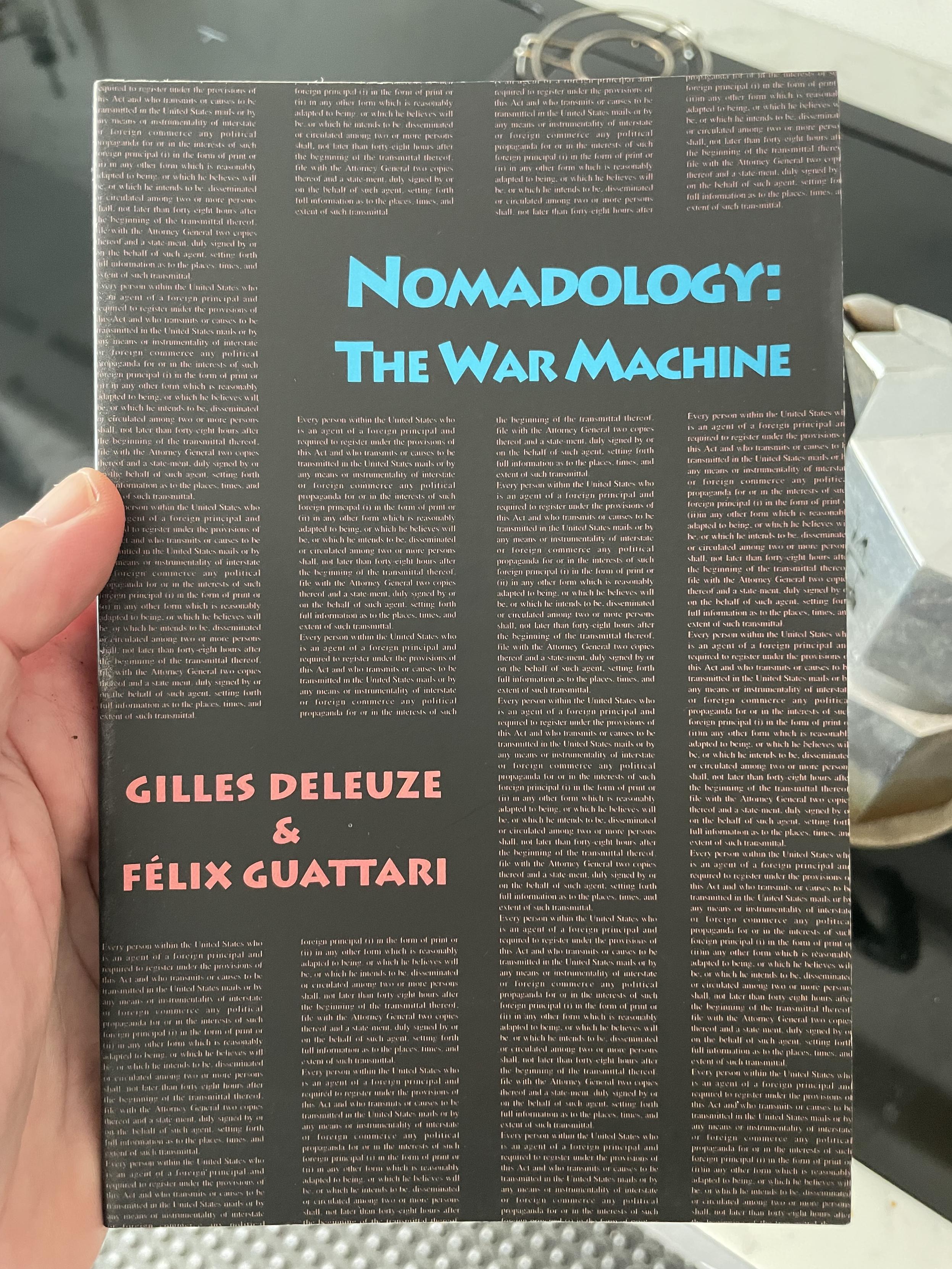
I got this down off the shelf because it’s relevant to one of the things I’m working on, and because – some 39 years after buying it and reading it for the first time – I feel like I’m finally in a position to understand and make use of it. Follow along with me, as I do a reasonably close reading of it here? It ought to be a fair amount of fun. #nomadology #deleuzeandguattari #deleuze #guattari
Post
Replies:
15
From my own position, actually – which is assuredly not that of someone with an elite education of any provenance. I can offer a concrete example, and hopefully it will shed some light on what I mean.
I forget where I first heard the term “conditions of possibility,” but it made sense to me immediately. I was a fan of James Burke’s TV show “Connections,” & therefore delighted to have been offered an elegant phrase to describe what has to happen before something else can come into being.
But what I didn’t know, and in fact wouldn’t grasp for decades, was that the phrase belongs to Immanuel Kant, and therefore brings in its train a whole set of resonances & implied understandings. And these would be obvious to anyone who’d had a proper grounding in philosophy, in the same way it’s obvious to folks with a different grounding that the guitar sound on a Galaxie 500 record is an allusion to/invocation of the Velvet Underground, with everything that implies. https://en.m.wikipedia.org/wiki/Condition_of_possibility
And just in the way a fish never becomes aware of the water through which it swims, I think it’s fair to say that D&G had remarkably little reflexivity about the field of knowledge they implicitly assume mastery of on the part of the reader. They were products of a particular curriculum, and it equipped them with the ability to encapsulate ideas in a single reference, without citation, and trust that a certain payload would be delivered to the mind of a reader in the moment of encountering it.
What follows from this is that a text like “Nomadology” is much denser than it appears to a casual reader, in fact fractally dense, and that readers with the proper equipment enjoy an incomparably richer experience in the text than those of us who don’t. Most contemporary theory is like this: the author is implicitly situated in a lineage, (generally) implicitly arguing with someone/s specific, and enlisting entire bodies of thought in their argument by deploying the most glancing reference.
These are not books, in other words, that have been through the highly contemporary, market-oriented process of breaking things down for legibility & comprehension. Their authors did not care if someone coming to their work wound up hurling it across the room the moment they first encountered a train of unfamiliar terms. You’re very much on your own – still moreso if, like me, you picked the book up not as part of any curriculum, or because it’s been assigned or chosen by a reading group, but
just because it looked or seemed interesting.
What I would maintain – would insist – is that the act of reading a book like this from what we might call the naive position is still generative of value. You might not have the slightest idea who Georges Dumézil is, have only the shallowest familiarity with the entire Western canon foundational to the authors & being drawn on in ways they themselves are only liminally aware of.
But the text will strike its own resonances for you. You’ll bring your own experiences to it, your own canon. You’ll think of examples, and counterexamples, from the cultural texts that signify for you. You’ll bring your own sideways richness to the act of interpretation. And while I think this is always true, it’s super apposite in the specific case of D&G. We haven’t, yet, discussed “lines of flight,” or what a “milieu” or a “stratum” means for them…
but when we get there I think you’ll see immediately why I think this is so.
OK, we proceed. We have weighed why D&G think the exteriority of the war machine to the State apparatus is borne out in Indo-European myth. How about games, though?
D&G begin their discussion by counterpoising chess (a “game of State”) with go, and while the comparison is entirely apposite – indeed profound – it does assume a certain familiarity with both games on the reader’s part. Many American kids grow up playing chess, by no means all of them middle class (as any stroll past the southwest corner of Washington Square Park can attest), so that’s less problematic. The game is present in the culture, in space and metaphor, at least in its general outlines.
But go? In 1986, I had never seen a go board outside martial-arts films & a single vitrine way in the back of the Compleat Strategist on 32nd Street. So while the description of the mechanics of go here is accurate & the contrast with chess both illuminating and supremely well chosen, it’s a little unfair to the reader. In order for the metaphor to land fully, you really have to have played the game. Once you have, though, the contrast splendidly clarifies the distinction D&G are making.
If it’ll give you a better sense of the point D&G are trying to make, though, you can try for yourself right now.
This is a very slick site where you can learn the rules of chess, and test your understanding in actual play: https://www.chess.com/learn
The basic rules of go are here, and once you’ve got your head around them, I believe the same site offers online play for free: https://online-go.com/learn-to-play-go
Hopefully, you can grasp something of that contrast, even in the first moments of encounter with these two rulesets & the spaces and relations they enfold & call into being. For D&G, chess pieces “have an internal nature and intrinsic properties, from which their movements, situations and confrontations derive.” Knight, bishop & pawn, in other words – and note the mapping of roles from the courtly history of Europe – move differently across the board, and exert differing pressures across space.
It is also the case that the board constrains their movement – most interestingly in the case of the knight, whose characteristic L-shaped movement pattern makes it a metaphor for the indirect application of influence. This, indeed, is why the knight is the symbol of military psychological operations, or PSYOP:
https://www.psywarrior.com/PschologicalOperationsBranch.html
But go…ahh, go! In go the anonymous pieces are “elements of a nonsubjectified machine assemblage [cough] with no intrinsic properties, but only situational ones.” Played on the board, they establish the conditions of “life,” or disrupt the opponent’s ability to do so. A placed stone radiates influence across the entire space of play, an influence conditioned by the pattern already established. The player of go develops a sense for the properties of shape and the board as a field of potential.
D&G’s gloss: “In Go, it is a question of arraying oneself in an open space, of holding space, of maintaining the possibility of springing up at any point…the ‘smooth’ space of Go, as against the ‘striated’ space of chess…The difference is that chess codes and decodes space, while Go proceeds altogether differently territorializing or deterritorializing it (make the outside a territory in space; consolidate that territory by the construction of a second, adjacent territory; deterritorialize…