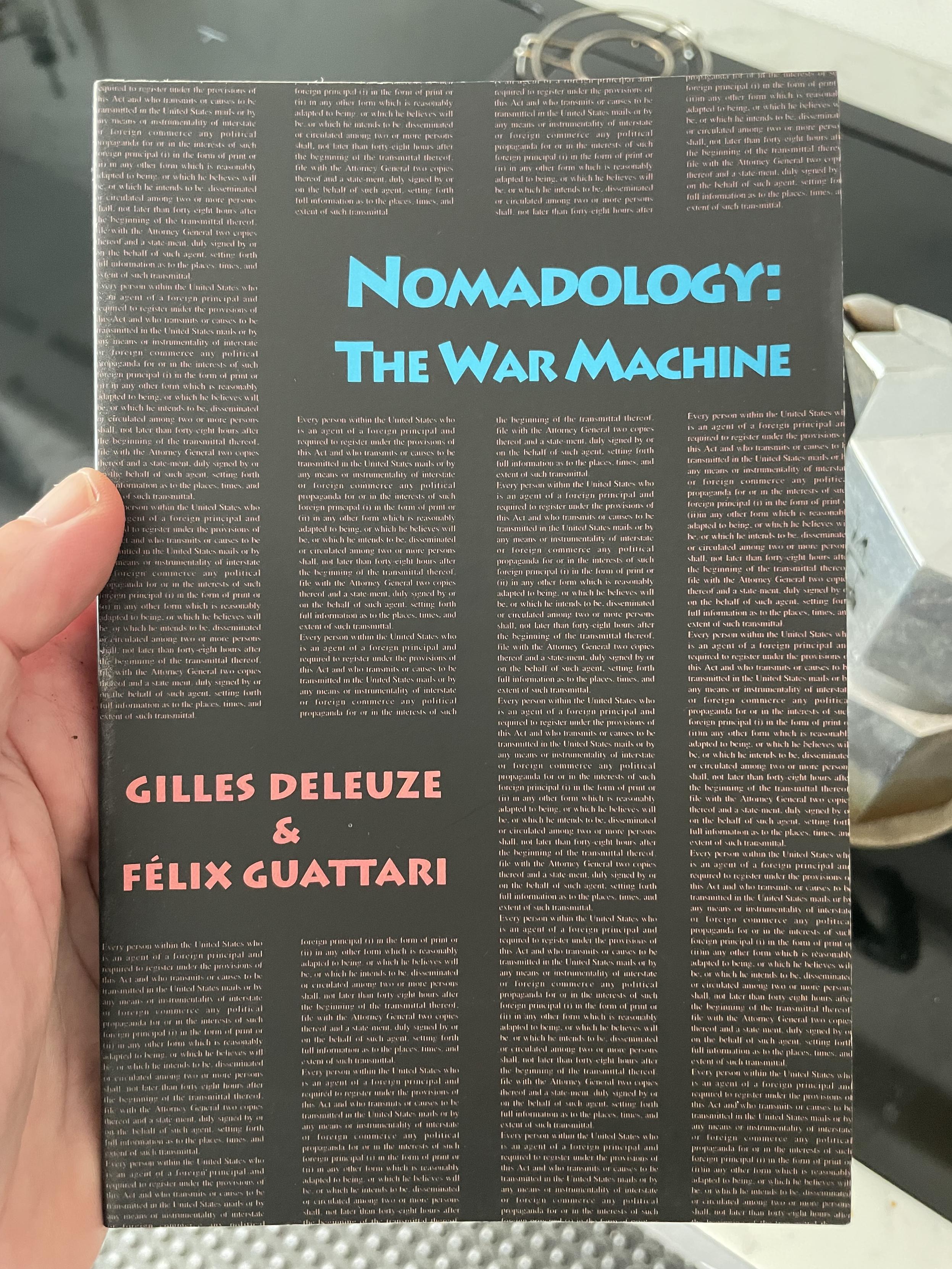
I got this down off the shelf because it’s relevant to one of the things I’m working on, and because – some 39 years after buying it and reading it for the first time – I feel like I’m finally in a position to understand and make use of it. Follow along with me, as I do a reasonably close reading of it here? It ought to be a fair amount of fun. #nomadology #deleuzeandguattari #deleuze #guattari
Post
Replies:
15
The contrast being drawn with his immediate (and equally legendary) successor Numa is, again, less sharp than it might be, but evidently vests in the latter’s ability to instill civic peace not through the imposition of order but via the quality of inspiration. (The source here is Plutarch, who tells us that a kind of golden age of conciliation descended on Rome during Numa’s reign, until “on the iron-bound shield-handles lie the tawny spiders' webs.”)
What can we learn from Varuna and Mitra? They take us back to the “Indo-“ facet of Dumézil's expertise. Varuna is a Hindu god – perhaps significantly, the god of Order and Truth – but rather confusingly, Mitra has so little independent identity he generally appears in the hybrid form Mitra-Varuna, “which has essentially the same attributes as the god Varuna alone.” It’s not much to go on, by way of opposition between figures symbolizing two principles, modes or rationalities of domination.
Because, remember, what these figures of myth are supposedly emblematizing is the “absolute exteriority” of the war machine to the State apparatus – given that emphasis, you might expect a more sharply inscribed, not to say polar, binary than that present between Romulus and Numa or Varuna and Mitra. Fortunately we now arrive at the final terms in this series, which give us something to sink our teeth into: “the despot and the legislator, the binder and the organizer.”
We continue! We’re still on the first page of “Nomadology,” still working our way through the quote from philologist and comparative mythologist Georges Dumézil with which D&G choose to open up their exploration of the war machine and its exteriority to the State apparatus.
Following Dumézil, they have offered up a series of opposed pairs, each term of which represents one of the two modes in which the State practices its art of domination: the “magician-king” and the “jurist-priest.”
And as we’ve seen, while it is possible to glimpse some distinction between the opposed terms of each pair, in each case they are hardly polar opposites. Each term seems to share something of its nature with the other. What becomes clear here is that maybe there’s a reason for this: “their opposition is only relative”. They are, in fact, different moments or aspects of a State apparatus that “distributes binary distinctions and forms a milieu of interiority.”
Rather like three points define a plane, the State’s cyclical alternation between its modes of domination makes a stratum. And what D&G go on to argue is that war is always exterior to this space, this milieu or stratum. We might, indeed, think of the State as something that constitutes itself precisely in and through war, but for D&G the bundle of energies we know as war is something that properly remains outside of the State and furnishes an absolute contrast to it.
And here, already, the reader begins to get a sense of the specialized way in which D&G use common terms.
We might think of contemporary policing, for example, as something practically indistinguishable from the State’s making of war on its own subjects, and so – as these terms are conventionally understood, anyway, by just about anyone from Schmittians to critical race theorists – it would seem nonsensical to insist that war occupies a position of absolute exteriority to the State apparatus.
And what begins to take shape is a conception not of war as we might think of it – as a logistical, indeed bureaucratic exercise, which has as much or more to do with organization and command as with the ability to inflict kinetic violence on a given target – and more of something wilder and purer. For them, war is a force, or skein of forces, that inherently runs counter to State logics and each of its modes of power: “Indra, the warrior god, is in opposition to Varuna no less than to Mitra.”
And this is pivotal. In a sense, even, it’s the whole book. For as I understand them, what D&G are arguing is that this thing they call the war machine produces an opening. With its sudden flashing violence, its “pure and immeasurable multiplicity,” the war machine constitutes “an irruption of the ephemeral and the power of metamorphosis” against sovereignty, the State apparatus and the milieu of interiority it churns out in its cycling between principles of rule. Whether or not this appeals
to you, all this talk of “incomprehensible cruelty” and so on, well, that’s a perfectly legitimate question. There is unquestionably a degree of romanticization here that feels – to put it mildly – incompatible with the experience of war’s reality, and I can’t really find fault with anyone who loses interest in the argument at this point. But there it is: if what you’re interested in is disrupting the State’s logic of control, what D&G propose is that you have to ride the lightning.
Or so, anyway, they would have us understand the counsel of the Western mythos. Tomorrow, we’ll have a look at the ways in which the notion of the war machine’s pure exteriority to the logic of State is manifest in games…and maybe even get past the book’s first few pages. Do let me know if you’re enjoying this reading, are finding it useful, or think I’ve missed something? 👊
Oh, and: links. I see I invoked, in passing, the name of the Nazi jurist Carl Schmitt, so here’s a link to the Wikipedia page on one of his most impactful ideas, the “state of exception”: https://en.m.wikipedia.org/wiki/State_of_exception
I also mentioned critical race theory. Here’s a painstakingly neutral overview of the topic, though you may well prefer one more rooted in advocacy. https://www.americanbar.org/groups/crsj/resources/human-rights/archive/lesson-critical-race-theory/
And finally for today, rrrreally close readers may want to pursue the ceremonial management of spiritual power in Rome as a submerged but discernible theme in John Brunner’s 1969 near-future SF novel “The Jagged Orbit” (which features a household-security firm called Lares & Penates Inc., and one of whose protagonists is indeed given the name “Matthew Flamen”). I’ll be back tomorrow with more “Nomadology”!
Before we get into today’s text, I want to briefly weigh the question of preparation and, conversely, authorial intention. Does it matter what you bring with you to reading a book like this? What will the author(s) have expected of a reader, by way of context?
I think it’s important to situate this chapter from “A Thousand Plateaus” not simply in the history of philosophy, but in the context of an elite French education. And I’m going to approach that, appropriately enough, from the outside.
From my own position, actually – which is assuredly not that of someone with an elite education of any provenance. I can offer a concrete example, and hopefully it will shed some light on what I mean.
I forget where I first heard the term “conditions of possibility,” but it made sense to me immediately. I was a fan of James Burke’s TV show “Connections,” & therefore delighted to have been offered an elegant phrase to describe what has to happen before something else can come into being.