Discussion
Loading...

Post

Log in
  • About
  • Code of conduct
  • Privacy
  • Users
  • Instances
  • About Bonfire
Petr Nuska
Petr Nuska
@petrnuska@mastodon.world  ·  activity timestamp 10 months ago

On 13–14th of February 2025, I organised a #Hackathon on #RomaniChords that explored various methodological avenues for my #MSCA project’s data acquisition.

Here’s a short thread summarising what we dealt with and achieved during these days.

CCying everyone interested in #Ethnomusicology, #Musicology, #ComputationalMusicology, #MusicScience, #RomaniStudies, #RomaniMusic and alike.

Let’s jump right into it!

[Note: See alt text for more info about the pictures attached to this thread]

🧵1/20
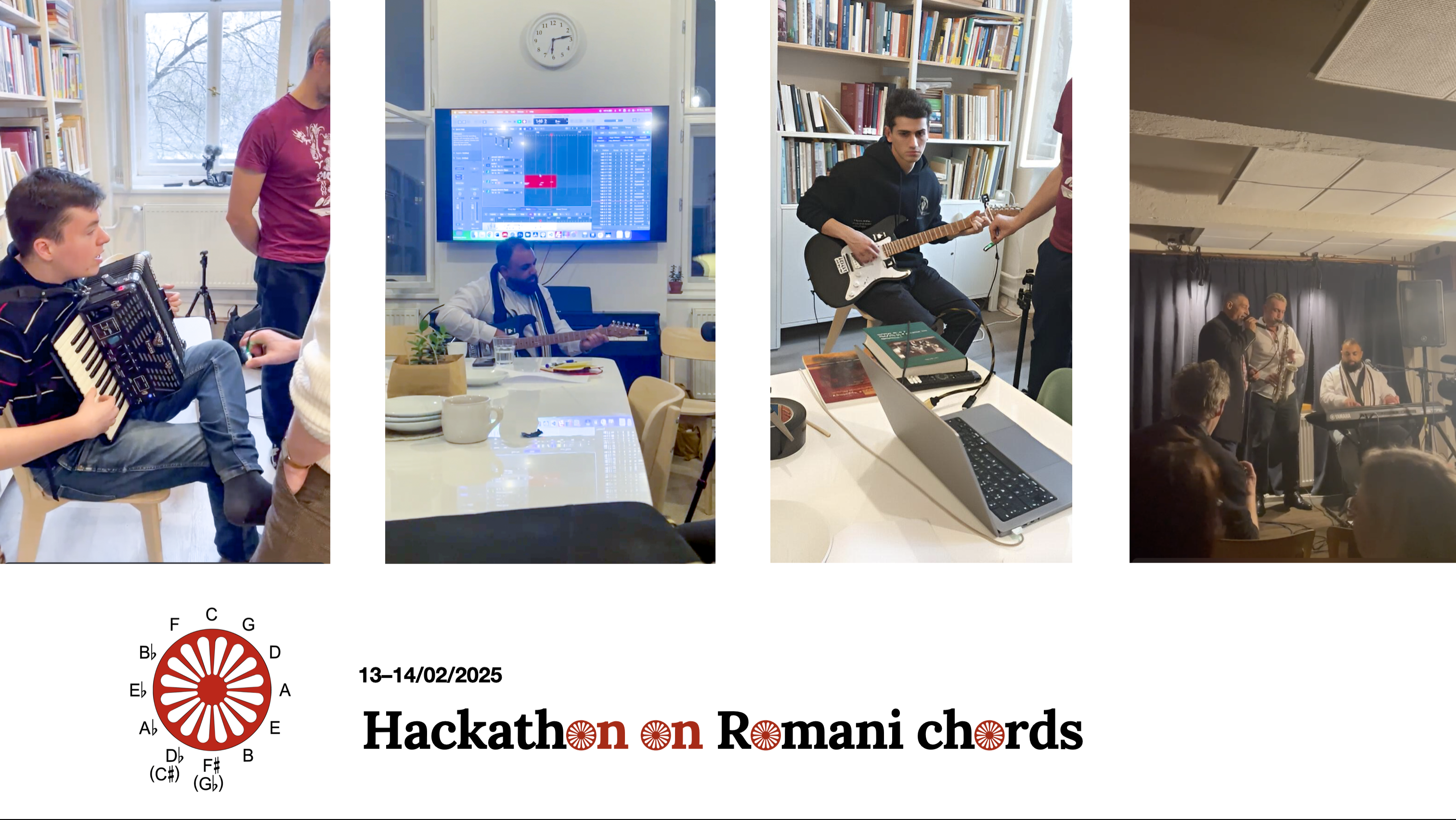
Selection of 4 pictures and the sign “Hackathon on Romani chords – 13–14/02/2025). Pictures from the left:

1)	A gentleman with an accordion.
2)	A gentleman with a guitar. There’s a big screen behind him projecting the process of sonic data acquisition. 
3)	A gentleman playing an electric guitar, looking at a computer screen.
4)	Three gentlemen playing a concert – a singer, a sax player and a keyboard player.
Selection of 4 pictures and the sign “Hackathon on Romani chords – 13–14/02/2025). Pictures from the left: 1) A gentleman with an accordion. 2) A gentleman with a guitar. There’s a big screen behind him projecting the process of sonic data acquisition. 3) A gentleman playing an electric guitar, looking at a computer screen. 4) Three gentlemen playing a concert – a singer, a sax player and a keyboard player.
  • Copy link
  • Flag this post
  • Block
Petr Nuska
Petr Nuska
@petrnuska@mastodon.world replied  ·  activity timestamp 10 months ago

The Hackathon brought together 10 scientists of different backgrounds – from linguists to music scholars and computer scientists.

To warm up intellectually,* we began with a general discussion of the phenomenon of Romani chords.

–––
*
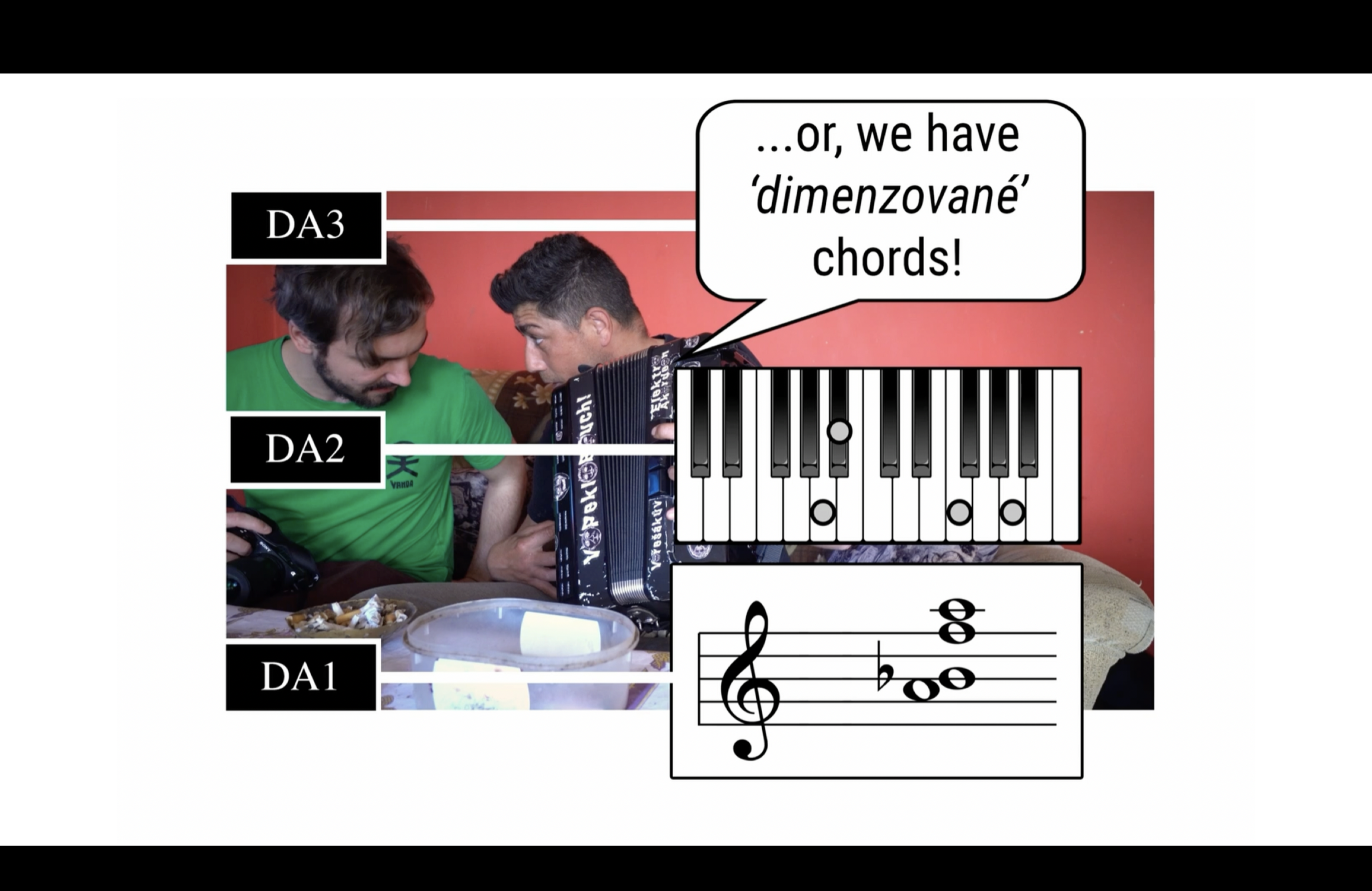
Do you want to warm up with us to digest this thread easier? Watch the bit of the project’s video abstract from 7:17–7:58 and then try to answer the question: “Why does the dimenzovaný chord matter?”

=>

https://www.youtube.com/watch?v=aEXkI2br3cc&t=437s

#RomaniChords

🧵2/20

2 media
A scheme picturing the so-called “dimenzovaný chord”. There is a Romani accordionist (right) and an ethnomusicologist looking at his finger (left). There is a picture of a sonic representation of the chord (consisting of tones A – A# – F – A) and a comic bubble pointing from the accordionist saying, “…or, we have ‘dimenzované’ chords.”
Romani Chords – Video abstract | HORIZON-MSCA-2022-PF research project [RomChords]
  • Copy link
  • Flag this comment
  • Block
Petr Nuska
Petr Nuska
@petrnuska@mastodon.world replied  ·  activity timestamp 10 months ago

The discussion helped to identify the biggest challenges for the Hackathon:

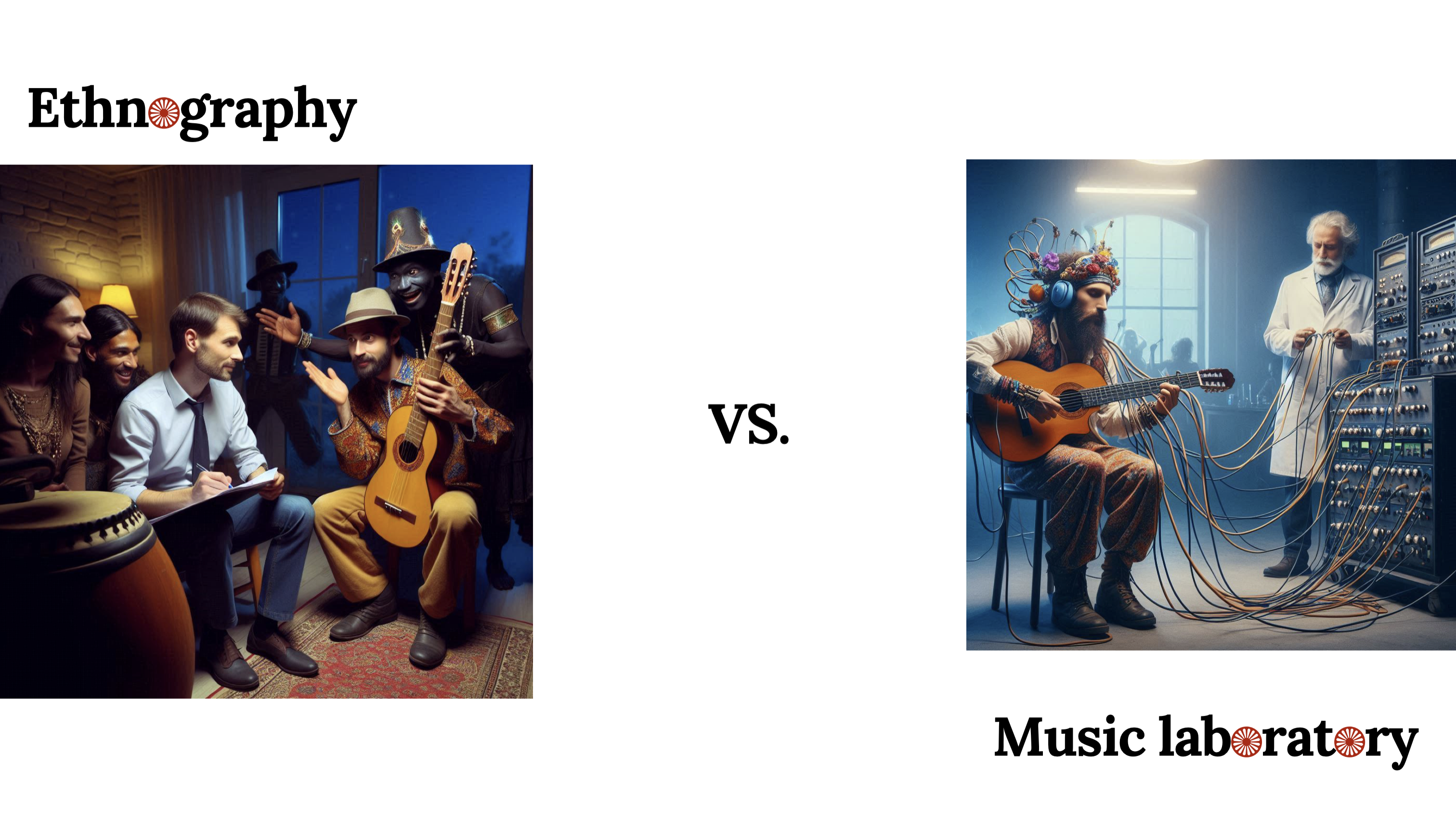
On the one hand, the project aims to collect the data on an ambitious scale, which requires a pragmatic data-driven approach (a “musical laboratory”). But on the other, the phenomenon of Romani chords is embedded in peculiar layers of sociocultural reality, the uncovering of which requires a sensitive ethnographic approach.

This dilemma became the central theme for our methodological thoughts.

#RomaniChords

🧵3/20

Two pictures, both AI-generated. The one on the left says “Ethnography” and pictures a scene from ethnomusicological research, showing a guitarist saying something meaningful to the anthropologist. 

The one on the right says “Music laboratory”. The e’s a musician wired to tonnes of cables and a gentleman with a white scientific lab coat.

There’s “versus” in between the pictures.
Two pictures, both AI-generated. The one on the left says “Ethnography” and pictures a scene from ethnomusicological research, showing a guitarist saying something meaningful to the anthropologist. The one on the right says “Music laboratory”. The e’s a musician wired to tonnes of cables and a gentleman with a white scientific lab coat. There’s “versus” in between the pictures.
  • Copy link
  • Flag this comment
  • Block
Petr Nuska
Petr Nuska
@petrnuska@mastodon.world replied  ·  activity timestamp 10 months ago

Then, we discussed and tried out various contemporary music information retrieval methods with a special focus on accompanying #harmonies (aka #chords).

The first method to come up was “Automatic chord recognition” ( #ACR), a method that scientists have worked on for over 25 years.

A nice summary of this ongoing research (with the most significant challenges identified) can be found in this 5-year-old article => https://archives.ismir.net/ismir2019/paper/000004.pdf

#RomaniChords

🧵4/20

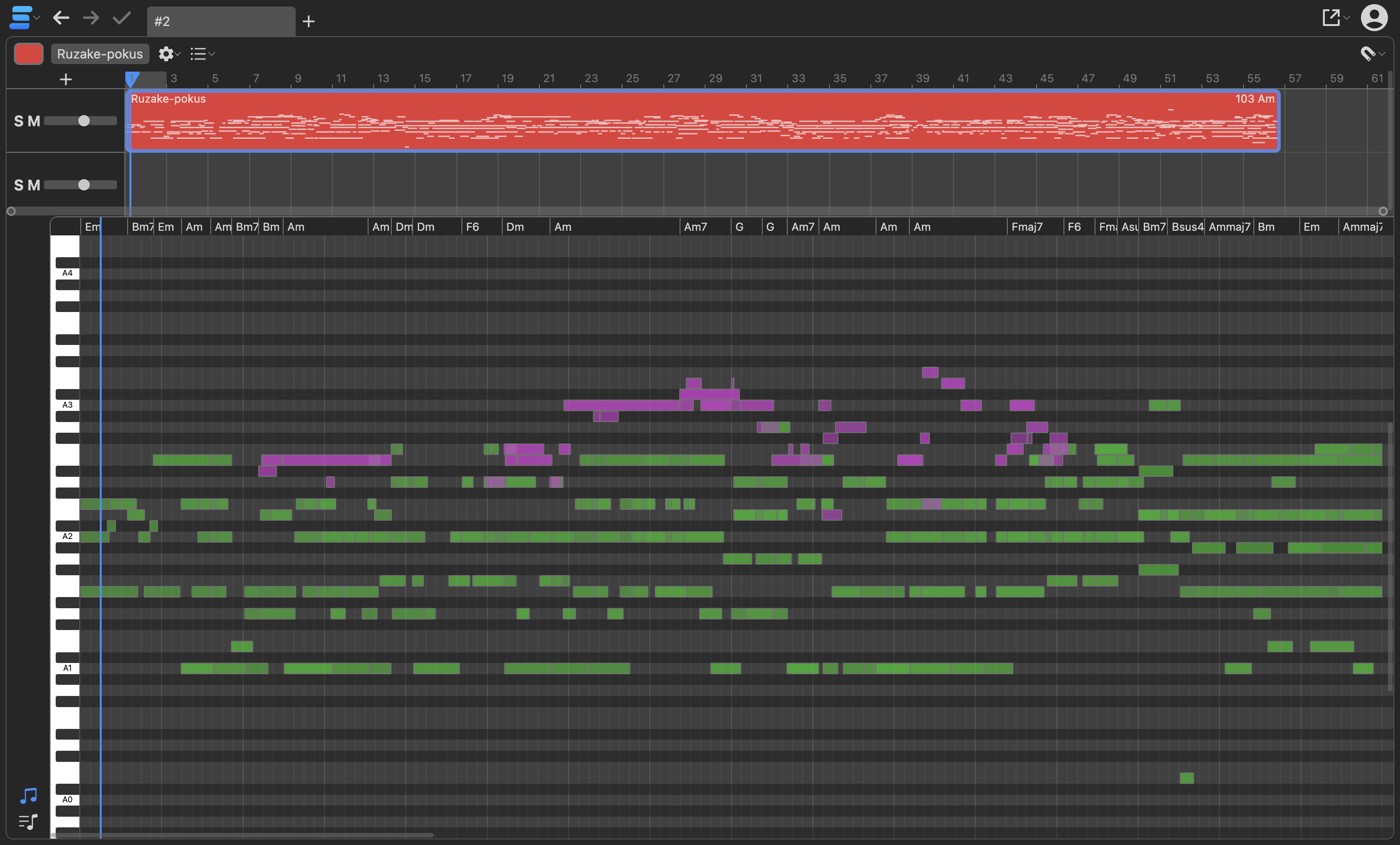
A print screen from the software “Samplab” shows sonic data like a piano roll.
  • Copy link
  • Flag this comment
  • Block
Petr Nuska
Petr Nuska
@petrnuska@mastodon.world replied  ·  activity timestamp 10 months ago

Nevertheless, we found the use of ACR for the #RomChords project to be limited.

ACR is a classification task that analyses audio signals to compare and categorise harmonic content into *predefined* chord labels.

While this method estimates very well the common progressions in functional harmony, it doesn’t quite know how to handle less common chords and voicings (such as the “dimenzovaný” chord” mentioned above) as they are not usually found in the *predefined* labels.

#RomaniChords

🧵5/20

A coloured table from ACR-related research.

Source: https://ko28.github.io/chord-transcription/
A coloured table from ACR-related research. Source: https://ko28.github.io/chord-transcription/
  • Copy link
  • Flag this comment
  • Block
Petr Nuska
Petr Nuska
@petrnuska@mastodon.world replied  ·  activity timestamp 10 months ago

Another method we considered was the #PolyphonicDetection.

This method focuses on identifying and extracting individual notes from musical textures by analysing frequency components, onset times, and timbral features using techniques such as spectral decomposition, pitch tracking, and machine learning-based transcription methods.

#RomaniChords

🧵6/20

A scheme explaining various musical textures – monophonic, homophonic, polyphonic and heterophonic.
  • Copy link
  • Flag this comment
  • Block

bonfire.cafe

A space for Bonfire maintainers and contributors to communicate

bonfire.cafe: About · Code of conduct · Privacy · Users · Instances
Bonfire social · 1.0.1-beta.35 no JS en
Automatic federation enabled
Log in
  • Explore
  • About
  • Members
  • Code of Conduct