Discussion
Loading...

#Tag

Log in
  • About
  • Code of conduct
  • Privacy
  • Users
  • Instances
  • About Bonfire
Tyng-Ruey Chuang boosted
Andrea Luck
Andrea Luck
@andrealuck@fosstodon.org  ·  activity timestamp 3 weeks ago
Andrea Luck
Andrea Luck
@andrealuck@fosstodon.org  ·  activity timestamp 4 weeks ago

1/n 🧵

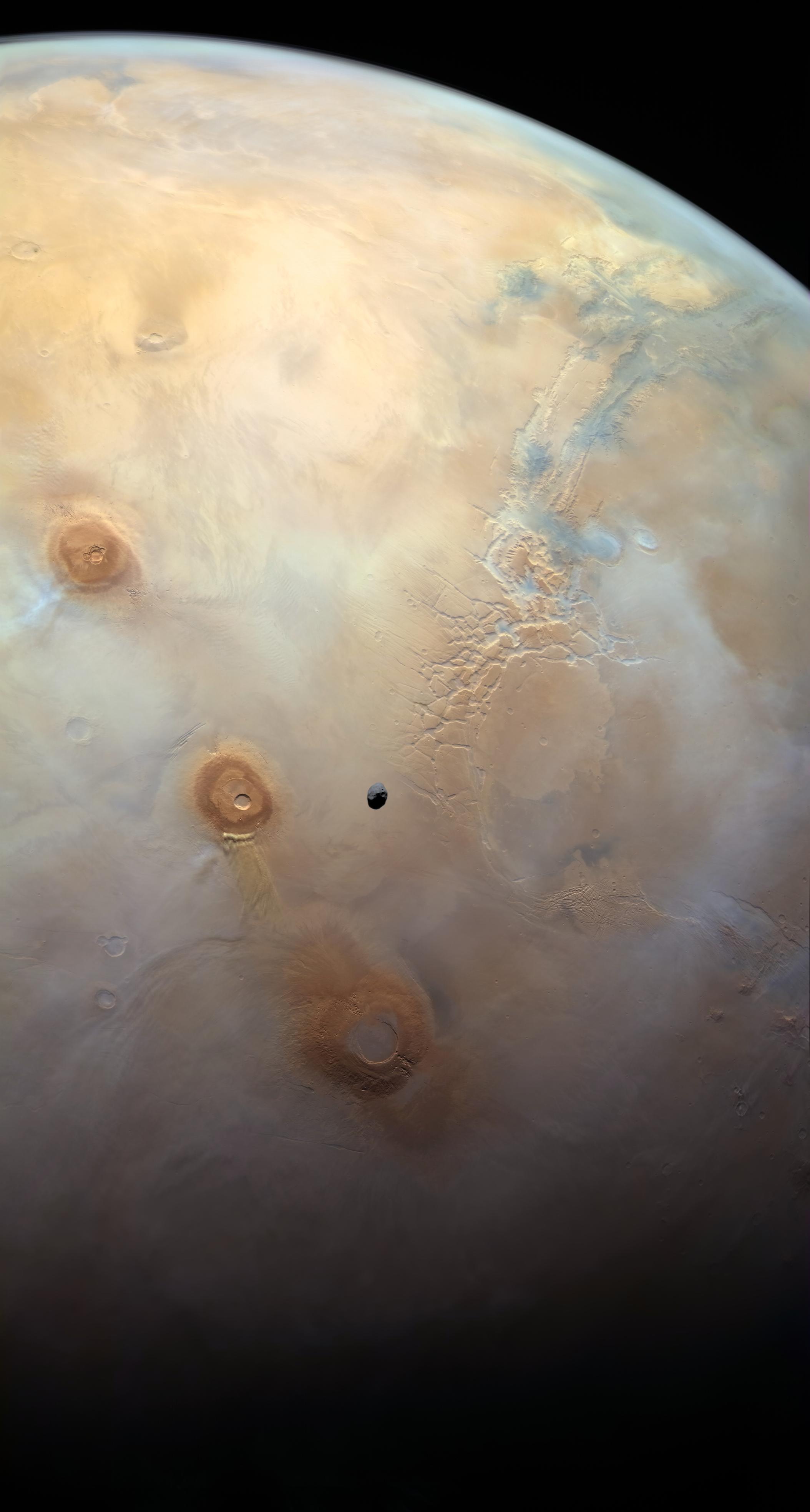
2 NEW epic images of Phobos over Mars just released by ESA Mars Express

This view is especially striking, with Phobos between the Tharsis volcanoes and Noctis Labyrinthus–Valles Marineris

Full resolution 300MP(!) & info on: https://flic.kr/p/2rMW4so
Credit: ESA/DLR/FUBerlin/AndreaLuck CC BY

#Mars #Space #Astronomy #Phobos #ESA #Astrodon #Solarocks

1/2 🧵

Here’s the recently released sequence of Phobos passing over a Martian dust storm near Pavonis Mons.

Video & full info: https://flic.kr/p/2rNN8wk
Credit: ESA/DLR/FUBerlin/AndreaLuck CC BY

ESA Mars Express HRSC
300 MP Photo: https://fosstodon.org/@andrealuck/115758026625208427
Easy zoom: https://easyzoom.com/image/674026

#Space #Mars #Phobos #Solarocks #Astronomy #Astrodon #ESA

Your browser does not support the video tag.
This video cannot be previewed
Open original
Video animation from Mars orbit. The scene is dominated by a massive Martian volcano at the top of the frame, its caldera forming a wide depression surrounded by gentle flanks. To the right, a large dust storm drifts away from the volcano. The terrain shows rusty red tones. Phobos the potato-shape satellite of Mars, passes across the bottom of the frame, appearing very dark grey compared to the martian surface.
{{meta.site_name}}

{{meta.title}}

Share huge gigapixel high-resolution images from microscopy, photography, astronomy
  • Copy link
  • Flag this post
  • Block
Andrea Luck
Andrea Luck
@andrealuck@fosstodon.org  ·  activity timestamp 3 weeks ago
Andrea Luck
Andrea Luck
@andrealuck@fosstodon.org  ·  activity timestamp 4 weeks ago

1/n 🧵

2 NEW epic images of Phobos over Mars just released by ESA Mars Express

This view is especially striking, with Phobos between the Tharsis volcanoes and Noctis Labyrinthus–Valles Marineris

Full resolution 300MP(!) & info on: https://flic.kr/p/2rMW4so
Credit: ESA/DLR/FUBerlin/AndreaLuck CC BY
#Mars #Space #Astronomy #Phobos #ESA #Astrodon #Solarocks

1/2 🧵

Here’s the recently released sequence of Phobos passing over a Martian dust storm near Pavonis Mons.

Video & full info: https://flic.kr/p/2rNN8wk
Credit: ESA/DLR/FUBerlin/AndreaLuck CC BY

ESA Mars Express HRSC
300 MP Photo: https://fosstodon.org/@andrealuck/115758026625208427
Easy zoom: https://easyzoom.com/image/674026

#Space #Mars #Phobos #Solarocks #Astronomy #Astrodon #ESA

Your browser does not support the video tag.
This video cannot be previewed
Open original
Video animation from Mars orbit. The scene is dominated by a massive Martian volcano at the top of the frame, its caldera forming a wide depression surrounded by gentle flanks. To the right, a large dust storm drifts away from the volcano. The terrain shows rusty red tones. Phobos the potato-shape satellite of Mars, passes across the bottom of the frame, appearing very dark grey compared to the martian surface.
{{meta.site_name}}

{{meta.title}}

Share huge gigapixel high-resolution images from microscopy, photography, astronomy
  • Copy link
  • Flag this post
  • Block
Beardy Star Stuff 🏴🌹🇵🇸 boosted
Andrea Luck
Andrea Luck
@andrealuck@fosstodon.org  ·  activity timestamp 4 weeks ago

1/n 🧵

2 NEW epic images of Phobos over Mars just released by ESA Mars Express

This view is especially striking, with Phobos between the Tharsis volcanoes and Noctis Labyrinthus–Valles Marineris

Full resolution 300MP(!) & info on: https://flic.kr/p/2rMW4so
Credit: ESA/DLR/FUBerlin/AndreaLuck CC BY

#Mars #Space #Astronomy #Phobos #ESA #Astrodon #Solarocks

A wide view of the planet Mars fills the frame, shown as a curved, rust-colored world against black space. The bottom edge fades into darkness, marking the planet’s night side, while the upper portion is brightly lit by sunlight. Near the right side are three large, round volcanic mountains of the Tharsis region, each with a wide circular base and a darker central caldera, resembling shallow craters pressed into the surface. North of these volcanoes, stretching almost vertically across the upper right half of the planet, lies Noctis Labyrinthus and Valles Marineris: an immense system of deep canyons and fractured terrain that appears as pale, branching scars and cracks, partly softened by hazy, cloud-like atmospheric features. Near the center of the image, positioned between the volcanoes and the canyon system, a small dark oval appears against Mars’s surface. This is Phobos, one of Mars’s satellites. Its tiny size stands out sharply against the vast scale of the planet below.
Flickr

Phobos Over Mars - Tharsis, Valles Marineris and a Dust Storm - ESA Mars Express 300MP

Download full size 300MP here: www.flickr.com/photos/192271236@N03/54997401734/sizes/o/ See license below Credit: ESA/DLR/FUBerlin/AndreaLuck CC BY Easyzoom link here: easyzoom.com/image/674026 Mission: ESA Mars Express Image created processing data from: psa.esa.int North is approx on the top right side Instrument: HRSC Orbit: 27083 Date: 2025-06-17 Raw Data: HR083_0000_ND3 HR083_0000_GR3 HR083_0000_BL3 Notes: Phobos is at its original location as seen in the ND filter image HR083_0000_ND3, because it shifted during the different exposure times in the other filters. Credit: ESA/DLR/FUBerlin/AndreaLuck CC BY Feel free to share, giving the appropriate credit and providing a link to the original image: creativecommons.org/licenses/by/4.0/deed.en
  • Copy link
  • Flag this post
  • Block
Andrea Luck
Andrea Luck
@andrealuck@fosstodon.org  ·  activity timestamp 4 weeks ago

1/n 🧵

2 NEW epic images of Phobos over Mars just released by ESA Mars Express

This view is especially striking, with Phobos between the Tharsis volcanoes and Noctis Labyrinthus–Valles Marineris

Full resolution 300MP(!) & info on: https://flic.kr/p/2rMW4so
Credit: ESA/DLR/FUBerlin/AndreaLuck CC BY

#Mars #Space #Astronomy #Phobos #ESA #Astrodon #Solarocks

A wide view of the planet Mars fills the frame, shown as a curved, rust-colored world against black space. The bottom edge fades into darkness, marking the planet’s night side, while the upper portion is brightly lit by sunlight. Near the right side are three large, round volcanic mountains of the Tharsis region, each with a wide circular base and a darker central caldera, resembling shallow craters pressed into the surface. North of these volcanoes, stretching almost vertically across the upper right half of the planet, lies Noctis Labyrinthus and Valles Marineris: an immense system of deep canyons and fractured terrain that appears as pale, branching scars and cracks, partly softened by hazy, cloud-like atmospheric features. Near the center of the image, positioned between the volcanoes and the canyon system, a small dark oval appears against Mars’s surface. This is Phobos, one of Mars’s satellites. Its tiny size stands out sharply against the vast scale of the planet below.
Flickr

Phobos Over Mars - Tharsis, Valles Marineris and a Dust Storm - ESA Mars Express 300MP

Download full size 300MP here: www.flickr.com/photos/192271236@N03/54997401734/sizes/o/ See license below Credit: ESA/DLR/FUBerlin/AndreaLuck CC BY Easyzoom link here: easyzoom.com/image/674026 Mission: ESA Mars Express Image created processing data from: psa.esa.int North is approx on the top right side Instrument: HRSC Orbit: 27083 Date: 2025-06-17 Raw Data: HR083_0000_ND3 HR083_0000_GR3 HR083_0000_BL3 Notes: Phobos is at its original location as seen in the ND filter image HR083_0000_ND3, because it shifted during the different exposure times in the other filters. Credit: ESA/DLR/FUBerlin/AndreaLuck CC BY Feel free to share, giving the appropriate credit and providing a link to the original image: creativecommons.org/licenses/by/4.0/deed.en
  • Copy link
  • Flag this post
  • Block

bonfire.cafe

A space for Bonfire maintainers and contributors to communicate

bonfire.cafe: About · Code of conduct · Privacy · Users · Instances
Bonfire social · 1.0.1-beta.35 no JS en
Automatic federation enabled
Log in
  • Explore
  • About
  • Members
  • Code of Conduct