Discussion
Loading...

#Tag

Log in
  • About
  • Code of conduct
  • Privacy
  • Users
  • Instances
  • About Bonfire
Centre for Population Change
@CPCpopulation@sciences.social  ·  activity timestamp 2 months ago

New Policy Insight by #PopulationErope, co-authored by CPC-CG's Hill Kulu & Sarah Christison as part of the #WeID project ' #Identities, #migration and #democracy'.

Examines #EU #migration #policy and the tension between #crisisresponse and long-term #integration.

👉 https://population-europe.eu/research/policy-insights/rethinking-migration-and-integration-europe-crisis-management-democratic

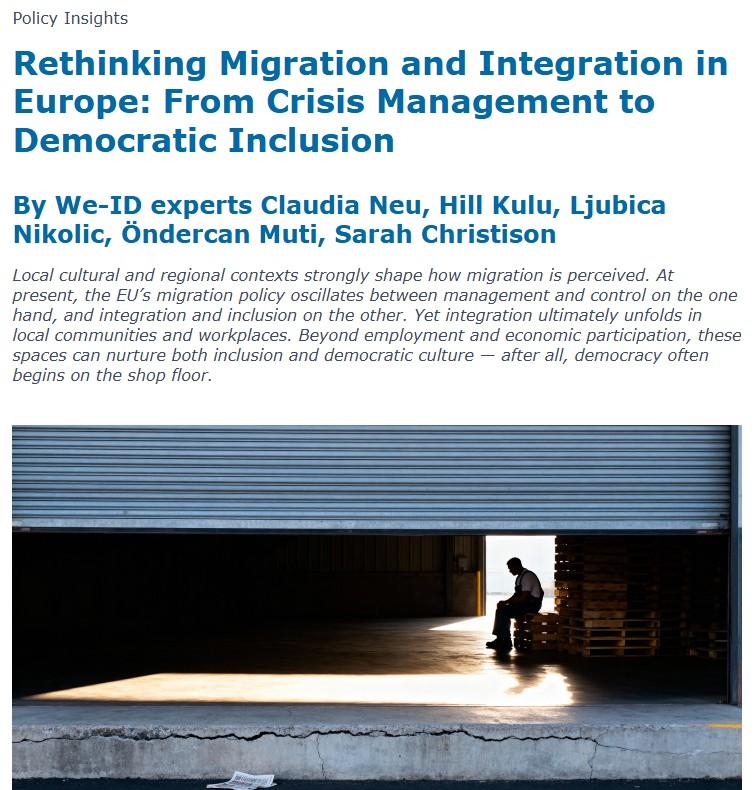
Image shows a clip of the Population Europe Policy Insight web page with the text: Policy Insights
Rethinking Migration and Integration in Europe: From Crisis Management to Democratic Inclusion
By We-ID experts Claudia Neu, Hill Kulu, Ljubica Nikolic, Öndercan Muti, Sarah Christison
Local cultural and regional contexts strongly shape how migration is perceived. At present, the EU’s migration policy oscillates between management and control on the one hand, and integration and inclusion on the other. Yet integration ultimately unfolds in local communities and workplaces. Beyond employment and economic participation, these spaces can nurture both inclusion and democratic culture — after all, democracy often begins on the shop floor.
Above an image of a person sitting on a stack of pallets inside a dim warehouse while a large metal shutter is partly open, letting sunlight spill across the floor.

Image shows a clip of the Population Europe Policy Insight web page with the text: Policy Insights Rethinking Migration and Integration in Europe: From Crisis Management to Democratic Inclusion By We-ID experts Claudia Neu, Hill Kulu, Ljubica Nikolic, Öndercan Muti, Sarah Christison Local cultural and regional contexts strongly shape how migration is perceived. At present, the EU’s migration policy oscillates between management and control on the one hand, and integration and inclusion on the other. Yet integration ultimately unfolds in local communities and workplaces. Beyond employment and economic participation, these spaces can nurture both inclusion and democratic culture — after all, democracy often begins on the shop floor. Above an image of a person sitting on a stack of pallets inside a dim warehouse while a large metal shutter is partly open, letting sunlight spill across the floor.
  • Copy link
  • Flag this post
  • Block

bonfire.cafe

A space for Bonfire maintainers and contributors to communicate

bonfire.cafe: About · Code of conduct · Privacy · Users · Instances
Bonfire social · 1.0.1 no JS en
Automatic federation enabled
Log in
  • Explore
  • About
  • Members
  • Code of Conduct