
Discussion
Loading...

#Tag

Log in
  • About
  • Code of conduct
  • Privacy
  • Users
  • Instances
  • About Bonfire
Hacker News
Hacker News
@h4ckernews@mastodon.social  ·  activity timestamp 3 weeks ago

An Orbital House of Cards: Frequent Megaconstellation Close Conjunctions

https://arxiv.org/abs/2512.09643

#HackerNews #OrbitalHouseOfCards #Megaconstellations #SpaceExploration #CloseConjunctions #AstronomyNews

arXiv.org

An Orbital House of Cards: Frequent Megaconstellation Close Conjunctions

The number of objects in orbit is rapidly increasing, primarily driven by the launch of megaconstellations, an approach to satellite constellation design that involves large numbers of satellites paired with their rapid launch and disposal. While satellites provide many benefits to society, their use comes with challenges, including the growth of space debris, collisions, ground casualty risks, optical and radio-spectrum pollution, and the alteration of Earth's upper atmosphere through rocket emissions and reentry ablation. There is substantial potential for current or planned actions in orbit to cause serious degradation of the orbital environment or lead to catastrophic outcomes, highlighting the urgent need to find better ways to quantify stress on the orbital environment. Here we propose a new metric, the CRASH Clock, that measures such stress in terms of the time it takes for a catastrophic collision to occur if there are no collision avoidance manoeuvres or there is a severe loss in situational awareness. Our calculations show the CRASH Clock is currently 2.8 days, which suggests there is now little time to recover from a wide-spread disruptive event, such as a solar storm. This is in stark contrast to the pre-megaconstellation era: in 2018, the CRASH Clock was 121 days.
  • Copy link
  • Flag this post
  • Block
Prof. Sam Lawler boosted
Dr. John Barentine FRAS
@JohnBarentine@scicomm.xyz  ·  activity timestamp 4 weeks ago

A @Nature paper published today argues that "Satellite megaconstellations will threaten space-based astronomy" https://www.nature.com/articles/s41586-025-09759-5

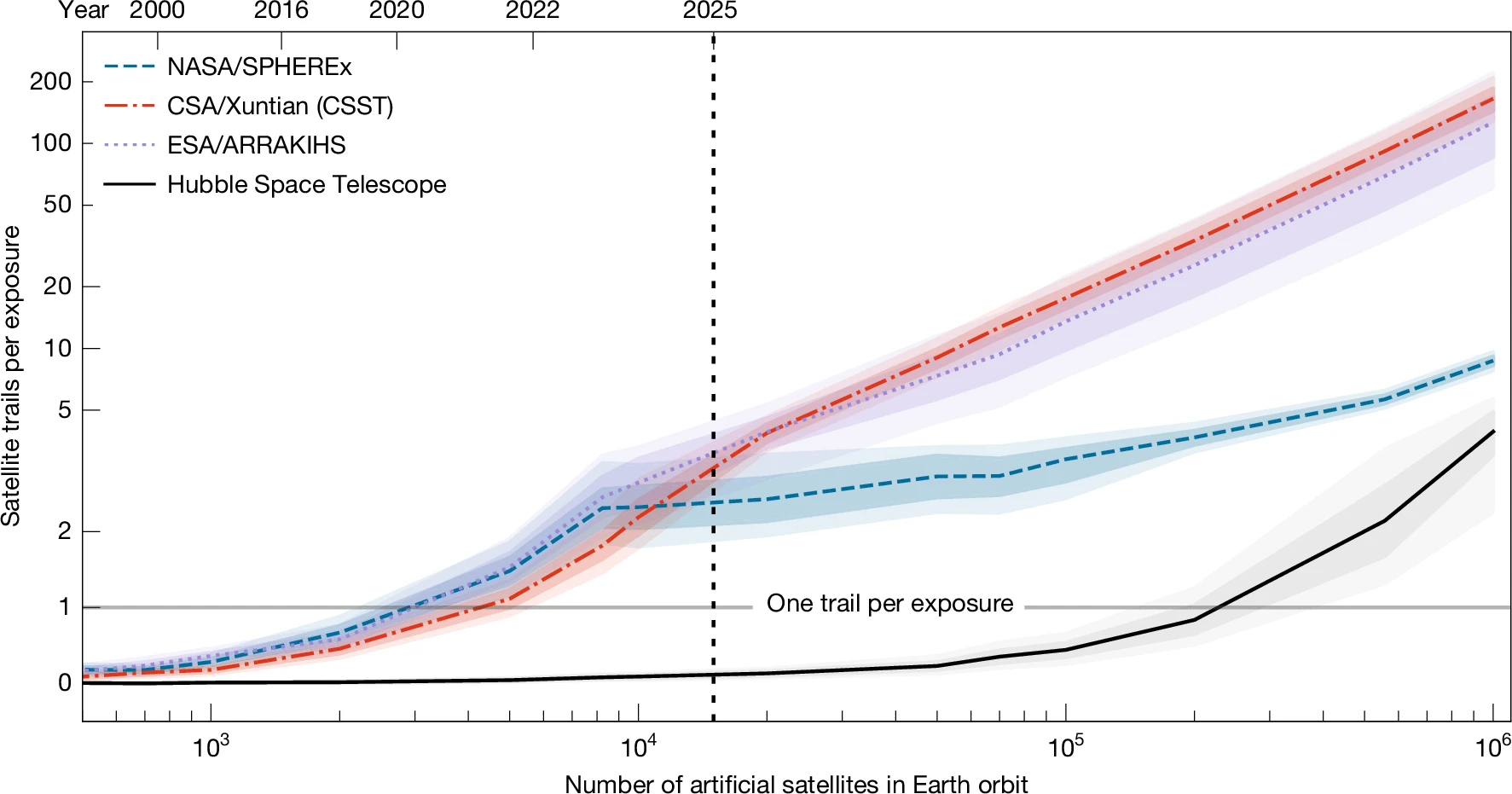
Here's the punchline of the paper: satellites could be a problem even for orbiting space telescopes, but the impact depends on how many are launched. "Our results show that if these constellations are completed, one-third of the images of the Hubble Space Telescope will be contaminated, while the SPHEREx (Spectro-Photometer for the History of the Universe, Epoch of Reionization and Ices Explorer), ARRAKIHS (Analysis of Resolved Remnants of Accreted galaxies as a Key Instrument for Halo Surveys) and Xuntian space telescopes will have more than 96% of +0.3 their exposures affected, with 5.6^+0.3_−0.3, 69^+21_−22, and 92^+11_−10 trails per exposure, respectively, with an average surface brightness of μ = 19 ± 2 mag arcsec−2."

#Astronomy #Satellites #Megaconstellations #SpaceTelescope

The average number of satellite trails visible in each exposure is shown in relation to both the number of artificial satellites orbiting Earth (lower x axis) and epoch (upper x axis). Blue, SPHEREx; red, Xuntian; purple, ARRAKIHS; black, Hubble Space Telescope. Contours represent the 95% confidence levels for the mean number of trails. Horizontal solid line indicates one trail per exposure critical contamination level; vertical dotted line marks the current number of active and inactive satellites in orbit (15,000 as of March 2025).
  • Copy link
  • Flag this post
  • Block
Dr. John Barentine FRAS
@JohnBarentine@scicomm.xyz  ·  activity timestamp 4 weeks ago

A @Nature paper published today argues that "Satellite megaconstellations will threaten space-based astronomy" https://www.nature.com/articles/s41586-025-09759-5

Here's the punchline of the paper: satellites could be a problem even for orbiting space telescopes, but the impact depends on how many are launched. "Our results show that if these constellations are completed, one-third of the images of the Hubble Space Telescope will be contaminated, while the SPHEREx (Spectro-Photometer for the History of the Universe, Epoch of Reionization and Ices Explorer), ARRAKIHS (Analysis of Resolved Remnants of Accreted galaxies as a Key Instrument for Halo Surveys) and Xuntian space telescopes will have more than 96% of +0.3 their exposures affected, with 5.6^+0.3_−0.3, 69^+21_−22, and 92^+11_−10 trails per exposure, respectively, with an average surface brightness of μ = 19 ± 2 mag arcsec−2."
#Astronomy #Satellites #Megaconstellations #SpaceTelescope

The average number of satellite trails visible in each exposure is shown in relation to both the number of artificial satellites orbiting Earth (lower x axis) and epoch (upper x axis). Blue, SPHEREx; red, Xuntian; purple, ARRAKIHS; black, Hubble Space Telescope. Contours represent the 95% confidence levels for the mean number of trails. Horizontal solid line indicates one trail per exposure critical contamination level; vertical dotted line marks the current number of active and inactive satellites in orbit (15,000 as of March 2025).
  • Copy link
  • Flag this post
  • Block

bonfire.cafe

A space for Bonfire maintainers and contributors to communicate

bonfire.cafe: About · Code of conduct · Privacy · Users · Instances
Bonfire social · 1.0.1-alpha.44 no JS en
Automatic federation enabled
Log in
  • Explore
  • About
  • Members
  • Code of Conduct