
Discussion
Loading...

#Tag

  • About
  • Code of conduct
  • Privacy
  • Users
  • Instances
  • About Bonfire
Prof. Sam Lawler boosted
Dr. John Barentine FRAS
@JohnBarentine@scicomm.xyz  ·  activity timestamp last week

A @Nature paper published today argues that "Satellite megaconstellations will threaten space-based astronomy" https://www.nature.com/articles/s41586-025-09759-5

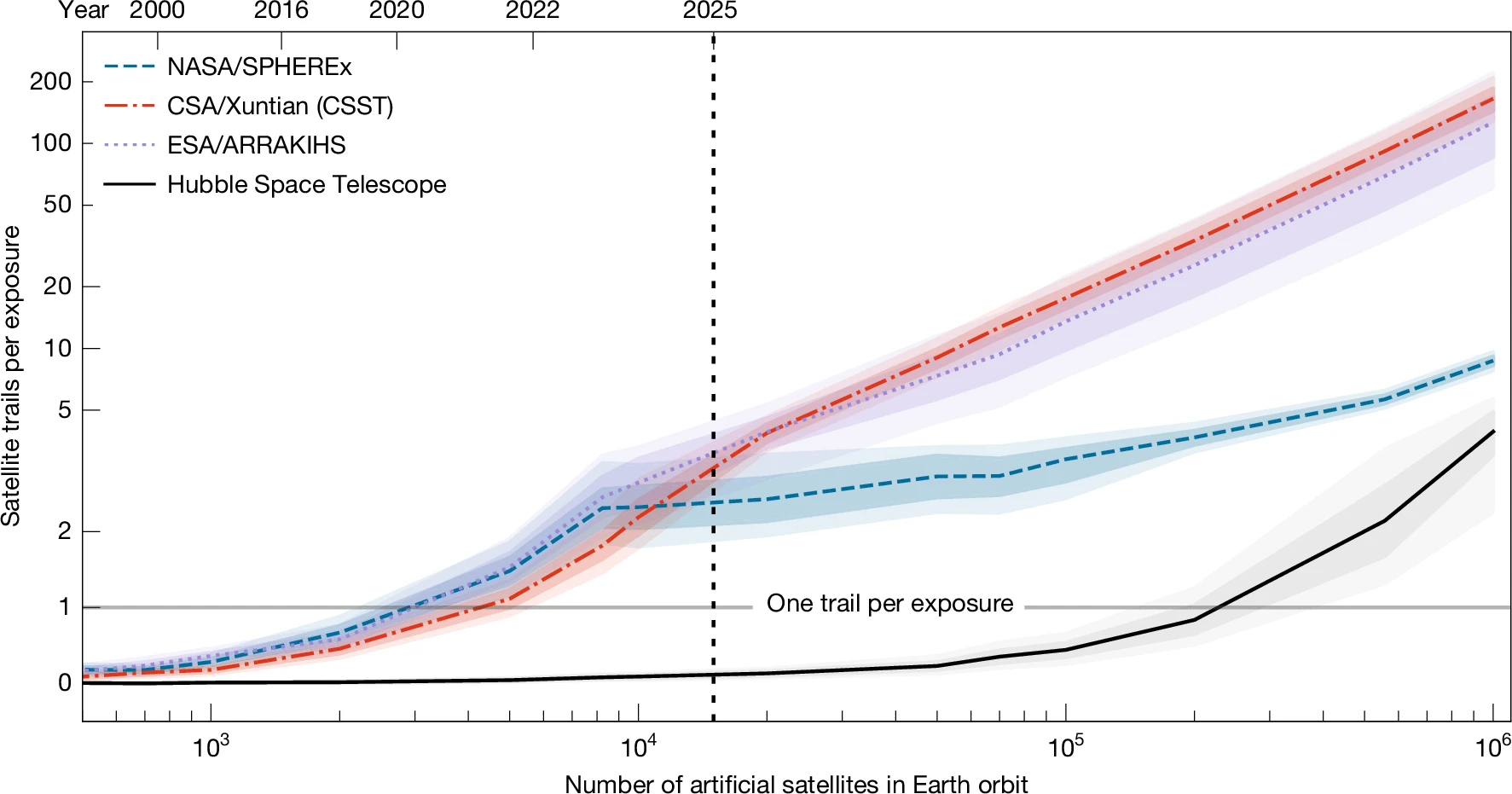
Here's the punchline of the paper: satellites could be a problem even for orbiting space telescopes, but the impact depends on how many are launched. "Our results show that if these constellations are completed, one-third of the images of the Hubble Space Telescope will be contaminated, while the SPHEREx (Spectro-Photometer for the History of the Universe, Epoch of Reionization and Ices Explorer), ARRAKIHS (Analysis of Resolved Remnants of Accreted galaxies as a Key Instrument for Halo Surveys) and Xuntian space telescopes will have more than 96% of +0.3 their exposures affected, with 5.6^+0.3_−0.3, 69^+21_−22, and 92^+11_−10 trails per exposure, respectively, with an average surface brightness of μ = 19 ± 2 mag arcsec−2."

#Astronomy #Satellites #Megaconstellations #SpaceTelescope

The average number of satellite trails visible in each exposure is shown in relation to both the number of artificial satellites orbiting Earth (lower x axis) and epoch (upper x axis). Blue, SPHEREx; red, Xuntian; purple, ARRAKIHS; black, Hubble Space Telescope. Contours represent the 95% confidence levels for the mean number of trails. Horizontal solid line indicates one trail per exposure critical contamination level; vertical dotted line marks the current number of active and inactive satellites in orbit (15,000 as of March 2025).
  • Copy link
  • Flag this post
  • Block
Dr. John Barentine FRAS
@JohnBarentine@scicomm.xyz  ·  activity timestamp last week

A @Nature paper published today argues that "Satellite megaconstellations will threaten space-based astronomy" https://www.nature.com/articles/s41586-025-09759-5

Here's the punchline of the paper: satellites could be a problem even for orbiting space telescopes, but the impact depends on how many are launched. "Our results show that if these constellations are completed, one-third of the images of the Hubble Space Telescope will be contaminated, while the SPHEREx (Spectro-Photometer for the History of the Universe, Epoch of Reionization and Ices Explorer), ARRAKIHS (Analysis of Resolved Remnants of Accreted galaxies as a Key Instrument for Halo Surveys) and Xuntian space telescopes will have more than 96% of +0.3 their exposures affected, with 5.6^+0.3_−0.3, 69^+21_−22, and 92^+11_−10 trails per exposure, respectively, with an average surface brightness of μ = 19 ± 2 mag arcsec−2."

#Astronomy #Satellites #Megaconstellations #SpaceTelescope

The average number of satellite trails visible in each exposure is shown in relation to both the number of artificial satellites orbiting Earth (lower x axis) and epoch (upper x axis). Blue, SPHEREx; red, Xuntian; purple, ARRAKIHS; black, Hubble Space Telescope. Contours represent the 95% confidence levels for the mean number of trails. Horizontal solid line indicates one trail per exposure critical contamination level; vertical dotted line marks the current number of active and inactive satellites in orbit (15,000 as of March 2025).
  • Copy link
  • Flag this post
  • Block
Alex, the Hearth Fire boosted
Picturavis
@Picturavis@pixelfed.de  ·  activity timestamp 3 weeks ago

Cat's Paw Nebula


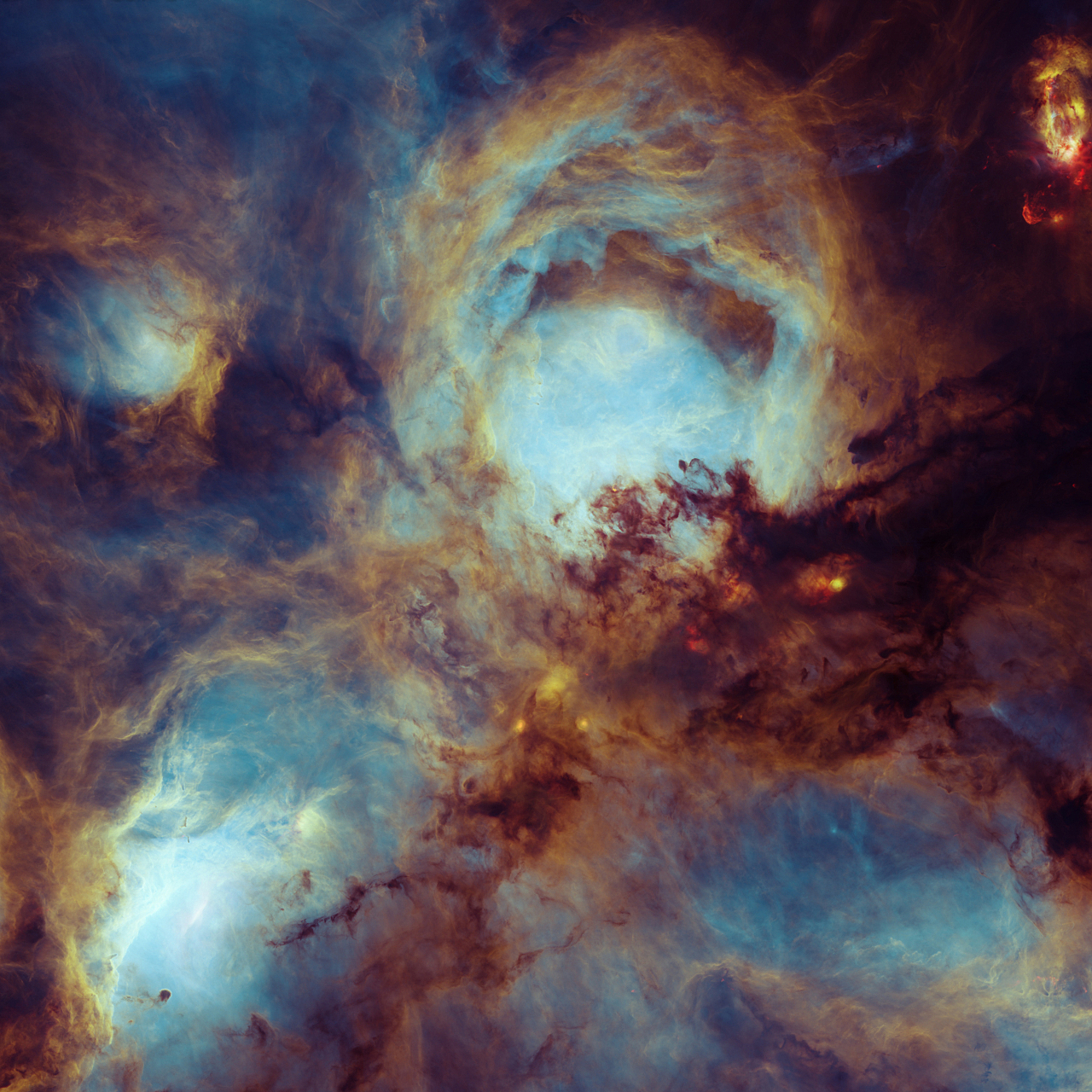
This is my attempt at the James Webb Space Telescope data of the Cat's Paw Nebula NGC 6334. Many stars were removed or oversaturated in the filter data downloaded from MAST, resulting in a lot of artifacts in the short- and long-wavelength composite images created with #Siril. I combined both images in #GIMP and tried to fix some of the artifacts. After different tries, also on the raw data, I decided to run #StarNet++ on the combined FITS file created with GIMP and then painstakingly clean the rest (felt like 10000) of the star artifacts up. I tried to stay true to the nebula by interpolating what the area behind and around the stars most likely looks like. GIMP's heal brush worked really well, but it took many hours to complete.


The full-resolution image can be seen on my website when choosing the original size in the upper right corner (warning: it is 77 MB in size): https://www.picturavis.com/picture?/391/categories


Telescope: JWST/NIRCam

Proposal ID: 6778

Observation description: NIRCam observations of a star forming nebula

Release date: 10.07.2025

Filters: F090W (blue), F187N (light blue), F200W (blue-green), F277W (yellow-green), F335M (yellow), F444W-F470N (red)


#CatsPawNebula #NGC6334 #JWST #JamesWebb #NIRCam #Nebula #SpaceTelescope #astrophotography #DeepSky #DigiKam

A surreal image of a colorful false-color space nebula photographed in infrared by the James Webb Space Telescope. There are four bright blue regions that resemble a cat's paw. They are surrounded by yellow and orange streaks, as well as darker brown areas. There are a few smaller bright yellow and red areas as well.
  • Copy link
  • Flag this post
  • Block
Picturavis
@Picturavis@pixelfed.de  ·  activity timestamp 3 weeks ago

Cat's Paw Nebula


This is my attempt at the James Webb Space Telescope data of the Cat's Paw Nebula NGC 6334. Many stars were removed or oversaturated in the filter data downloaded from MAST, resulting in a lot of artifacts in the short- and long-wavelength composite images created with #Siril. I combined both images in #GIMP and tried to fix some of the artifacts. After different tries, also on the raw data, I decided to run #StarNet++ on the combined FITS file created with GIMP and then painstakingly clean the rest (felt like 10000) of the star artifacts up. I tried to stay true to the nebula by interpolating what the area behind and around the stars most likely looks like. GIMP's heal brush worked really well, but it took many hours to complete.


The full-resolution image can be seen on my website when choosing the original size in the upper right corner (warning: it is 77 MB in size): https://www.picturavis.com/picture?/391/categories


Telescope: JWST/NIRCam

Proposal ID: 6778

Observation description: NIRCam observations of a star forming nebula

Release date: 10.07.2025

Filters: F090W (blue), F187N (light blue), F200W (blue-green), F277W (yellow-green), F335M (yellow), F444W-F470N (red)


#CatsPawNebula #NGC6334 #JWST #JamesWebb #NIRCam #Nebula #SpaceTelescope #astrophotography #DeepSky #DigiKam

A surreal image of a colorful false-color space nebula photographed in infrared by the James Webb Space Telescope. There are four bright blue regions that resemble a cat's paw. They are surrounded by yellow and orange streaks, as well as darker brown areas. There are a few smaller bright yellow and red areas as well.
  • Copy link
  • Flag this post
  • Block
Log in

bonfire.cafe

A space for Bonfire maintainers and contributors to communicate

bonfire.cafe: About · Code of conduct · Privacy · Users · Instances
Bonfire social · 1.0.1-alpha.8 no JS en
Automatic federation enabled
  • Explore
  • About
  • Members
  • Code of Conduct
Home
Login