Discussion
Loading...

#Tag

Log in
  • About
  • Code of conduct
  • Privacy
  • Users
  • Instances
  • About Bonfire
Alex, the Hearth Fire boosted
Wanderin' Weeta 馃崄
Wanderin' Weeta 馃崄
@WWeeta@flipping.rocks  路  activity timestamp 6 months ago

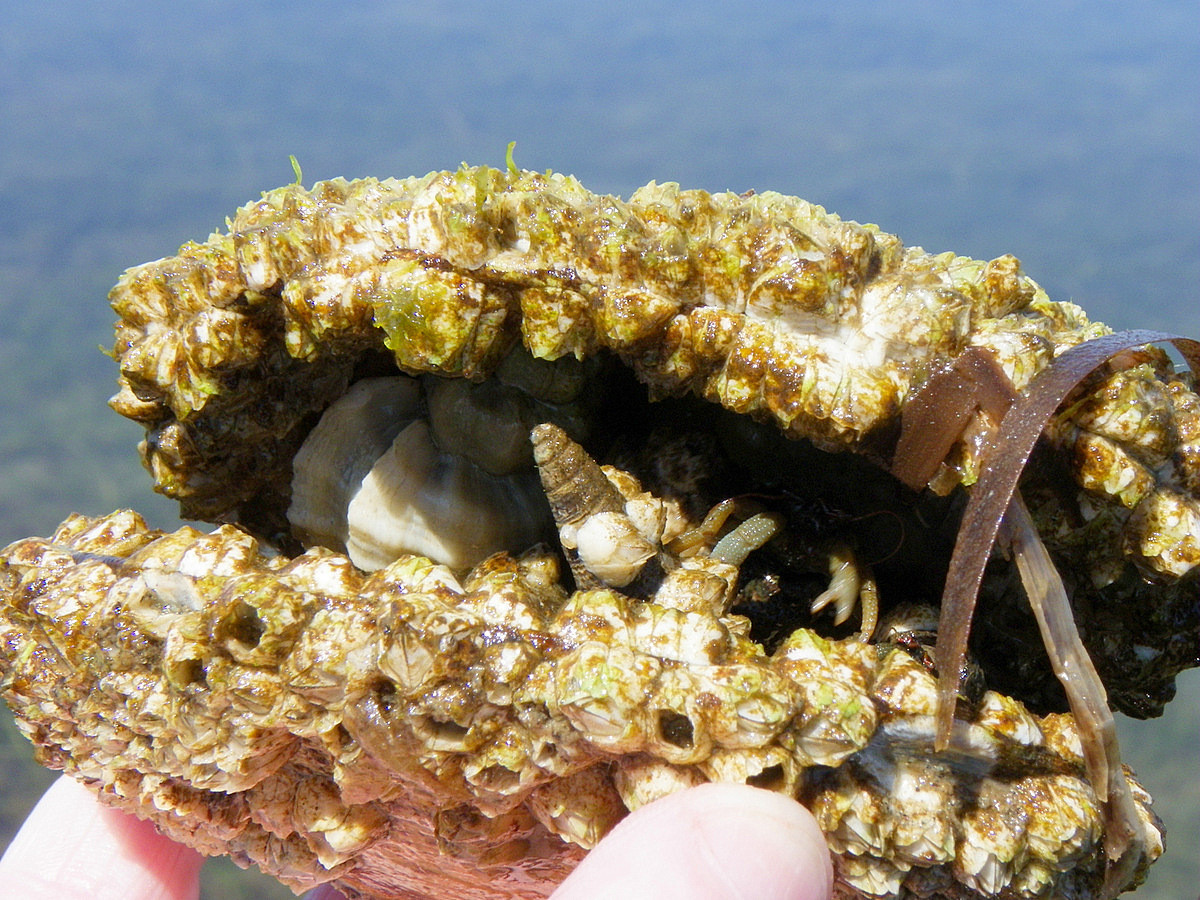
Secret shelter. I picked up an old clamshell, heavy with barnacles, and looked inside. Find the hermit! At low tide, hidden space is highly prized; 3 hermits share the space with assorted snails and worms. #VancouverIsland#HermitCrabs#IntertidalInvertebrates#Invertebrates#MarineLife#DailyHermit

A clamshell, held in my hand, with the open front facing us. The shell is completely covered, inside and out, with barnacles, which prevent the shell from either opening or closing. In the open space can be seen, left to right, a white and cream trophon snail, a mud snail with three or four barnacles on its shell, and then a leg, two chelipeds and another leg of a hermit. Next is another shell which may be holding another hermit. Behind and below these are hints of other beasties, all jammed together in the dark.
The hermit is a Grainy-Hand; the olive-green cheliped has pale blue dots, and if you look closely, you can see his orange antennae in the shadows.
(There are actually three Grainy-hand hermits here, but only one can be seen clearly. Also present; more snails, many different worms, tunicates. The clamshell was highly desirable housing.)
A couple of blades of dead eelgrass drape over the clamshell.
Background; water over a sandy beach.
A clamshell, held in my hand, with the open front facing us. The shell is completely covered, inside and out, with barnacles, which prevent the shell from either opening or closing. In the open space can be seen, left to right, a white and cream trophon snail, a mud snail with three or four barnacles on its shell, and then a leg, two chelipeds and another leg of a hermit. Next is another shell which may be holding another hermit. Behind and below these are hints of other beasties, all jammed together in the dark. The hermit is a Grainy-Hand; the olive-green cheliped has pale blue dots, and if you look closely, you can see his orange antennae in the shadows. (There are actually three Grainy-hand hermits here, but only one can be seen clearly. Also present; more snails, many different worms, tunicates. The clamshell was highly desirable housing.) A couple of blades of dead eelgrass drape over the clamshell. Background; water over a sandy beach.
  • Copy link
  • Flag this post
  • Block
Wanderin' Weeta 馃崄
Wanderin' Weeta 馃崄
@WWeeta@flipping.rocks  路  activity timestamp 6 months ago

Secret shelter. I picked up an old clamshell, heavy with barnacles, and looked inside. Find the hermit! At low tide, hidden space is highly prized; 3 hermits share the space with assorted snails and worms. #VancouverIsland#HermitCrabs#IntertidalInvertebrates#Invertebrates#MarineLife#DailyHermit

A clamshell, held in my hand, with the open front facing us. The shell is completely covered, inside and out, with barnacles, which prevent the shell from either opening or closing. In the open space can be seen, left to right, a white and cream trophon snail, a mud snail with three or four barnacles on its shell, and then a leg, two chelipeds and another leg of a hermit. Next is another shell which may be holding another hermit. Behind and below these are hints of other beasties, all jammed together in the dark.
The hermit is a Grainy-Hand; the olive-green cheliped has pale blue dots, and if you look closely, you can see his orange antennae in the shadows.
(There are actually three Grainy-hand hermits here, but only one can be seen clearly. Also present; more snails, many different worms, tunicates. The clamshell was highly desirable housing.)
A couple of blades of dead eelgrass drape over the clamshell.
Background; water over a sandy beach.
A clamshell, held in my hand, with the open front facing us. The shell is completely covered, inside and out, with barnacles, which prevent the shell from either opening or closing. In the open space can be seen, left to right, a white and cream trophon snail, a mud snail with three or four barnacles on its shell, and then a leg, two chelipeds and another leg of a hermit. Next is another shell which may be holding another hermit. Behind and below these are hints of other beasties, all jammed together in the dark. The hermit is a Grainy-Hand; the olive-green cheliped has pale blue dots, and if you look closely, you can see his orange antennae in the shadows. (There are actually three Grainy-hand hermits here, but only one can be seen clearly. Also present; more snails, many different worms, tunicates. The clamshell was highly desirable housing.) A couple of blades of dead eelgrass drape over the clamshell. Background; water over a sandy beach.
  • Copy link
  • Flag this post
  • Block
Wanderin' Weeta 馃崄
Wanderin' Weeta 馃崄
@WWeeta@flipping.rocks  路  activity timestamp 6 months ago

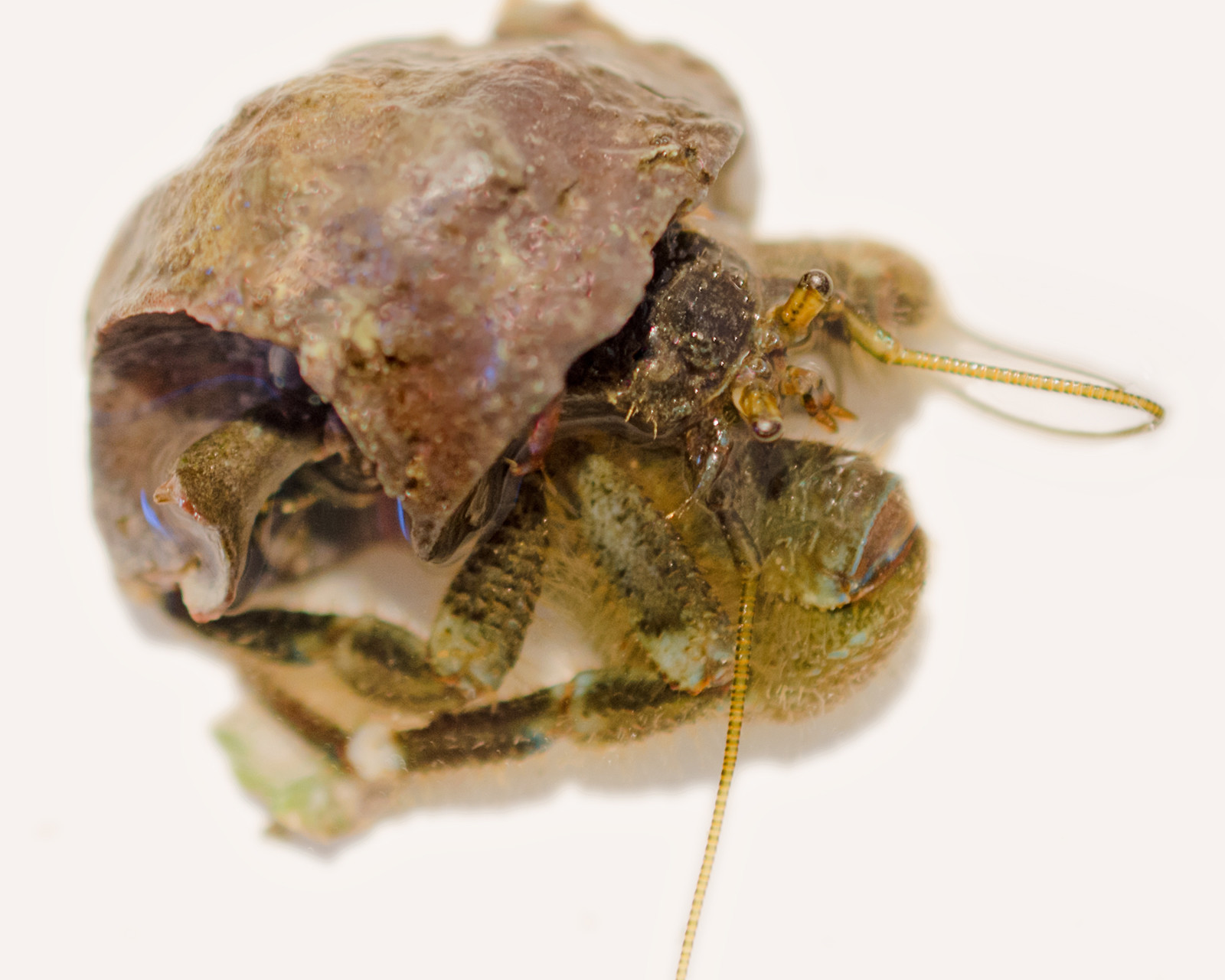
Why we leave pretty shells on the beach where we found them. Growing hermits need decent outfits to live safely. Here, a rescue Hairy waits for transfer to a tank provided with intact shells in her size. #VancouverIsland #HermitCrabs #IntertidalInvertebrates #Invertebrates #MarineLife #DailyHermit

A hermit crab in a broken shell. Only part of the first whorl remains and there is no spiral to shelter the hermit's tender abdomen. This is an older hermit; her carapace is rough and hosts small organisms. She shares the broken shell with a reddish amphipod.
The hermit is mostly green and brown; there's barely a hint of blue at the knees. The shell, what there is of it, is rough and lumpy; the central pillar projects through what would be the second spiral whorl, now without walls, and is snapped off there.
The hermit sits, for now, in a white bowl.

A word of explanation: without traumatizing a hermit, there's no way to determine the sex unless she's carrying young. And she has too much personality (and intelligence) to call her an "it". And "they/them" gets confusing in a community setting. So I alternate between calling them she and he. It's a matter of respect.
A hermit crab in a broken shell. Only part of the first whorl remains and there is no spiral to shelter the hermit's tender abdomen. This is an older hermit; her carapace is rough and hosts small organisms. She shares the broken shell with a reddish amphipod. The hermit is mostly green and brown; there's barely a hint of blue at the knees. The shell, what there is of it, is rough and lumpy; the central pillar projects through what would be the second spiral whorl, now without walls, and is snapped off there. The hermit sits, for now, in a white bowl. A word of explanation: without traumatizing a hermit, there's no way to determine the sex unless she's carrying young. And she has too much personality (and intelligence) to call her an "it". And "they/them" gets confusing in a community setting. So I alternate between calling them she and he. It's a matter of respect.
  • Copy link
  • Flag this post
  • Block

bonfire.cafe

A space for Bonfire maintainers and contributors to communicate

bonfire.cafe: About 路 Code of conduct 路 Privacy 路 Users 路 Instances
Bonfire social 路 1.0.2-alpha.7 no JS en
Automatic federation enabled
Log in
  • Explore
  • About
  • Members
  • Code of Conduct