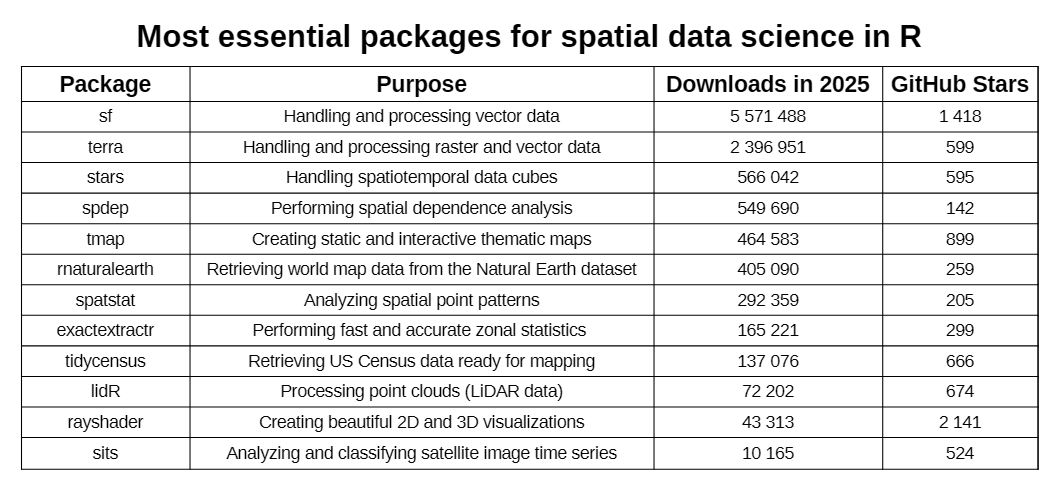
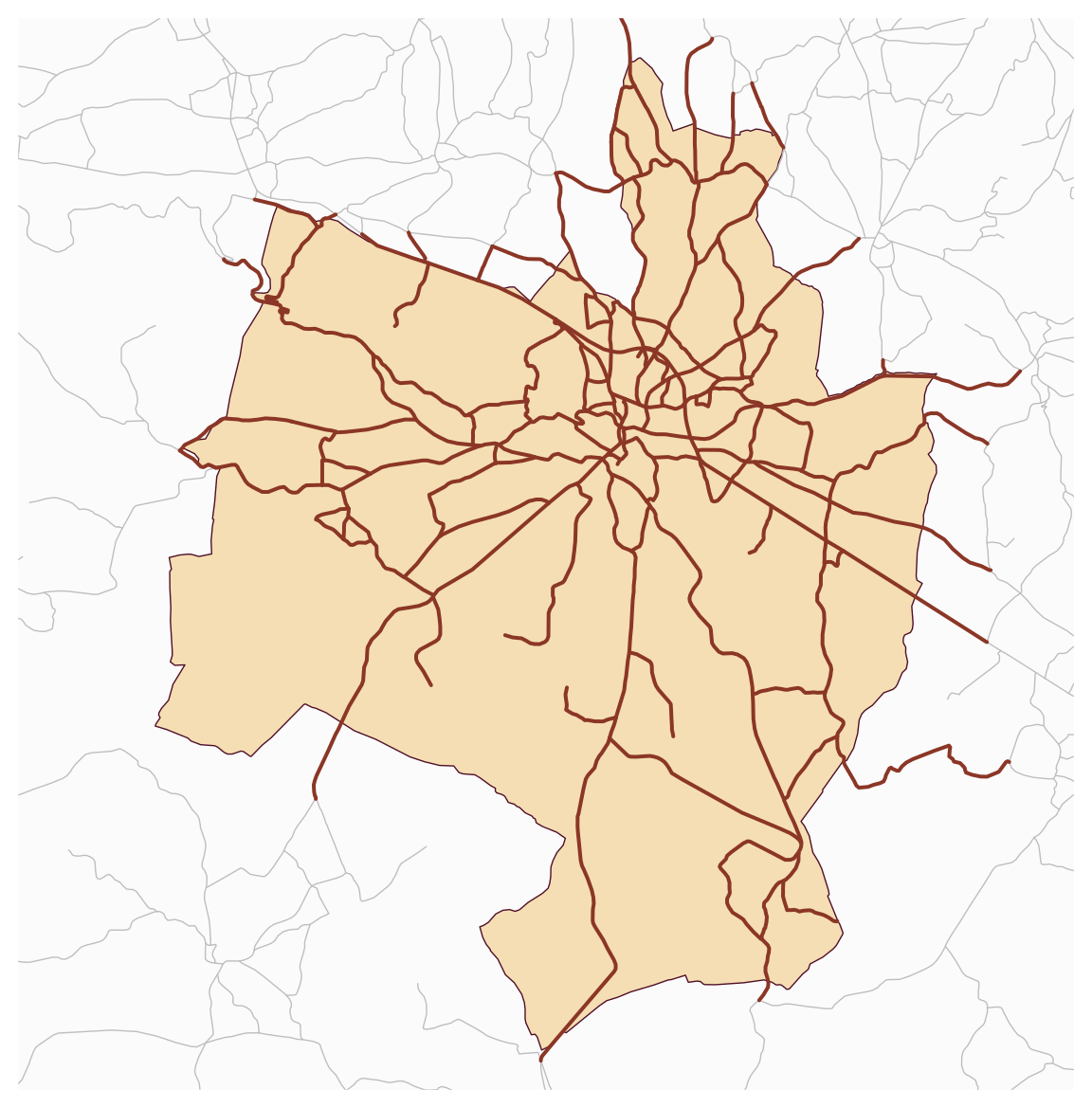
Are you interested in modern spatial data analysis and mapping? If you are looking for a way to improve your point-and-click workflow, R programming language is the perfect solution! With these powerful spatial packages, it is possible to handle the entire process in a transparent, reproducible and scalable way.
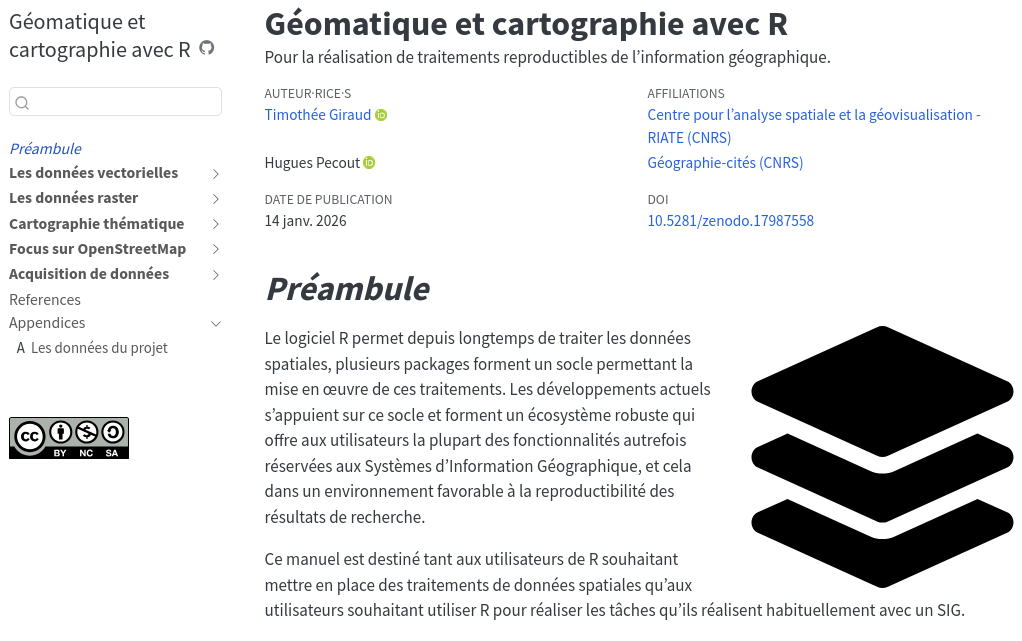
"Géomatique et cartographie avec R" has been updated!
🗺️
- Données vectorielles avec {sf}
(vector data processing)
- Données raster avec {terra}
(raster data processing)
- Cartographie avec {mapsf}
(thematic mapping)
- OpenstreetMap
This manual is in French. A lighter, slightly outdated English version is available here: https://rcarto.github.io/cartography_with_r/
"Géomatique et cartographie avec R" has been updated!
🗺️
- Données vectorielles avec {sf}
(vector data processing)
- Données raster avec {terra}
(raster data processing)
- Cartographie avec {mapsf}
(thematic mapping)
- OpenstreetMap
This manual is in French. A lighter, slightly outdated English version is available here: https://rcarto.github.io/cartography_with_r/
New version of {maplegend} ! 📦
{maplegend} is an R package for creating, well, map legends. 🙂
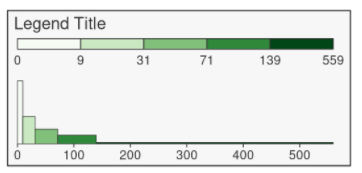
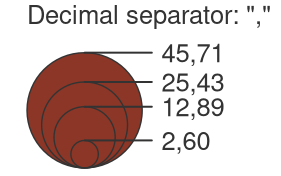
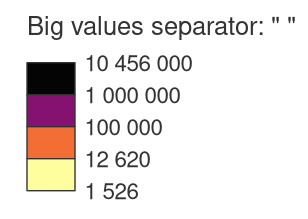
This version improves the display of legends in plots and introduces two new features: a histogram legend type, and arguments to set decimal and big value separators.
🔗 Blog post: https://rcarto.github.io/posts/maplegend_v0.4.0/
https://cran.r-project.org/web/packages/maplegend/index.html
New version of {maplegend} ! 📦
{maplegend} is an R package for creating, well, map legends. 🙂
This version improves the display of legends in plots and introduces two new features: a histogram legend type, and arguments to set decimal and big value separators.
🔗 Blog post: https://rcarto.github.io/posts/maplegend_v0.4.0/
https://cran.r-project.org/web/packages/maplegend/index.html
What are the most exciting trends you’re seeing in spatial data science lately?
Some of mine:
- New file formats (e.g. #GeoParquet)
- Geospatial DBs (e.g. #DuckDB + spatial)
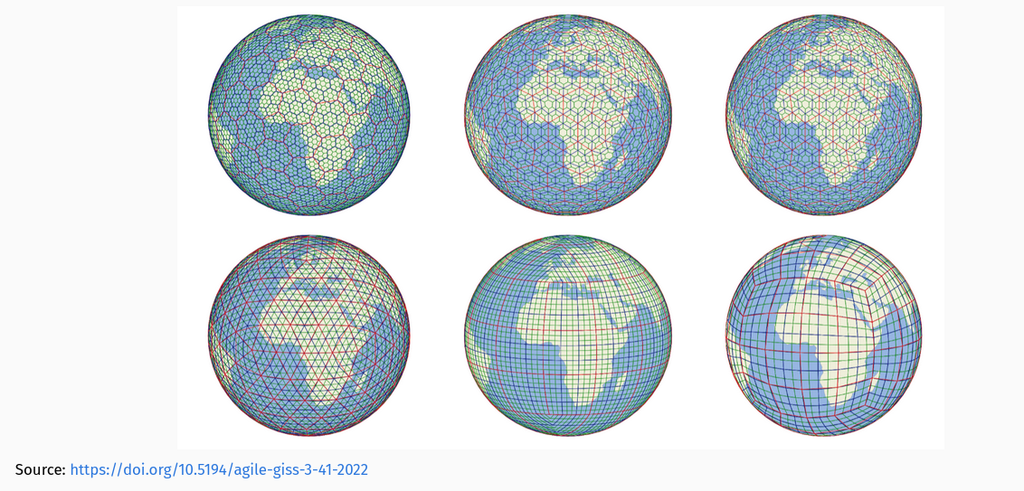
- Global discrete grids
What would you add?
What are the most exciting trends you’re seeing in spatial data science lately?
Some of mine:
- New file formats (e.g. #GeoParquet)
- Geospatial DBs (e.g. #DuckDB + spatial)
- Global discrete grids
What would you add?
How spatial sampling methods affect the variance of your mean estimate when spatial autocorrelation is present.
https://dosull.github.io/posts/2025-11-14-gia-chapter-2A-spatial-autocorrelation/
#rstats #rspatial
How spatial sampling methods affect the variance of your mean estimate when spatial autocorrelation is present.
https://dosull.github.io/posts/2025-11-14-gia-chapter-2A-spatial-autocorrelation/
#rstats #rspatial
GDAL is not only a tool for handling various geospatial data formats. The new version introduces support for many geoprocessing tools, including:
- raster algebra,
- raster reclassification,
- focal and zonal statistics,
- multi-stage pipelines,
- and much more!
Check out the details here: https://gdal.org/en/release-3.12/programs/index.html#gdal-application (note, this is still experimental).
GDAL is not only a tool for handling various geospatial data formats. The new version introduces support for many geoprocessing tools, including:
- raster algebra,
- raster reclassification,
- focal and zonal statistics,
- multi-stage pipelines,
- and much more!
Check out the details here: https://gdal.org/en/release-3.12/programs/index.html#gdal-application (note, this is still experimental).
📦 New R package: sfhotspot by Matt Ashby
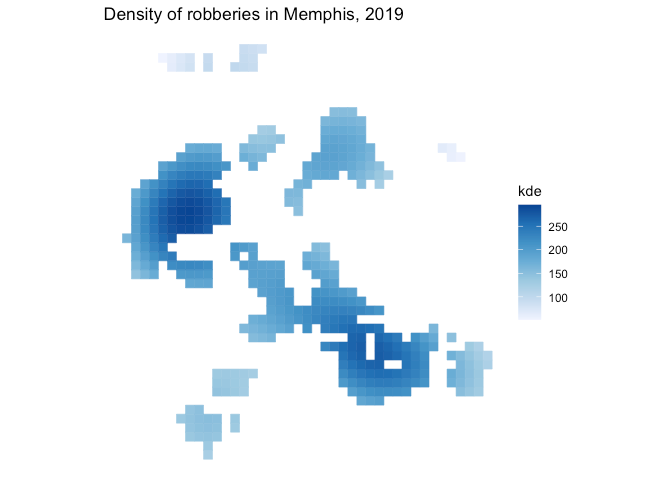
Identify & analyze spatial clusters of points (places/events) entirely with sf objects.
Includes tools for counts, change over time, kernel density, Getis–Ord Gi*, & classification.
🔗 GitHub: https://github.com/mpjashby/sfhotspot
📦 New R package: sfhotspot by Matt Ashby
Identify & analyze spatial clusters of points (places/events) entirely with sf objects.
Includes tools for counts, change over time, kernel density, Getis–Ord Gi*, & classification.
🔗 GitHub: https://github.com/mpjashby/sfhotspot
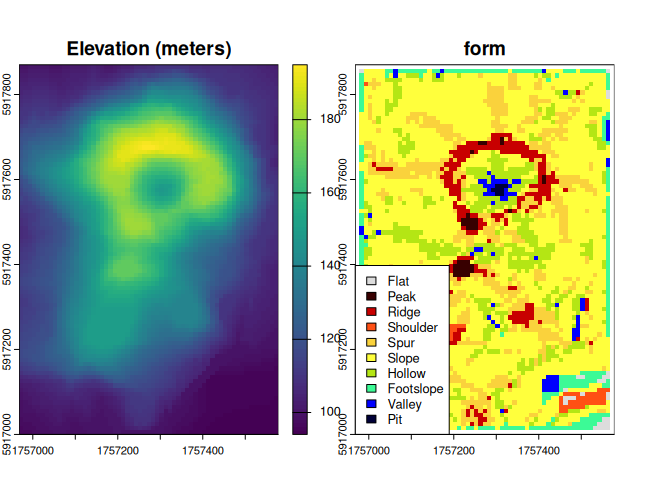
New R package: rgeomorphon 📦 by Andrew Brown
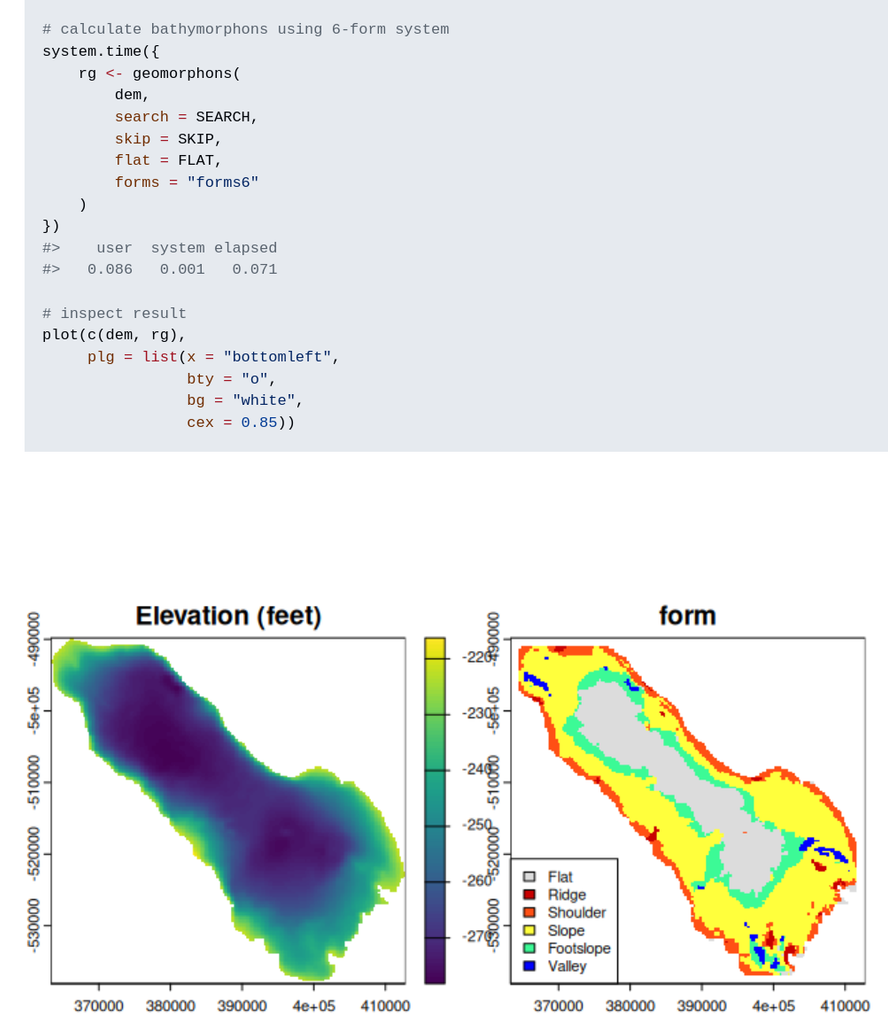
Classifies terrain forms using a parallel C++ implementation of the geomorphon algorithm.
New R package: rgeomorphon 📦 by Andrew Brown
Classifies terrain forms using a parallel C++ implementation of the geomorphon algorithm.