Discussion
Loading...

#Tag

Log in
  • About
  • Code of conduct
  • Privacy
  • Users
  • Instances
  • About Bonfire
Esther Payne :bisexual_flag: boosted
DoNoHarm BC
DoNoHarm BC
@DoNoHarmBC@zeroes.ca  ·  activity timestamp 4 days ago

Advocacy opportunity 📣 BCCDC is currently assessing BC’s wastewater surveillance program. Do the survey here: https://ubc.ca1.qualtrics.com/jfe/form/SV_5bVmczsX2GeocuO

Wastewater testing is an “early warning system” to monitor community illness levels, including surges & new variants. Clinical data (like rising hospitalizations & deaths) are lagging indicators, making wastewater monitoring an essential tool for pandemic preparedness and risk assessments. Unfortunately, BC drastically downgraded their testing program in Sept 2025 - they stopped testing a third of the wastewater treatment plants, reduced sampling to only once a week (it was previously 3 times a week), and reduced sequencing to once every two weeks.

This is our chance to let BC know:

👉 wastewater testing is essential
👉 we don’t want any more cuts
👉 we want them to improve the program!

The survey only takes a few minutes & is anonymous. You can also learn more about BC’s wastewater program here: https://www.bccdc.ca/our-services/programs/wastewater-surveillance

#PublicHealth #Covid19BC #CovidIsNotOver #RSV #influenza #AvianInfluenza #measles #mpox

Screencap from the BCCDC wastewater dashboard with a notice stating, report updated on September 18, 2025. Data is presented up to the reporting period of epi week 37 (September 7 - 13, 2025). The wastewater surveillance program has implemented some new changes starting September 11, 2025: 1) the number of wastewater treatment plants tested has been changed to eight provincewide, as opposed to previously 12 wastewater treatment plants. 2) they will now be one sample collected per wastewater treatment plant per week, as opposed to previously three samples per treatment plant per week. 3) sequencing of wastewater samples will be changed from weekly to every two weeks.
Wastewater Surveillance
Testing community wastewater provides information about the health of a community.

BCCDC Wastewater Surveillance Dashboard Evaluation Survey

The British Columbia Centre for Disease Control (BCCDC) is evaluating the provincial wastewater surveillance program. The survey will be used to understand how the BCCDC Wastewater Surveillance Dashboard is used, who is using it, and how it can be improved.
  • Copy link
  • Flag this post
  • Block
DoNoHarm BC
DoNoHarm BC
@DoNoHarmBC@zeroes.ca  ·  activity timestamp 4 days ago

Advocacy opportunity 📣 BCCDC is currently assessing BC’s wastewater surveillance program. Do the survey here: https://ubc.ca1.qualtrics.com/jfe/form/SV_5bVmczsX2GeocuO

Wastewater testing is an “early warning system” to monitor community illness levels, including surges & new variants. Clinical data (like rising hospitalizations & deaths) are lagging indicators, making wastewater monitoring an essential tool for pandemic preparedness and risk assessments. Unfortunately, BC drastically downgraded their testing program in Sept 2025 - they stopped testing a third of the wastewater treatment plants, reduced sampling to only once a week (it was previously 3 times a week), and reduced sequencing to once every two weeks.

This is our chance to let BC know:

👉 wastewater testing is essential
👉 we don’t want any more cuts
👉 we want them to improve the program!

The survey only takes a few minutes & is anonymous. You can also learn more about BC’s wastewater program here: https://www.bccdc.ca/our-services/programs/wastewater-surveillance

#PublicHealth #Covid19BC #CovidIsNotOver #RSV #influenza #AvianInfluenza #measles #mpox

Screencap from the BCCDC wastewater dashboard with a notice stating, report updated on September 18, 2025. Data is presented up to the reporting period of epi week 37 (September 7 - 13, 2025). The wastewater surveillance program has implemented some new changes starting September 11, 2025: 1) the number of wastewater treatment plants tested has been changed to eight provincewide, as opposed to previously 12 wastewater treatment plants. 2) they will now be one sample collected per wastewater treatment plant per week, as opposed to previously three samples per treatment plant per week. 3) sequencing of wastewater samples will be changed from weekly to every two weeks.
Wastewater Surveillance
Testing community wastewater provides information about the health of a community.

BCCDC Wastewater Surveillance Dashboard Evaluation Survey

The British Columbia Centre for Disease Control (BCCDC) is evaluating the provincial wastewater surveillance program. The survey will be used to understand how the BCCDC Wastewater Surveillance Dashboard is used, who is using it, and how it can be improved.
  • Copy link
  • Flag this post
  • Block
Alex, the Hearth Fire boosted
WA Department of Health
@WADeptHealth@universeodon.com  ·  activity timestamp 3 months ago

A Grays Harbor resident who was hospitalized with influenza symptoms in early November has been confirmed to have influenza A H5, a type of avian influenza. Additional testing shows the virus to be H5N5, an #AvianInfluenza virus that has previously been reported in animals but never before in humans. The Centers for Disease Control and Prevention (CDC) and DOH currently consider the risk to the public from avian influenza to be low.

https://doh.wa.gov/newsroom/h5n5-avian-influenza-confirmed-grays-harbor-county-resident

Washington State Department of Health

H5N5 Avian influenza confirmed in Grays Harbor County resident

For immediate release: November 14, 2025 (25-138) First detection of this strain in a human, risk to the public remains low Contact: DOH Communications
  • Copy link
  • Flag this post
  • Block
WA Department of Health
@WADeptHealth@universeodon.com  ·  activity timestamp 3 months ago

A Grays Harbor resident who was hospitalized with influenza symptoms in early November has been confirmed to have influenza A H5, a type of avian influenza. Additional testing shows the virus to be H5N5, an #AvianInfluenza virus that has previously been reported in animals but never before in humans. The Centers for Disease Control and Prevention (CDC) and DOH currently consider the risk to the public from avian influenza to be low.

https://doh.wa.gov/newsroom/h5n5-avian-influenza-confirmed-grays-harbor-county-resident

Washington State Department of Health

H5N5 Avian influenza confirmed in Grays Harbor County resident

For immediate release: November 14, 2025 (25-138) First detection of this strain in a human, risk to the public remains low Contact: DOH Communications
  • Copy link
  • Flag this post
  • Block
Angela Antunovic boosted
DoomsdaysCW
DoomsdaysCW
@DoomsdaysCW@kolektiva.social  ·  activity timestamp 11 months ago

How your #cat can contract #BirdFlu without seeing a bird

New data reveals unexpected infection pathways to #HouseholdPets

By Serena Summer
Feb 25, 2025

Excerpt: "The CDC report details two confirmed cases of indoor domestic cats contracting bird flu, with both felines belonging to #DairyWorkers who had previously displayed symptoms consistent with the virus. Prior to the cats becoming ill, their owners had experienced symptoms including #vomiting and #diarrhea. Although the owners declined testing for bird flu, laboratory analysis confirmed the presence of the virus in both cats, with one eventually dying from the infection.

"This finding represents a significant development in our understanding of #AvianInfluenza #transmission, as it suggests that #humans may serve as intermediary hosts capable of passing the virus to household pets. Previously, most concern centered on direct transmission from infected birds to mammals, but these cases indicate more complex transmission patterns may exist.

"The indoor setting of these infections is particularly noteworthy, as it eliminates the possibility of direct contact with infected #WildBirds, which had been considered the primary transmission route for cats in previous outbreaks."

Read more:
https://rollingout.com/2025/02/25/bird-flu-transmission-humans-cats/
#HPAINews #BirdFlu #AvianInfluenza #PetHealth #CatHealth

  • Copy link
  • Flag this post
  • Block
Clive Thompson
Clive Thompson
@clive@saturation.social  ·  activity timestamp 7 months ago

I realized I hadn't heard any news about bird flu lately

it turns out the seeming reduction in cases being reported ...

... is likely a side-effect of Trump's desire to expel immigrants

As this physician notes, most bird flu is encountered in farm work ...

... so you want to test farm workers, to figure out if it's spreading!

but farm workers now have a very good reason to avoid all authorities

The piece: https://undark.org/2025/07/10/opinion-bird-flu-emergency-end/

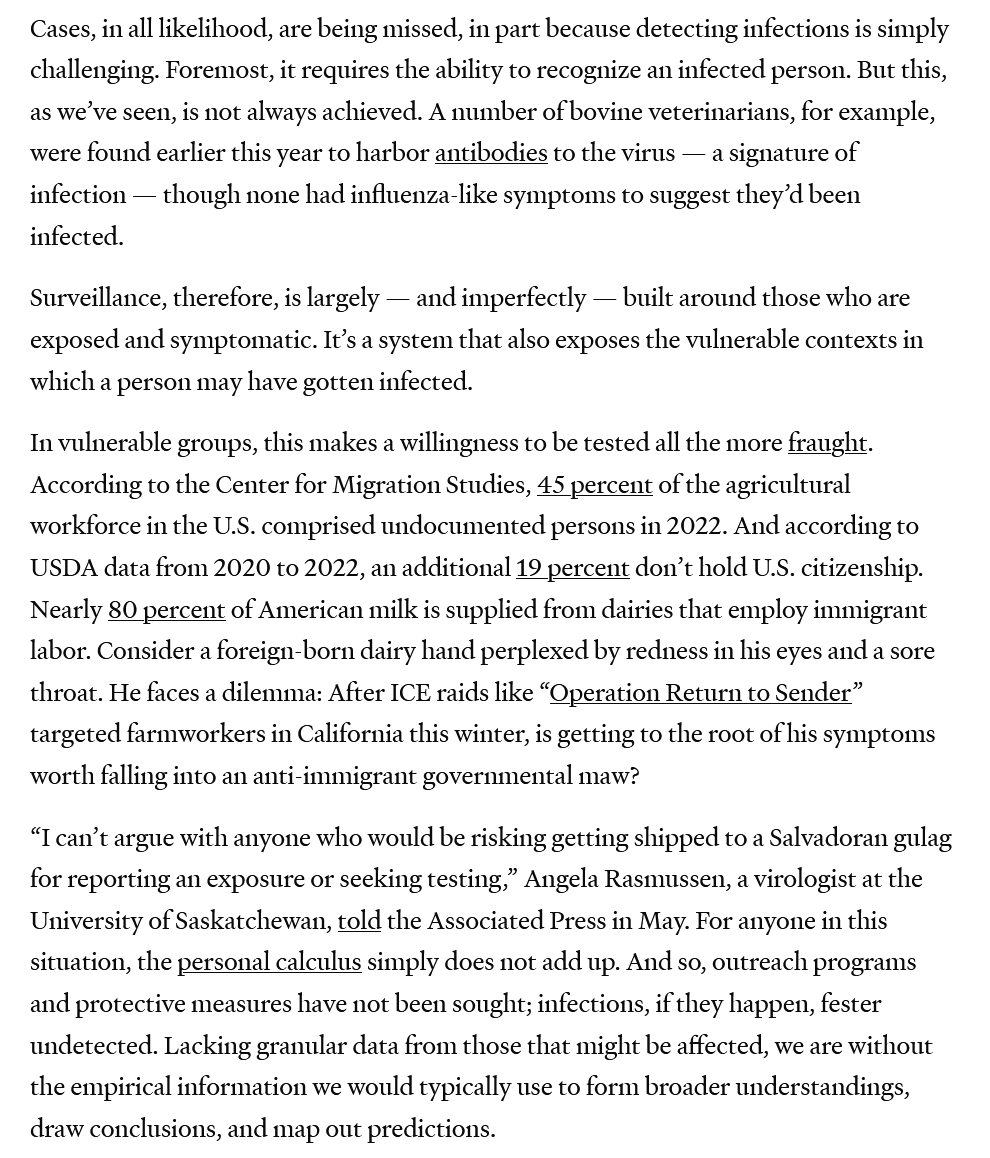
Screenshot reading: Cases, in all likelihood, are being missed, in part because detecting infections is simply challenging. Foremost, it requires the ability to recognize an infected person. But this, as we’ve seen, is not always achieved. A number of bovine veterinarians, for example, were found earlier this year to harbor antibodies to the virus — a signature of infection — though none had influenza-like symptoms to suggest they’d been infected.

Surveillance, therefore, is largely — and imperfectly — built around those who are exposed and symptomatic. It’s a system that also exposes the vulnerable contexts in which a person may have gotten infected.

In vulnerable groups, this makes a willingness to be tested all the more fraught. According to the Center for Migration Studies, 45 percent of the agricultural workforce in the U.S. comprised undocumented persons in 2022. And according to USDA data from 2020 to 2022, an additional 19 percent don’t hold U.S. citizenship. Nearly 80 percent of American milk is supplied from dairies that employ immigrant labor. Consider a foreign-born dairy hand perplexed by redness in his eyes and a sore throat. He faces a dilemma: After ICE raids like “Operation Return to Sender” targeted farmworkers in California this winter, is getting to the root of his symptoms worth falling into an anti-immigrant governmental maw?

“I can’t argue with anyone who would be risking getting shipped to a Salvadoran gulag for reporting an exposure or seeking ..."
Screenshot reading: Cases, in all likelihood, are being missed, in part because detecting infections is simply challenging. Foremost, it requires the ability to recognize an infected person. But this, as we’ve seen, is not always achieved. A number of bovine veterinarians, for example, were found earlier this year to harbor antibodies to the virus — a signature of infection — though none had influenza-like symptoms to suggest they’d been infected. Surveillance, therefore, is largely — and imperfectly — built around those who are exposed and symptomatic. It’s a system that also exposes the vulnerable contexts in which a person may have gotten infected. In vulnerable groups, this makes a willingness to be tested all the more fraught. According to the Center for Migration Studies, 45 percent of the agricultural workforce in the U.S. comprised undocumented persons in 2022. And according to USDA data from 2020 to 2022, an additional 19 percent don’t hold U.S. citizenship. Nearly 80 percent of American milk is supplied from dairies that employ immigrant labor. Consider a foreign-born dairy hand perplexed by redness in his eyes and a sore throat. He faces a dilemma: After ICE raids like “Operation Return to Sender” targeted farmworkers in California this winter, is getting to the root of his symptoms worth falling into an anti-immigrant governmental maw? “I can’t argue with anyone who would be risking getting shipped to a Salvadoran gulag for reporting an exposure or seeking ..."
David Mitchell :CApride:
@DavidM_yeg@mstdn.ca replied  ·  activity timestamp 7 months ago
@clive

With things being what they are in the US, it certainly seems possible - even likely - that the first sustained human transmission and epidemic outbreak of H5N1 in people will occur in the terrible and crowded conditions of the concentration camps - bringing together potentially infected ag workers in squalid, unsanitary conditions.

#H5N1#AvianInfluenza#Trump#MigrantWorkers

  • Copy link
  • Flag this comment
  • Block
DoomsdaysCW
DoomsdaysCW
@DoomsdaysCW@kolektiva.social  ·  activity timestamp 11 months ago

How your #cat can contract #BirdFlu without seeing a bird

New data reveals unexpected infection pathways to #HouseholdPets

By Serena Summer
Feb 25, 2025

Excerpt: "The CDC report details two confirmed cases of indoor domestic cats contracting bird flu, with both felines belonging to #DairyWorkers who had previously displayed symptoms consistent with the virus. Prior to the cats becoming ill, their owners had experienced symptoms including #vomiting and #diarrhea. Although the owners declined testing for bird flu, laboratory analysis confirmed the presence of the virus in both cats, with one eventually dying from the infection.

"This finding represents a significant development in our understanding of #AvianInfluenza #transmission, as it suggests that #humans may serve as intermediary hosts capable of passing the virus to household pets. Previously, most concern centered on direct transmission from infected birds to mammals, but these cases indicate more complex transmission patterns may exist.

"The indoor setting of these infections is particularly noteworthy, as it eliminates the possibility of direct contact with infected #WildBirds, which had been considered the primary transmission route for cats in previous outbreaks."

Read more:
https://rollingout.com/2025/02/25/bird-flu-transmission-humans-cats/
#HPAINews #BirdFlu #AvianInfluenza #PetHealth #CatHealth

  • Copy link
  • Flag this post
  • Block

bonfire.cafe

A space for Bonfire maintainers and contributors to communicate

bonfire.cafe: About · Code of conduct · Privacy · Users · Instances
Bonfire social · 1.0.2-alpha.7 no JS en
Automatic federation enabled
Log in
  • Explore
  • About
  • Members
  • Code of Conduct